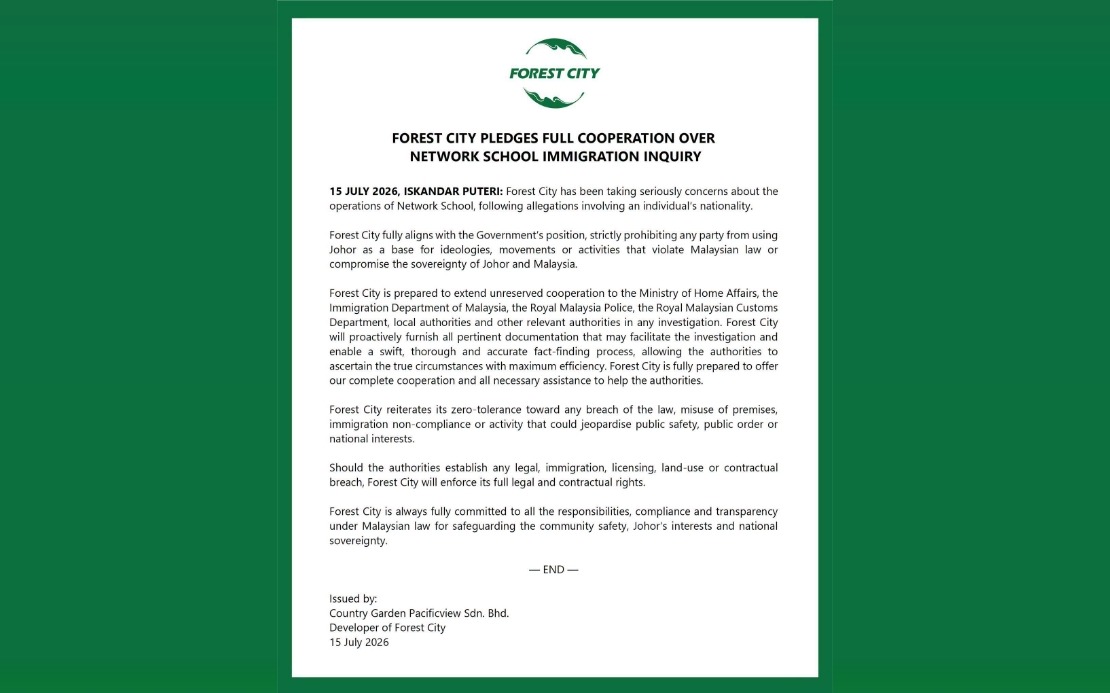
The developer of Forest City has signalled its willingness to work closely with government agencies investigating the Network School operation in Johor, which has drawn scrutiny over the reported presence of Israeli citizens on the sprawling residential and commercial project. Country Garden Pacificview Sdn Bhd issued a formal statement expressing its commitment to assisting all relevant authorities and emphasising that the matter warrants serious attention given Malaysia's longstanding position on matters relating to Israel.
Country Garden Pacificview's statement represents a measured corporate response to mounting public concern about what investigators are exploring as a potential breach of immigration protocols and national security procedures. The developer explicitly stated its alignment with the Johor state government's directive that the state should not become a platform for activities that contradict Malaysian law or compromise national sovereignty. This positioning reflects the sensitivity surrounding any connection, however tenuous, to Israeli interests or operations within Malaysian territory.
The developer's commitment extends beyond verbal assurances. Country Garden Pacificview indicated it would furnish all documentation and records necessary for a comprehensive investigation and would facilitate cooperation from relevant departments. The company also underscored its zero-tolerance approach toward legal violations, misuse of its facilities, circumvention of immigration requirements, and any actions that could endanger public safety and social stability within the Forest City development.
This investigation emerged after Johor Menteri Besar Datuk Onn Hafiz Ghazi publicly called on the Home Ministry (KDN) and allied agencies to examine Network School's operations following allegations that foreign nationals, purportedly Israeli citizens, had attended programmes at the facility. According to initial reports, these individuals may have entered Malaysia using alternative citizenship documents, raising questions about how such entries occurred and what oversight mechanisms failed to identify irregularities at the visa or customs level.
The Immigration Department (JIM) responded swiftly to the Menteri Besar's directive by conducting an extensive inspection of the Forest City development. Officials examined approximately 266 foreign nationals representing 40 different countries within the zone. Preliminary documentation checks indicated that all individuals inspected possessed valid immigration credentials, though investigators cautioned that deeper scrutiny into travel histories, visa applications, and the authenticity of submitted papers would continue as the broader probe progresses.
For Malaysia, the incident touches on several sensitive policy intersections. First, it underscores ongoing concerns about the adequacy of immigration enforcement and document verification systems, particularly regarding large residential complexes that house transient international populations. Second, it reflects the government's unwavering position that Malaysian territory and institutions cannot be leveraged for purposes that conflict with the nation's foreign policy stance or legal framework. Third, it highlights the challenge of balancing economic development—Forest City remains a significant project employing thousands—with national security and legal compliance requirements.
The Network School itself operates within Forest City, a mixed-use development that has attracted considerable international residents and businesses. The facility's reported mission involved educational programming and professional development, yet the alleged participation of Israeli nationals without proper disclosure or appropriate visa designations suggests a gap either in how the school vetted attendees or in how immigration authorities monitored entry protocols. Such lapses, if confirmed, would demand systemic corrections to prevent recurrence.
For Country Garden Pacificview, the proactive cooperation stance serves multiple purposes. It demonstrates corporate responsibility and alignment with government priorities, potentially limiting reputational damage that could affect future development approvals or foreign investor confidence. It also signals to Malaysian regulators that the developer takes its obligations seriously and will not tolerate misuse of its property. However, the company's position also reflects the reality that developers, particularly large international firms operating in Malaysia, must remain vigilant regarding tenant activities and facility usage to avoid inadvertent entanglement in regulatory or security concerns.
The broader implications for Southeast Asia are noteworthy. Malaysia's swift and visible response to the Network School matter demonstrates the region's continued sensitivity to Israeli activities and presence. The investigation also illustrates how immigration and customs systems in major commercial and residential hubs across Asia face persistent challenges in preventing document fraud, visa irregularities, and the entry of individuals under false pretences. For other ASEAN nations with comparable large-scale foreign-resident developments, the case provides a cautionary example of the need for robust inter-agency coordination and regular audits of facilities catering to international populations.
As the investigation proceeds, attention will focus on whether authorities uncover additional evidence of systematic circumvention of immigration rules, whether Network School itself knowingly facilitated irregular entries, and what administrative or legal consequences might follow for responsible parties. The involvement of multiple government agencies—KDN, JIM, the Royal Malaysia Police, customs authorities, and local municipal bodies—suggests a comprehensive approach intended to leave no stone unturned.
Country Garden Pacificview's pledged cooperation provides an institutional framework for a thorough investigation. However, the real test of that cooperation will emerge as detailed questioning progresses and investigators request specific records about tenant vetting, facility access controls, and communications with Network School management. The developer's willingness to facilitate this process may ultimately determine whether Forest City's reputation recovers from the controversy or whether lingering questions about oversight and accountability continue to dog the project.

