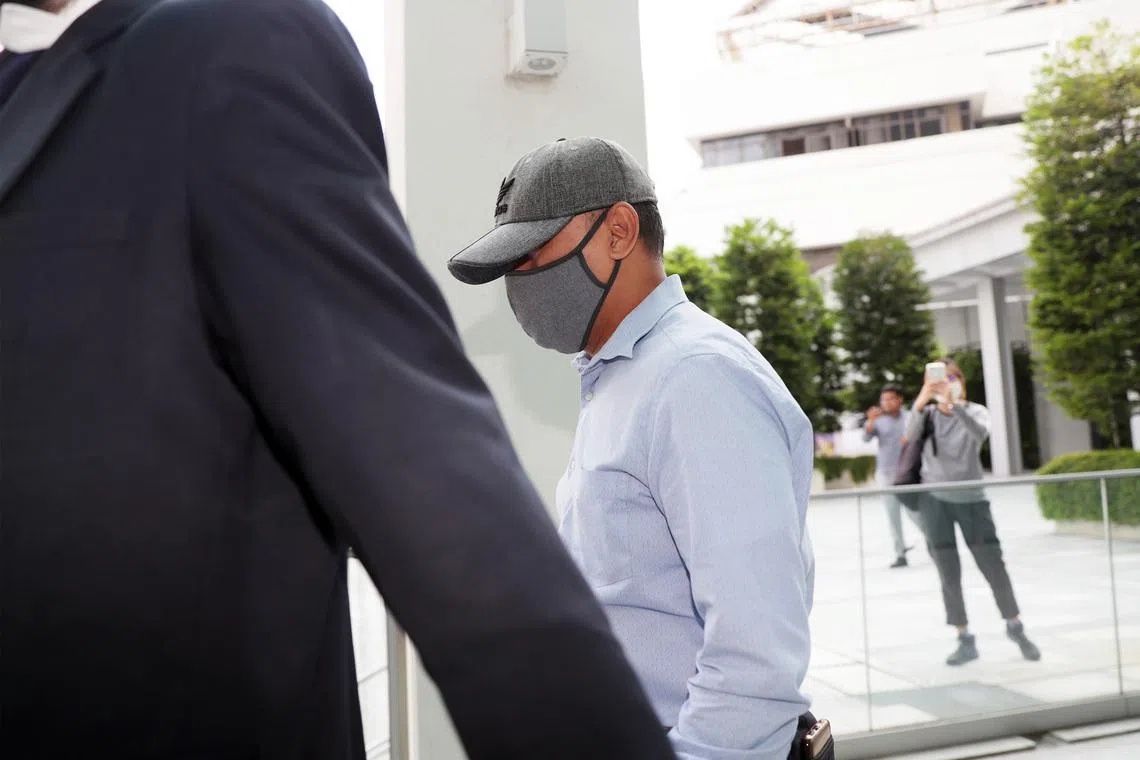
Abdul Rahim Mawasi, the former executive chairman of Darul Aman Mosque and Sallim Mattar Mosque in Singapore, has been sentenced to 14 months imprisonment following his conviction on corruption charges. The 59-year-old, who at the time of the offences was also a senior officer with the Islamic Religious Council of Singapore (MUIS), was found to have abused his position to benefit a long-standing acquaintance by providing improper pricing guidance that enabled the friend's construction company to secure lucrative contracts valued at S$223,000 from the two religious institutions.
The scheme came to light through court proceedings that revealed how Mawasi and his associate, Mohd Mustaqim Kam (also known as Kam Hock Beng), had entered into an undisclosed arrangement in mid-2018. Under their agreement, Kam would involve Mawasi in a travel company venture for pilgrimage tours without requiring any initial capital investment from Mawasi. In exchange, Mawasi committed to leveraging his official position to secure construction work from both mosques for Zeal-Con Engineering, the construction firm where Kam held directorship. The profits generated from these contracts would then be funnelled into the joint travel business as paid-up capital.
The corruption became manifest through a series of carefully orchestrated bidding activities at Darul Aman Mosque. In 2018, when the mosque sought vendors for yard construction works, Zeal-Con submitted two consecutive quotations. The initial quote submitted on 20 August 2018 was priced at S$128,600. Critically, after Mawasi's intervention and guidance on market pricing, Zeal-Con revised its bid downward to S$118,000 on 12 September. This adjusted figure undercut the second-closest competitor's offer of S$125,500, and by 26 September 2018, Zeal-Con secured the contract. The mosque's management board remained unaware that Mawasi had conducted extensive discussions with Kam regarding the bidding strategy and had provided crucial price indications that directly influenced the outcome.
A parallel pattern of misconduct unfolded at Sallim Mattar Mosque. In September 2018, Zeal-Con submitted a quotation of S$115,700 for renovation works encompassing the roof and reception areas. Months later, in July 2019, the company resubmitted a substantially reduced quotation of S$105,000 for identical works. Court evidence indicated that Mawasi had explicitly advised Kam to lower the company's quote to ensure contract award. The following month, Sallim Mattar Mosque issued letters of contract award to Zeal-Con, formalising the arrangement. Together, these two contracts represented the S$223,000 value at the centre of the corruption case.
To obscure his involvement in the venture and sidestep disclosure requirements to MUIS, Mawasi employed a deliberate concealment strategy. In November 2019, Kam converted an existing shell company into Amal Travel and Tour (ATT) and capitalised it at S$100,000 through the issuance of 100,000 shares at S$1 each. Crucially, 25,000 shares were allocated to Mawasi's son, effectively placing the beneficial ownership in the hands of a family member rather than Mawasi directly. This arrangement allowed Mawasi to benefit from the venture's profits while maintaining plausible deniability regarding his financial interest in the company. During trial proceedings, Mawasi's legal representative denied any involvement with ATT and correctly noted that his client held no shares in his own name, though this technical truth masked the underlying corrupt arrangement.
The severity of the breach extended beyond mere financial impropriety. Mawasi's conduct represented a fundamental violation of public trust, particularly given his responsibilities within MUIS, an institution entrusted with managing religious endowments and resources for community benefit. His misuse of official position to channel lucrative contracts to a favoured contractor—rewarded through undisclosed profit-sharing in a joint venture—struck at the heart of institutional integrity and fair procurement practices. The Deputy Public Prosecutor emphasised during sentencing that Mawasi had committed a serious public sector corruption offence undertaken explicitly for personal financial gain.
Mawasi's co-conspirator, Mohd Mustaqim Kam, received a comparatively lighter sentence of six months imprisonment handed down in February 2025, reflecting his slightly subordinate role in initiating the corrupt scheme. However, both men faced the consequences of their actions, with their convictions marking another instance of corruption within Singapore's public and quasi-public institutional frameworks. The prosecution successfully demonstrated through documentary evidence and testimony how the corrupt arrangement operated systematically across both mosques and evolved over an extended period.
Interestingly, the court found no evidence that Darul Aman Mosque or Sallim Mattar Mosque suffered substantial financial losses as a result of the arrangement, as Zeal-Con satisfactorily completed the contracted works. This mitigating factor did not, however, diminish the seriousness of the misconduct itself. The fact that work was adequately performed does not justify the corrupt process through which contracts were awarded, nor does it absolve Mawasi of his breach of duty and abuse of authority. Corruption cases in Asia frequently demonstrate this distinction—the absence of quantifiable harm to an institution does not negate the corrosive effect of corrupt practices on institutional credibility and public confidence.
For Malaysian observers and regional stakeholders concerned with governance standards, the case offers instructive lessons regarding institutional vulnerability to corruption even within religious and community-oriented organisations. The sophisticated concealment strategy—involving family proxies, shell company conversions, and undisclosed profit-sharing arrangements—reflects tactics employed in sophisticated corruption schemes across Southeast Asia. The fact that Mawasi held senior position within a religious council and enjoyed trust-based relationships underscores how personal networks and long-standing associations can be weaponised to bypass institutional controls and oversight mechanisms.
Mawasi's April 2025 conviction followed a full trial, suggesting the prosecution built a robust evidentiary foundation. His defence counsel sought leniency during sentencing, requesting no more than six months imprisonment and highlighting his previously unblemished record. The judge's imposition of 14 months—more than double the requested threshold—indicates judicial emphasis on the aggravating factors inherent in the case: the systematic nature of the corruption, the extended timeframe over which it operated, the deliberate concealment mechanisms employed, and the betrayal of institutional trust. Mawasi has been granted bail of S$30,000 pending the commencement of his sentence on 10 July.
The ramifications of this case extend beyond Singapore's borders, serving as a cautionary example for religious and community institutions throughout Malaysia and the broader Southeast Asian region. Procurement processes within mosques, temples, churches, and other faith-based organisations frequently operate with less rigorous oversight than government agencies, creating potential vulnerabilities. The case demonstrates how officials wielding influence over contract awards—even within non-profit or religious contexts—must maintain absolute transparency regarding personal interests, potential conflicts, and relationships with bidding parties. For institutional leaders and governance committees in Malaysia, the conviction underscores the necessity of implementing robust procurement controls, mandatory conflict-of-interest disclosures, and independent oversight mechanisms to prevent similar abuses.

