Authorities in Vietnam's northern Phu Tho province have charged four individuals in connection with a scheme to transplant a foreign-controlled online fraud operation from Cambodia into Vietnamese territory, marking another significant enforcement action in the region's escalating battle against transnational cybercrime. The investigation reveals how criminal networks are responding to intensified law enforcement pressure in Cambodia by attempting to shift their infrastructure across borders, a pattern that underscores the fluid and adaptive nature of organised digital fraud in Southeast Asia.
The operation centred on Zhao Wei Zhong, a 37-year-old Chinese national who police say entered Vietnam under instructions from an overseas handler. His primary mission was logistical: to secure suitable housing, identify safe locations, and establish the groundwork necessary to accommodate an anticipated wave of workers from fraudulent call centres based in Cambodia. This preparation phase, before the full team arrived, gave investigators the window they needed to identify and dismantle the network before it could become fully operational on Vietnamese soil.
Zhao's criminal credentials were well-established long before his arrival in Vietnam. Police records indicate he had previously worked within Chinese-managed scam operations in Cambodia, where he accumulated both expertise in fraud operations and crucial personal connections. It was through these prior associations that he met two Vietnamese nationals who would become instrumental to his Vietnamese scheme: Tran Thi Thu Huong, 24, and Dình Nam, 27, both from Bac Ninh province in the north. These individuals represented the crucial bridge between Zhao's foreign network and the local knowledge necessary to execute the relocation successfully.
The division of labour was carefully structured. Huong and Nam were assigned practical, ground-level responsibilities: translation services to communicate with incoming Cambodian and Chinese workers, transportation logistics to move people and equipment, and reconnaissance missions to identify suitable safe houses and operational venues across Vietnamese territory. These supporting roles were essential to the broader scheme, as foreign operatives would require trusted Vietnamese intermediaries to navigate local systems, obtain necessary facilities, and avoid detection from authorities unfamiliar with proper channels and regulations.
Beyond the trio, investigators identified Nguyen Thanh Long, a 43-year-old based in Hanoi, as providing critical logistical coordination for the operation. Long's contribution involved arranging the practical necessities that would enable the scam centre to function once established, including identifying suppliers, coordinating deliveries, and managing the day-to-day operational infrastructure. His role demonstrates how even relatively modest-level participants in transnational fraud networks—those not directly executing scams but merely facilitating their movement—remain essential to the criminal enterprise.
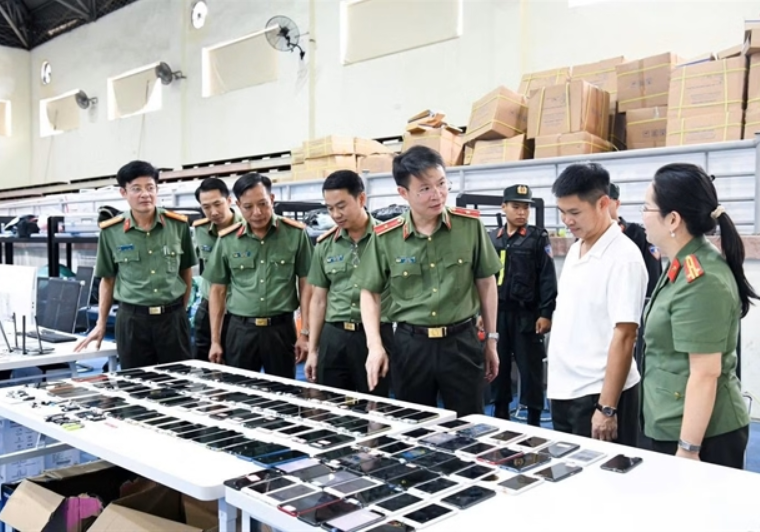
The equipment seized at properties connected to the suspects provides concrete evidence of the scale and sophistication intended for the operation. Police recovered 73 computers, 134 mobile phones, 34 USB drives, and 20 Wi-Fi routers, along with additional unspecified technical apparatus designed for the scam call centre. This substantial hardware cache suggests the operation was envisioned as a major installation, likely capable of handling dozens of concurrent fraudulent interactions with victims across multiple countries. The technology inventory indicates this was not a small-scale, improvised venture but rather a professional relocation of an established criminal infrastructure.
On June 17, authorities in Phu Tho filed formal charges against Zhao, Huong, and Long for organising the illegal stay of foreign nationals in Vietnam, a charge that carries serious implications for immigration law violations and conspiracy. All three were ordered held in pretrial detention, reflecting the prosecution's assessment of flight risk and the severity of the alleged offences. Dình Nam faced identical charges but received more lenient treatment: he was placed under a movement restriction order rather than detained in custody, a distinction that may reflect his lower-level involvement or cooperation with investigators.
The successful dismantling of this operation before personnel transfers could occur represents a significant tactical victory for Vietnamese law enforcement in combating transnational organised crime. Had the scheme progressed to its operational stage, investigators note the scam centre would likely have become fully functional on Vietnamese soil, enabling criminal networks to continue targeting victims globally while exploiting Vietnamese territory as a base of operations. The timing of the police intervention—during the preparatory phase rather than after establishment—maximised the disruption to the broader criminal network.
This case illuminates the broader challenge facing Southeast Asian governments as criminal syndicates respond to enforcement pressure by shifting operations across borders. Cambodia's intensified crackdowns on online fraud operations have proven effective in making that jurisdiction increasingly inhospitable for scam centres, yet they have simultaneously created incentive structures for networks to relocate rather than cease operations entirely. Vietnam, with its educated workforce, reliable infrastructure, and relative proximity to Cambodia, became an attractive alternative destination. The fact that authorities detected and disrupted this relocation attempt demonstrates Vietnam's growing capacity to identify and intercept transnational criminal movements, though the underlying dynamics—organised networks seeking new jurisdictions—will likely persist absent regional cooperation and harmonised enforcement strategies.
The involvement of Chinese nationals in coordinating and planning the operation reflects the well-documented role of Chinese crime syndicates in Southeast Asian online fraud ecosystems. These networks leverage language skills, technical expertise, and established logistical capabilities to operate across the region, often recruiting local assistance to navigate jurisdictional boundaries and cultural factors that might otherwise impede their activities. The reliance on Vietnamese nationals for translation and local knowledge reveals how transnational criminal enterprises function through hybrid structures combining foreign expertise with indigenous partnerships.
For Malaysian authorities and citizens, this case carries instructive implications. Malaysia itself has become both a transit point and a destination for similar cross-border criminal schemes, with evidence of scam operations either based domestically or using Malaysian infrastructure to target victims. The methodical approach demonstrated by Vietnamese police—identifying preparation phases, tracking equipment procurement, and intercepting operations before full activation—provides a model for regional enforcement cooperation. Additionally, the case underscores the necessity for strengthened information sharing between ASEAN nations regarding transnational fraud networks, as these organisations deliberately exploit the gaps and jurisdictional boundaries that separate national law enforcement systems.

