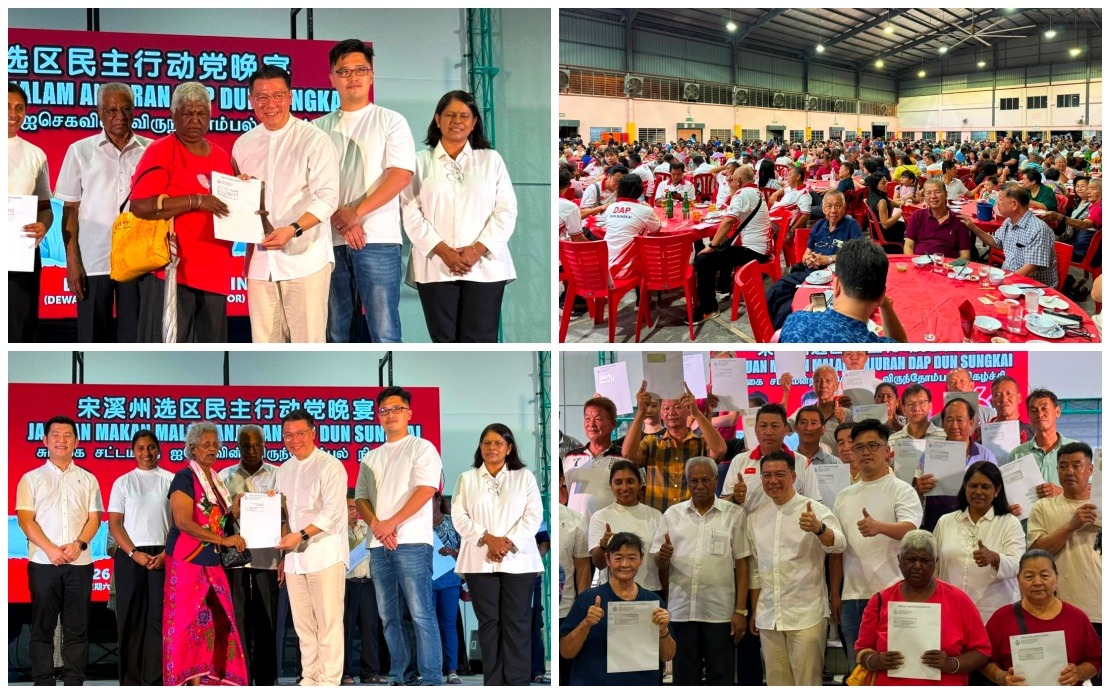
Housing and Local Government Minister Nga Kor Ming announced on August 8 that 120 families living as squatters in the Sungkai and Kuala Bikam areas of Perak have finally secured formal land ownership through government grants. The resolution marks the conclusion of a decades-long dispute that had left these communities in legal limbo since the early 1980s, unable to formally own their homes or plan for long-term stability. The land grants ceremony took place during a DAP Sungkai constituency anniversary dinner attended by more than 1,200 community members, underscoring the significance of the occasion for the local population.
Nga characterised the resolution as emblematic of the MADANI Government's stated philosophy of inclusive development. He emphasised that the initiative demonstrated the administration's commitment to advancing the interests of all citizens, regardless of ethnicity or socioeconomic standing. The minister framed the settlement not merely as a bureaucratic achievement but as a transformative moment for recipients and their descendants, suggesting that formal land ownership would provide the foundation for generational wealth accumulation and improved living standards. The symbolic weight of presenting physical grants to families who have lived in precarity for four decades reflected broader messaging around the government's people-first agenda.
The minister extended specific recognition to Sungkai assemblyman Datuk A. Sivanesan, crediting both the elected representative and civil service machinery with the persistence required to untangle a complex administrative matter. Sivanesan, who chairs the state's Human Resources, Health, Indian Community Affairs and National Integration Committee, had evidently championed the cause within state structures. The acknowledgment of bureaucratic effort highlighted how long-standing land disputes often require coordination across multiple government agencies and levels, from local land offices to state authorities. Such recognition also subtly reinforced that the current administration prioritises follow-through on historical grievances that previous governments may have shelved.
Beyond the immediate land grants, Nga outlined complementary investments targeting the Indian community, a demographic that represents a significant portion of Sungkai's population. The government has allocated RM20 million for improvements to Indian settlements more broadly, RM50 million for Tamil vernacular schools, and increased the Malaysian Indian Transformation Unit budget to RM150 million. These figures, presented together, suggested a coordinated policy approach rather than isolated gestures. For Malaysian readers, particularly those familiar with historical patterns of communal neglect, such allocations carry weight as indicators of whether pledges of equitable governance translate into measurable resource distribution. The timing and scale of these announcements, concentrated around the land grants event, amplified their political messaging value.
Nga's rhetoric pivoted toward a critique of identity-based politics, urging citizens to evaluate government performance on substance rather than emotional or divisive appeals. He argued that Malaysia requires a politics rooted in measurable outcomes, unity, and development rather than what he termed outdated, divisive approaches. This framing reflects an ongoing tension within Malaysian politics between administrative delivery and identity-based mobilisation, a contest that shapes electoral outcomes and policy priorities. For the MADANI coalition, demonstrating tangible improvements in communal welfare serves both as genuine policy objective and as political counter-narrative against opposition parties that might emphasise grievance narratives.
The gathering itself embodied inclusive representation. Multiple DAP legislators attended—Ipoh Timur MP Howard Lee Chuan How, Buntong assemblyman M. Thulsi, Malim Nawar assemblywoman V. Bavani, and Astaka assemblyman Jason Ng Thien Yong—alongside local community leaders. The multi-ethnic slate of attendees and the emphasis on DAP's 60-year institutional presence in Sungkai reinforced the ruling coalition's claim to represent diverse constituencies. For Malaysian observers, the composition of such events often signals which communities feel enfranchised within electoral politics and which remain marginalised, making the deliberate inclusion of Indian community representatives and leaders strategically significant.
The Sungkai constituency itself carries political weight in Perak state politics. As a traditionally stronghold area, the resolution of a longstanding grievance in this particular location strengthens the incumbent coalition's standing ahead of electoral cycles. The strategic timing of such announcements—concentrated in electoral-sensitive constituencies—is a recognised feature of Malaysian political practice. However, the substance of the land grants programme, if genuinely implemented and maintained across cohorts, would represent meaningful improvement in living standards regardless of electoral calculus.
For Malaysian readers in similar situations, the resolution offers both hope and a template. Across Malaysia, informal settlements and disputed tenure situations persist in various states, affecting hundreds of thousands of people. The Sungkai outcome demonstrates that such issues can be resolved through sustained advocacy, administrative reform, and political will. However, it also illustrates the considerable time horizon required—four decades passing before resolution suggests that even sympathetic governments face institutional inertia and competing budgetary pressures. The lesson for residents in unresolved settlements may be that persistence and organised community representation, coupled with electoral pressure in competitive constituencies, can eventually yield results.
The broader regional context matters as well. Southeast Asia contains numerous informal settlement populations facing similar tenure insecurity, particularly in rapidly urbanising areas. Malaysia's approach to resolving historical grievances through formalization and grants-based programmes offers a model that other nations might study, though implementation capacity and political will vary considerably across the region. The MADANI Government's emphasis on not leaving Malaysians behind, repeated throughout Nga's remarks, positions land security as integral to the administration's legitimacy and competitive positioning against alternatives.
Looking forward, the critical test will be whether these land grants translate into genuine ownership security, access to credit and services, and improved living conditions for recipients. Formal titling, while essential, represents only the initial step toward full integration into formal property markets and institutional systems. If the government simultaneously invests in infrastructure, schooling, healthcare, and economic opportunities in these newly regularised settlements, the initiative could serve as a model for addressing chronic development gaps. Conversely, if grants are issued without complementary investments, the symbolic value may exceed practical impact. The MADANI Government's credibility on its inclusive development narrative depends significantly on such follow-through.

