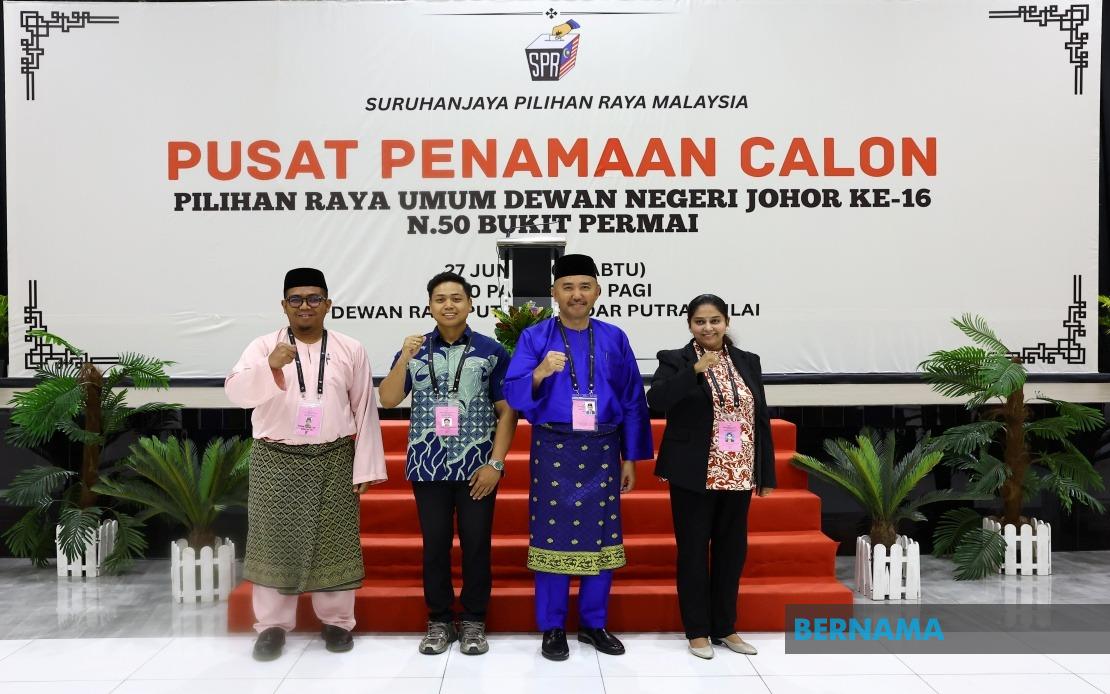
Incumbent Bukit Permai state assemblyman Datuk Mohd Jafni Md Shukor of Barisan Nasional (BN) is set for a competitive battle to retain his seat in the 16th Johor state election, facing opposition from three rival candidates representing major political coalitions and a newer political movement. The confirmation came on June 27 when the returning officer formally announced the final slate of contestants after the nomination process concluded in Batu Pahat.
Mohd Jafni's challengers represent a diverse political spectrum. Mohamad Shafwan Ani carries the colours of Pakatan Harapan (PH), the major opposition coalition, while M. Lina Manoh stands as the Perikatan Nasional (PN) candidate. The fourth contender, Muhammad Aidil Riduan Mohd Yusof, represents Parti Bersama Malaysia (Bersama), a newer political entity seeking to establish itself in peninsular Malaysian politics. The returning officer, Afzan Azhari, unveiled the candidate list at the nomination centre located at Dewan Raya Putra in Bandar Putra following the close of the nomination window at 10 am.
The presence of Johor DAP chairman Teo Nie Ching at the nomination centre early in the morning, arriving at 8.26 am to accompany Mohamad Shafwan, underscores the significance that the Opposition places on this particular contest. Such high-level political accompaniment typically signals competitive constituencies where coalitions believe they have genuine prospects of making gains.
Historical performance provides context for assessing the race ahead. In the previous Johor state election held in 2022, Mohd Jafni emerged victorious in a similarly contested four-cornered battle, securing the seat with a majority of 4,755 votes. This previous margin offers both a benchmark and a challenge—it demonstrates he can win in a crowded field, yet also suggests the seat remains competitive enough to attract multiple serious challengers. The fact that the 2024 contest again features four candidates indicates that opposition parties and alternative political movements continue to view Bukit Permai as winnable territory.
The Bukit Permai constituency sits within the broader Batu Pahat district in Johor, Malaysia's southern state and historically a significant political battleground. State assembly elections in Johor carry considerable weight as they directly influence the composition of the state government and determine which coalition will form the state administration. For BN, holding such seats is crucial to maintaining dominance in a state it has traditionally controlled. For PH, every seat represents an opportunity to chip away at government majorities and demonstrate growing support in traditional BN strongholds.
Peikatan Nasional's participation in this contest reflects the coalition's broader strategy to contest Johor elections despite the state's historical alignment with BN. PN brings together PAS and Bersatu, with the latter party having roots among former UMNO members who departed during internal party upheaval. The presence of a fourth candidate from Bersama introduces an additional variable that could fragment votes in unpredictable ways, potentially benefiting whichever faction achieves the highest consolidation of support.
The timeline for the election process has been set by the Election Commission with precision. Early voting will take place on July 7, accommodating those unable to vote on the main polling day. The official polling day is scheduled for July 11, giving candidates and their campaigns roughly two weeks from the nomination closure to mount their campaigns, conduct grassroots outreach, and persuade voters. In the Malaysian electoral context, this compressed timeline places premium value on existing ground organization, party machinery, and voter familiarity with candidates.
For Malaysian and Southeast Asian observers, the Bukit Permai race exemplifies several broader trends in Malaysian politics. The persistence of four-cornered contests reflects the fragmentation and fluidity of the political landscape, where no single coalition commands unanimous support even within its traditional base areas. The involvement of newer entities like Bersama alongside established major coalitions demonstrates the continued dynamism and openness of Malaysian electoral competition. Furthermore, the active participation of high-level opposition figures like Teo Nie Ching illustrates how state elections serve as crucial proving grounds for both government and opposition strategies.
The demographic and socioeconomic composition of Bukit Permai, while not detailed in official announcements, typically influences the campaign messaging and candidate selection. Johor's southern districts like Batu Pahat encompass both urban and semi-rural areas, with constituencies reflecting the state's mix of manufacturing, agriculture, commerce, and small-scale enterprises. This composition means candidates must address concerns ranging from urban infrastructure and education to agricultural support and rural development.
Mohd Jafni's task involves defending not just a seat but a demonstrated track record of electoral success in a contested environment. His ability to secure victory two years ago in a four-cornered fight suggests effective constituent service, organizational capacity, and political acumen. However, political conditions have shifted since 2022, with various developments at federal and state levels potentially altering voter sentiment and coalition dynamics throughout Johor.
For opposition parties, the strategic importance of races like Bukit Permai extends beyond immediate seat gains. Every constituency represents an opportunity to build momentum, test campaign messages, and establish footholds in areas where they seek expansion. PH's involvement through strong representation and high-level support indicates they view this as a competitive battleground worthy of serious investment of party resources and leadership attention.

