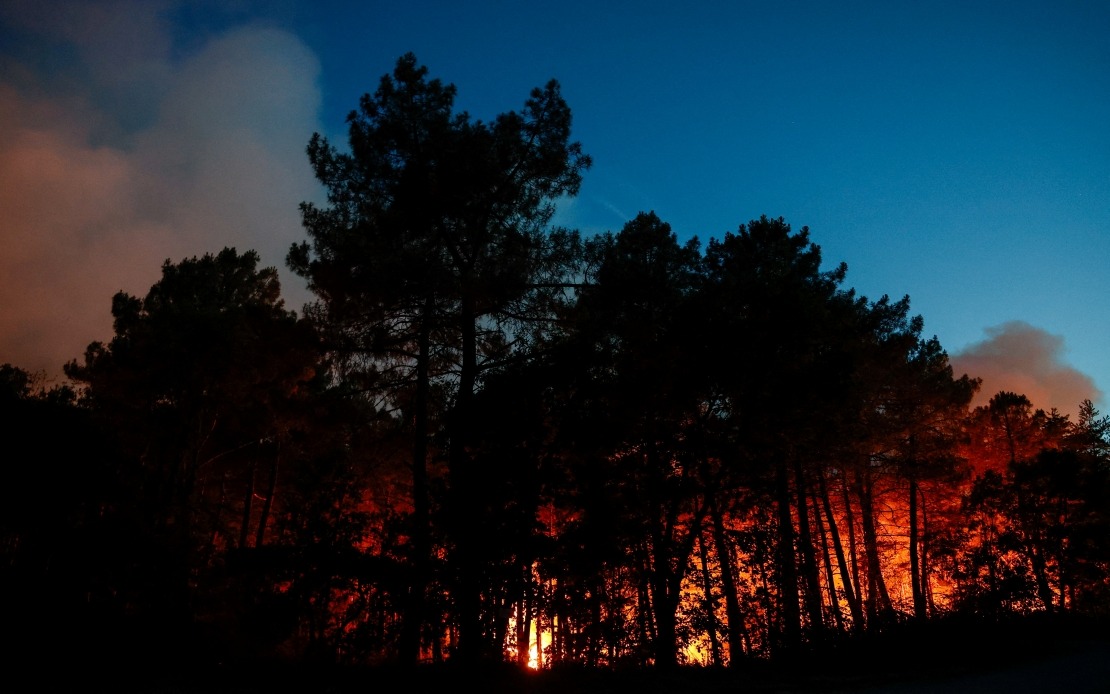
France is grappling with an exceptionally severe wildfire season that has already consumed nearly 119,000 hectares of forest and vegetation across the country, according to Interior Minister Laurent Nunez on Saturday. The scale of destruction underscores how climate change and prolonged heat waves are intensifying natural disasters in Western Europe, a region traditionally viewed as less vulnerable to such catastrophes than Mediterranean nations further south. The cumulative damage represents a stark reminder that no part of Europe is immune to the escalating environmental pressures reshaping the continent's fire landscape.
Since January, French authorities have documented 14,320 separate wildfire incidents, a figure that reflects both the frequency and persistence of fire outbreaks across diverse regions. On Friday alone, 25 major fires demanded substantial coordinated firefighting responses, signalling that the crisis continues to accelerate rather than stabilise. This intensity of occurrence strains emergency services and diverts critical resources away from other civil protection priorities, creating a cascading vulnerability within the national security apparatus. The sheer number of incidents also suggests that traditional prevention and early-warning mechanisms may be insufficient to contain the phenomenon.
Minister Nunez emphasised that despite marginal improvements in humidity levels across certain areas, the underlying conditions driving fires remain acutely dangerous. High ambient temperatures, severely depleted soil moisture, and parched vegetation create an environment where fire behaviour becomes unpredictable and containment extraordinarily difficult. These meteorological factors reflect a broader climatic shift toward drier, hotter summers in continental Europe, a pattern projected to intensify throughout the remainder of the twenty-first century. For Southeast Asian observers, the French experience serves as a cautionary example of how climate transformation affects nations far removed from tropical regions, suggesting that global warming poses universal rather than regionally confined threats.
Geographically, vulnerability is concentrated in France's southern and western zones. The Mediterranean coastline, extending inland through the Rhone Valley, faces elevated risk, while western departmental areas also experience significant fire danger. Particular concern centres on the Var department and southern Corsica, both designated at the highest alert classification of "very severe." The Var region exemplifies the acute jeopardy: a major fire that authorities believed controlled reignited on Friday, consuming an additional 1,500 hectares and demonstrating how rapidly situations can deteriorate even under intensive supervision. This reignition emphasises that firefighting strategies must account not merely for initial suppression but for long-duration monitoring and residual heat management.
Government response has mobilised substantial personnel and equipment. Approximately 1,500 additional firefighters were deployed overnight specifically to shield communities in the Var region, complementing intensive aerial operations sustained throughout daylight hours. Nationally, France maintains all available aerial assets in active deployment while sustaining 65 interdepartmental firefighter reinforcement columns at operational readiness, though this figure represents a reduction from peak mobilisation of 72 columns in recent days. The strategic decision to temporarily stand down certain units reflects the necessity of managing crew fatigue amid prolonged deployment; however, officials retain capacity to rapidly recommission assets should conditions deteriorate further.
Law enforcement has actively investigated fire origins, generating 328 arrests connected to wildfire-related investigations. While the source statement does not elaborate on whether these arrests reflect suspected arson, negligence, or other fire-related offences, the substantial arrest figure signals serious criminal involvement in some incidents. This dimension underscores how natural disaster management intersects with criminal justice, particularly in contexts where human activity either initiates fires or impedes suppression efforts.
For Malaysia and other Southeast Asian nations, the French wildfire crisis carries several instructive implications. First, climate change manifests as genuinely transnational phenomena; Western European nations once considered climatically stable now experience fire regimes historically associated with Mediterranean countries or tropical regions. Second, the institutional and logistical demands of managing large-scale fire events strain even wealthy, well-resourced democracies, suggesting that developing nations must begin preparatory investments now rather than awaiting crisis. Third, the French experience demonstrates that prevention, early detection, and community preparedness ultimately matter more than reactive firefighting, a lesson applicable wherever climate change accelerates wildfire risk.
The persistence of elevated danger despite marginal environmental improvements indicates that France faces a protracted crisis rather than an imminent resolution. Officials must balance immediate firefighting imperatives against the medium-term need to sustain personnel, equipment, and public morale. The fact that conditions remain classified as "high risk" despite some humidity recovery suggests that the threshold for danger in contemporary French circumstances has fundamentally shifted upward, reflecting climate normalisation rather than temporary aberration.
Minister Nunez's public warnings to residents, urging vigilance and compliance with local authority directives, acknowledge that disaster management increasingly depends on civilian cooperation and individual preparedness rather than state action alone. Communities facing persistent wildfire danger must internalise new safety protocols and accept that evacuation orders, property loss, and lifestyle disruption represent routine rather than exceptional occurrences. This psychological and behavioural transition constitutes perhaps the most profound long-term consequence of climate-driven wildfire intensification, extending impacts far beyond quantifiable hectare-loss statistics.
The unfolding situation in France, while geographically remote from Southeast Asia, embodies universal climate realities that demand international attention and collaborative adaptation strategies. European nations possess far greater financial and technical capacity than most developing countries, yet they struggle to manage escalating fire risk—a sobering indicator for regions with fewer resources but potentially higher climate vulnerability. France's response, encompassing large-scale resource mobilisation, criminal investigation, and public communication, establishes benchmarks against which other nations measure preparedness and resilience.

