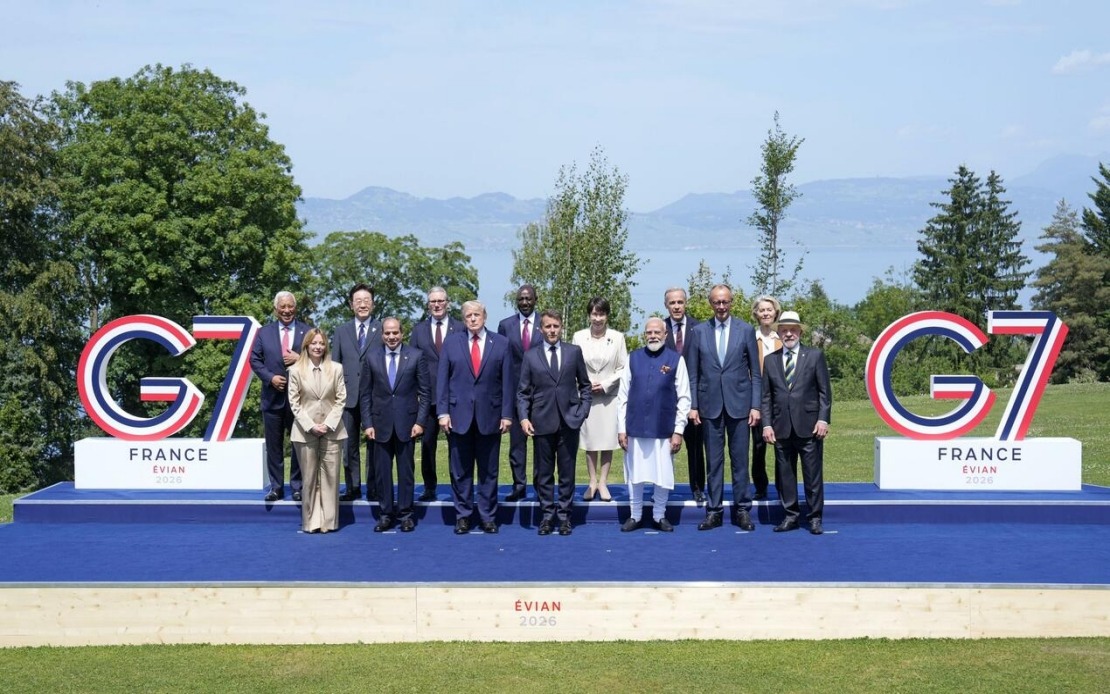
At their annual summit in the French spa town of Evian-les-Bains, leaders of the world's seven largest democracies have reaffirmed their commitment to Ukraine, signalling continued pressure on Russia even as the conflict enters its fourth year. The meeting, which brought together the heads of Britain, Canada, France, Germany, Italy, Japan and the United States alongside European Union representatives, demonstrated that despite recent strains between Washington and its traditional allies, there remains sufficient common ground on the Ukrainian crisis to maintain a united diplomatic front.
US President Donald Trump, speaking after attending a dedicated session on Ukraine with his G7 counterparts, called directly for Moscow to enter peace negotiations, framing the conflict as mutually devastating. Trump characterised both Russia and Ukraine as having suffered enormous casualties and suggested that economic incentives, particularly regarding oil sanctions relief, could encourage Russia to the negotiating table. His comments reflected a diplomatic approach that differs markedly from previous American administrations, emphasising immediate resolution over extended support for Kyiv's defensive efforts.
The consensus document emerging from the summit committed G7 nations to work collectively toward what they termed a "just and lasting peace" in Ukraine, achieved through maintaining sustained pressure on the Russian federation. This formulation represents a careful balance between supporting Ukraine's sovereignty and acknowledging the possibility of negotiated settlement. Japanese Prime Minister Sanae Takaichi articulated the group's position by emphasising that Russia must take "positive and concrete action quickly," while also warning that unilateral territorial changes achieved through military force would remain unacceptable to the international community.
Ukrainian President Volodymyr Zelenskyy participated directly in the summit's proceedings, providing the assembled leaders with firsthand assessment of his country's security requirements and diplomatic objectives. He subsequently highlighted the importance of strengthening Ukraine's air defence capabilities and advancing diplomatic channels simultaneously, positioning these as complementary rather than contradictory approaches to ending the war. Zelenskyy's presence underscored that despite ongoing peace discussions, Kyiv continues to prepare for sustained military operations and prioritises protection of civilian infrastructure from Russian aerial bombardment.
Trump's reference to recent negotiations with Iran and his suggestion that sanctions relief mechanisms could be rapidly deployed reveal the transactional framework through which his administration contemplates conflict resolution. The temporary lifting of sanctions on Russian oil exports, implemented to moderate global energy prices following the Iran conflict, could be reinstated, Trump suggested, if Moscow refuses to engage seriously in peace discussions. This leverage-based approach reflects an assumption that economic incentives rather than security guarantees or territorial concessions form the primary currency of international negotiation.
Japanese officials noted significant concern regarding the deepening military and strategic alignment between Russia and North Korea, as well as expanding military cooperation between Moscow and Beijing. These concerns extend beyond the immediate Ukraine theatre, reflecting broader anxieties among G7 members about the formation of alternative power blocs that challenge the post-Cold War international order. The summit discussions acknowledged that Russia's isolation from Western institutions has paradoxically strengthened its security partnerships with Beijing and Pyongyang, creating secondary strategic challenges for democratic nations.
The summit expanded beyond Ukraine to encompass the broader Middle Eastern crisis, following the nearly four-month conflict between Iran and the United States that concluded with preliminary agreements to reopen the Strait of Hormuz and establish sustainable maritime commerce through this critical chokepoint. The G7 leaders welcomed the emerging Iran settlement and stressed the importance of ensuring permanent guarantees for freedom of navigation through waters through which approximately one-third of globally traded oil passes. Japan, as an energy-import-dependent nation, has particular strategic interest in maintaining unobstructed shipping lanes and stable energy markets.
France, holding this year's G7 presidency, deliberately expanded the summit's participation to include leaders from Brazil, Egypt, India, Qatar, South Korea and the United Arab Emirates, reflecting an effort to construct broader coalitions on international development and global stability issues. This format demonstrates recognition that modern geopolitical challenges require engagement beyond the traditional industrial democracies, particularly when addressing conflicts in adjacent regions and mobilising financial resources for development in the Global South.
Development finance reform emerged as a central theme, with G7 members acknowledging that traditional official development assistance mechanisms have proven inadequate to address infrastructure and poverty reduction requirements in lower-income nations. The summit pivoted toward promoting public-private partnerships and leveraging private capital flows to finance long-term projects, representing a philosophical shift from traditional donor relationships toward mutual benefit frameworks. For Southeast Asian nations and regional development banks, this reorientation has significant implications for future financing of infrastructure and climate adaptation projects.
The underlying tensions between Trump and European G7 members—spanning trade disputes, NATO burden-sharing disagreements, and contentious American initiatives regarding Greenland—remained largely unresolved beneath the consensus language on Ukraine. European leaders appeared willing to maintain diplomatic unity on the Russian question despite broader policy disagreements, suggesting that the Ukrainian crisis retains sufficient salience to override other points of transatlantic friction, at least temporarily. However, observers noted that this consensus may prove fragile if Trump pursues unilateral Russian negotiations or conditions future Ukraine support on concessions that European members consider unacceptable.
For Malaysia and Southeast Asia, the summit's outcomes carry several implications. The reaffirmation of Western commitment to Ukraine's defence reassures smaller nations regarding great power reliability when larger states face security threats, while Trump's emphasis on negotiation reflects a potential shift toward bilateral diplomacy that could affect regional security architecture. Additionally, the expanded development financing discussions directly touch upon regional countries' interests in accessing capital for infrastructure and climate projects without accepting the geopolitical conditions that have historically accompanied Western bilateral aid. The summit's effort to construct inclusive coalitions involving India, South Korea and Gulf states signals recognition that future international partnerships must accommodate diverse interests and avoid recreating Cold War-style bloc structures.