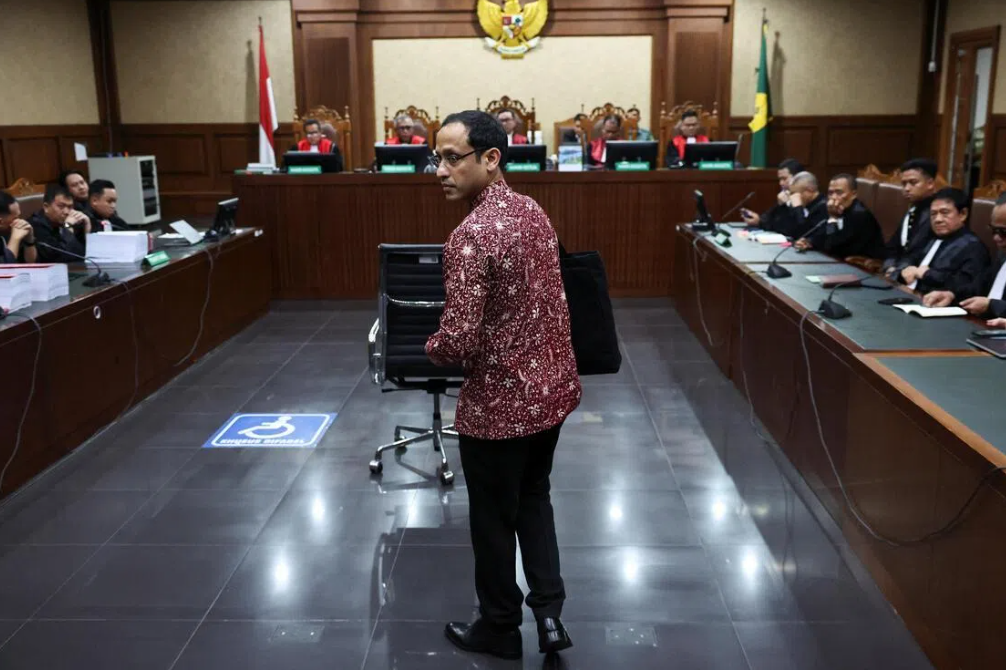
The downfall of Nadiem Makarim, once celebrated as a symbol of modern Indonesia's technological and entrepreneurial promise, reached its conclusion when the Jakarta Corruption Court handed down a 10-year prison sentence on Tuesday. The Harvard-educated technology entrepreneur, who transformed Gojek into Southeast Asia's first unicorn startup before joining government in 2019, now faces conviction in connection with a school laptop procurement programme that became mired in corruption allegations. The verdict represents a stunning reversal of fortune for someone who had championed digital innovation as a pathway to improving government efficiency and public services during the Covid-19 pandemic.
Beyond the prison term, Makarim received additional financial penalties totalling approximately 810.6 billion rupiah in combined fines and restitution. The court mandated a 1 billion rupiah fine and ordered him to repay 809.6 billion rupiah—equivalent to roughly US$45 million—to compensate for alleged state losses. Should he fail to complete the restitution payment, an extra five-year prison sentence will automatically apply. These financial obligations underscore the seriousness with which Indonesian courts have treated the alleged misconduct, suggesting the judiciary views the case as involving substantial harm to public finances during a critical period for the nation's education system.
Chief Judge Purwanto's ruling centred on findings that Makarim had abused his ministerial authority to benefit private interests, specifically his own technology company. The panel of five judges determined that the former education minister had deliberately steered the Chromebook procurement programme to strengthen business relationships with Google and advance the strategic interests of Gojek's parent company, PT Aplikasi Karya Anak Bangsa. The judgment characterised such motivation as fundamentally incompatible with ministerial responsibilities, describing it as behaviour that violated the oath of office Makarim had taken upon assuming his cabinet position.
The procurement scheme at the heart of the case involved acquiring approximately 1.1 million Chromebook laptops between 2020 and 2022, when schools across Indonesia transitioned to remote learning following pandemic lockdowns. Prosecutors argued this decision caused roughly 2.18 trillion rupiah in state losses while enriching Makarim through transactions connected to his company. They had originally sought an 18-year sentence, a substantially higher penalty than what the court ultimately imposed. The case attracted considerable public attention, with livestreamed proceedings and social media campaigns reflecting the unusual degree of public engagement this particular corruption trial generated throughout Southeast Asia's largest economy.
Defence arguments emphasised the genuine challenges facing Indonesian education during lockdowns and claimed the laptop programme addressed critical infrastructure gaps in remote learning. Makarim's legal team contended that approximately 97 percent of the 1.1 million devices had been successfully delivered to roughly 77,000 schools by 2023, suggesting the initiative achieved its intended educational objectives despite later corruption allegations. They maintained throughout the proceedings that their client received no personal financial benefit from the procurement and that decisions were made in good faith during an unprecedented crisis in the nation's education system.
However, prosecutors presented evidence suggesting problematic decision-making preceded Makarim's formal ministerial appointment. A Ministry of Education study from 2018, conducted before Makarim joined the cabinet, had already identified significant limitations in Chromebook effectiveness across remote and rural Indonesian regions lacking reliable internet connectivity. Additionally, prosecutors highlighted an August 2019 group chat discussing Chromebook-focused digitalisation plans, purportedly demonstrating advance coordination that raised questions about the programme's origins and justification.
The trial's conclusion marks a watershed moment for Indonesia's approach to holding technocrats and business leaders accountable within government. Makarim's trajectory—from founding one of Asia's most successful technology companies to serving as education minister, then facing prison time for corruption—illustrates the complex intersection of business and politics in contemporary Indonesia. His case raises fundamental questions about whether private sector leaders can successfully transition to public service, and whether ambitious digitalisation initiatives inevitably create opportunities for corruption when pursued without adequate institutional oversight.
Makarim's family background as the son of prominent lawyer Nono Anwar Makarim and grandson of an Indonesian independence fighter added another dimension to the trial, attracting attention from those invested in the country's political and business establishment. The case drew unusual expressions of public solidarity, with Gojek drivers attending court sessions and social media campaigns mobilising supporters. On one occasion, Makarim deliberately attended proceedings wearing his company's driver jacket before changing into traditional batik, a symbolic gesture seemingly designed to reinforce his connection to ordinary workers and positions himself as a man of the people despite facing corruption charges.
In his final defence plea before sentencing, Makarim attempted to reframe the trial's significance beyond simple questions of procurement misconduct. He appealed to the judges' recognition that the case would influence how young Indonesians perceived public service careers and whether talented professionals from outside traditional political circles would continue entering government. His plea represented a sophisticated attempt to position the trial as consequential not merely for his personal fate but for Indonesia's future capacity to attract capable administrators from the private sector. "Youth across all of Indonesia, and the diaspora in every corner of the world, await your answer to the question echoing in their hearts: 'Is this country still safe for us to serve?'" he told the court.
The conviction carries implications extending across Southeast Asia's business and political landscape. Other entrepreneurs contemplating government service in the region may view Makarim's experience with considerable caution, potentially deterring talented technology leaders from pursuing public sector roles. Simultaneously, the prosecution and conviction signal Indonesian authorities' determination to pursue high-profile corruption cases regardless of defendants' business accomplishments or social prominence. This approach reflects Jakarta's broader anti-corruption agenda, though observers note the contrasting sentences—prosecutors sought 18 years while judges imposed 10—suggest some judicial recognition of legitimate ambiguities surrounding the case.
As Makarim's legal team considers potential appeals, the verdict concludes an extraordinary chapter in Indonesian political and business history. His statement posted on LinkedIn, prepared by his legal representatives, expressed continued faith in judicial processes despite the harsh outcome. The case ultimately illustrates how digital transformation initiatives, intended to modernise public institutions and improve service delivery, can become entangled in corruption allegations when institutional safeguards prove inadequate. For Malaysia and other ASEAN nations pursuing similar digitalisation agendas in education and government, the Makarim case offers cautionary lessons about procurement transparency, conflict-of-interest protocols, and the importance of separating commercial interests from policy decisions affecting millions of students and educational institutions.

