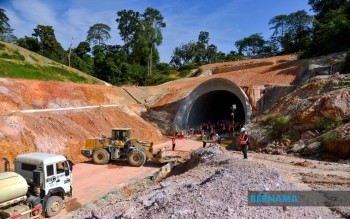
Malaysia's cabinet has endorsed a comprehensive development package for the Pasir Puteh parliamentary constituency in Kelantan, committing RM207.2 million across 46 initiatives scheduled for completion by 2026. The portfolio represents a strategic pivot toward leveraging the East Coast Rail Link (ECRL) as an economic multiplier for the region, moving beyond traditional infrastructure spending to create integrated industrial and logistics ecosystems.
Deputy Economy Minister Datuk Mohd Shahar Abdullah framed the investment during parliamentary questioning as part of a deliberately sequenced approach to regional development. Rather than scattering funds across competing priorities, the government has identified Pasir Puteh's unique positioning as a convergence point for rail and maritime connectivity, positioning it to anchor broader economic activity across Kelantan's east coast. The ECRL, which runs through the constituency, opens pathways for cargo movement that previously required lengthy road transport, fundamentally altering the logistics calculus for businesses considering inland operations.
Central to this vision is the development of the Pasir Puteh downstream industrial area, with the ECRL cargo station designated as both a passenger hub and a major logistics node. This dual functionality reflects international best practice in transport-oriented development, where infrastructure investments generate returns across multiple economic sectors simultaneously. The approved projects include foundational work such as land acquisition and preparation, utilities deployment, and access road construction—the unglamorous but essential groundwork that determines whether subsequent private investment materialises.
The proximity of the Tok Bali Supply Base to the proposed industrial zone adds considerable strategic value. Supply bases serve as concentration points for materials destined for maritime operations, and their colocation with rail infrastructure dramatically reduces handling costs and transit times. This geographic advantage creates what economists term agglomeration benefits, where the clustering of related activities lowers costs and attracts complementary businesses. For Kelantan, which has historically lagged peninsular Malaysia in manufacturing and logistics investment, such advantages are not merely incremental but potentially transformative.
Mohd Shahar emphasised that the initiative exemplifies a shift in how federal allocations approach regional development. Under the 13th Malaysia Plan (13MP), investment decisions increasingly reflect each locality's comparative strengths rather than formulaic distribution. This principle—tailoring infrastructure spending to regional assets—addresses a longstanding critique of Malaysian development policy, which often imposed generic industrial parks and highways regardless of local economic potential. For Pasir Puteh, that means emphasising its role as a logistics and supply chain hub rather than attempting to industrialise it along unrelated lines.
The coordination framework between rail facilities and port operations carries implications extending beyond Pasir Puteh itself. As Southeast Asia's manufacturing base increasingly shifts toward locations with superior logistics connectivity, Malaysia competes against Thailand, Vietnam, and Indonesia for supply chain investment. The ECRL development strategy signals commitment to this competition, recognising that firms choosing manufacturing locations now weight transport connectivity and logistics costs as heavily as labour availability or tax incentives. Kelantan's engagement with this calculus addresses a historical perception that the state remains peripheral to Malaysia's economic heartland.
Implementation will unfold across a seven-year window from 2024 through 2030, allowing for phased activation and learning adjustments. The government intends to monitor progress through the MyRMK system, a digital platform designed to track development spending and outcomes across constituencies. This transparency mechanism addresses previous concerns about project delays and cost overruns that plagued earlier Malaysian development initiatives. Regular parliamentary reporting on progress creates accountability pressure, differentiating this initiative from older approaches where spending approval marked the end rather than the beginning of scrutiny.
The 46-project portfolio encompasses traditional infrastructure—roads, utilities, land preparation—alongside what might be termed ecosystem investments. Creating downstream industrial zones requires more than physical assets; it demands business support services, training facilities, and regulatory clarity. Pasir Puteh's development package implicitly recognises this by bundling traditional infrastructure with measures to prepare the local workforce and business environment for logistics sector activity.
For Malaysian policymakers, the Pasir Puteh initiative reflects growing sophistication in how federal resources address regional inequality. Rather than attempting to replicate Kuala Lumpur or George Town's development patterns elsewhere, authorities increasingly identify each region's inherent advantages and concentrate investment there. Kelantan's ECRL station presents such an advantage, and the government's decision to build comprehensively around it suggests similar place-based strategies may be adopted elsewhere along the rail corridor, potentially benefiting states from Terengganu to Pahang.
The investment also signals confidence in the ECRL's ultimate profitability and utility. Since the project's completion amid financing disputes and renegotiations, questions persisted about whether freight volumes would justify operational costs. By positioning Pasir Puteh's industrial zone as a cargo generation point rather than merely a transit facility, the government shifts the ECRL from potential infrastructure white elephant to active economic catalyst. This approach creates virtuous cycles where proximity to the rail line attracts industries that generate cargo, which justifies the line's investment.
Regionally, the Pasir Puteh package represents Malaysia's attempt to compete for supply chain investment with rival Southeast Asian economies offering similar wage levels and geographic advantages. Thailand's Eastern Economic Corridor and Vietnam's coastal industrial zones similarly combine transport infrastructure with industrial zone development to attract manufacturing and logistics investment. Malaysia's 13MP initiatives across ECRL constituencies position the country competitively within this contest, provided execution matches ambition and political commitment persists beyond election cycles.
For local communities in Pasir Puteh, the immediate implications involve employment generation in construction and project management, while longer-term benefits depend on whether the downstream industrial zone attracts viable businesses. The government's emphasis on job creation and local economic growth suggests awareness that infrastructure investment without corresponding livelihood opportunities generates resentment rather than development. The success of this initiative will substantially depend on whether Kelantan-based entrepreneurs and migrant workers can meaningfully participate in the emerging logistics and industrial ecosystem rather than observing its development from outside.

