Greece has declared a red alert—its most severe wildfire warning—for three strategically important regions facing an exceptionally dangerous threat of fire on Thursday. The General Secretariat for Civil Protection, operating under the Climate Crisis and Civil Protection Ministry, elevated the wildfire risk to Category 4 for the regions of Attica, Viotia, and Evia, encompassing the capital Athens and surrounding territories. This maximum alert status signals authorities' grave concern about conditions that could rapidly escalate into catastrophic incidents, prompting the mobilization of every available resource to prevent and contain potential fires.
Under the red alert protocol, the National Civil Protection Mechanism has shifted to complete operational readiness, with coordinated teams from the fire service, police, and armed forces deployed across affected areas. Ground and aerial patrols now sweep vulnerable zones continuously, while preventive measures restrict vehicle traffic and visitor access to forests and other high-risk environments. These precautions represent a comprehensive approach to reducing ignition sources and ensuring rapid response capacity should fires emerge. Residents have been explicitly urged to avoid any activities that might trigger fires, from discarded cigarettes to machinery use that could generate sparks.
The alert comes immediately after firefighters successfully contained a blaze that erupted near Koropi, located southeast of Athens, on Wednesday afternoon. The fire ignited in low vegetation within the Driggia area at approximately 1:45 pm local time. Response teams mobilized substantially to address the threat, deploying at least 52 firefighters drawn from regular units and three specialized forest commando teams, supported by 14 ground vehicles. The aerial dimension of the operation proved equally critical, with four helicopters and two water-dropping aircraft joining efforts to contain the spreading flames.
The Koropi incident illustrates both the speed with which fires can develop across Greek terrain and the increasingly sophisticated response infrastructure now in place. Coordination mechanisms included aerial command helicopters that directed operations, while authorities employed thermal and optical drone technology to monitor the blaze's progression and identify hot spots. Local government contributed water tankers to replenish firefighting resources, and specialists from an arson investigation team were deployed to establish how the fire originated. This multi-layered response, combining ground and air assets with technological monitoring, has become the standard approach to Mediterranean wildfires, where topography and seasonal conditions can transform small incidents into regional disasters within hours.
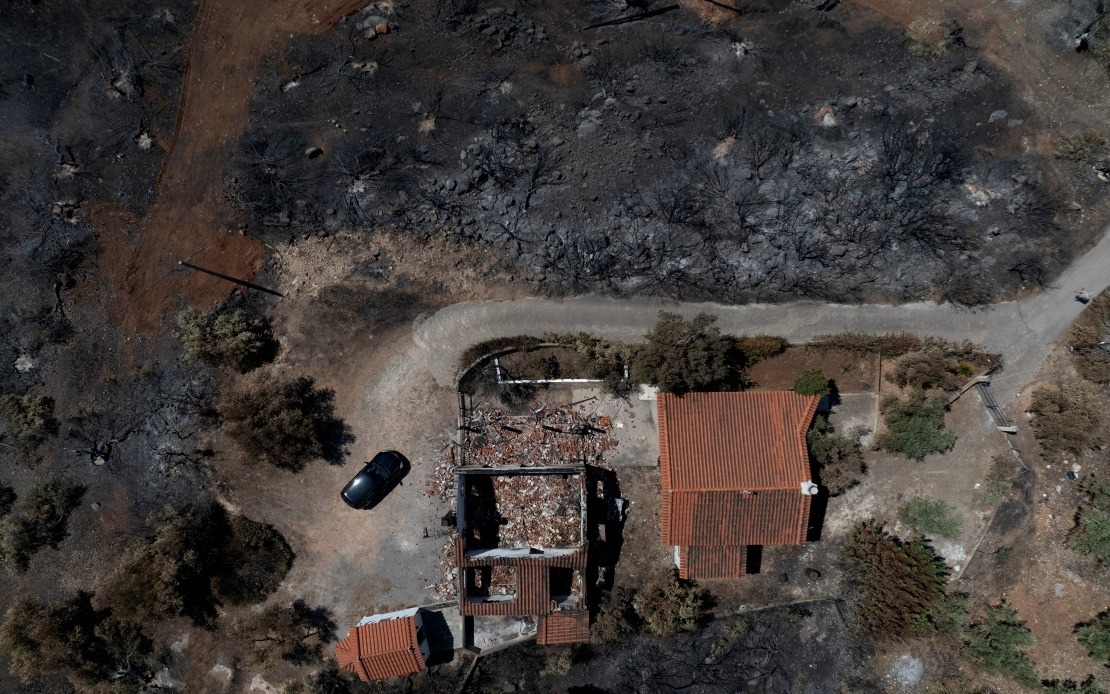
Yet even as crews managed the Koropi fire, a far more severe ongoing situation continued demanding attention across the region. Firefighters remained engaged Wednesday in containing a major wildfire that had initiated the previous week in Viotia before spreading westward into Attica. According to satellite data from the European Union's Copernicus monitoring system, this larger blaze has already consumed approximately 14,424 hectares, equivalent to roughly 35,642 acres. The sheer scale of this burned area demonstrates how quickly Mediterranean summer conditions can overwhelm firefighting capacity and turn individual fires into landscape-transforming events.
The human cost of these operations underscores the danger involved in aerial firefighting across southern Europe. On Sunday, during operations against the Viotia-Attica blaze, two firefighting helicopters collided midair in a tragedy that claimed the lives of a Danish pilot and a Greek aerial coordinator. The incident represents a stark reminder of the risks inherent in coordinating multiple aircraft across rugged terrain while pilots maintain focus on fire suppression beneath them. Such collisions, though rare, tend to occur when operational tempo accelerates and multiple aircraft navigate restricted airspace under challenging visibility conditions created by smoke.
For Malaysia and Southeast Asian observers, Greece's wildfire crisis holds several relevant implications. The region's experience demonstrates how climate-driven temperature extremes and seasonal drought conditions can overwhelm even well-resourced nations' firefighting infrastructure. Greece possesses advanced coordination systems, substantial equipment reserves, and regional mutual aid agreements with European partners—yet still struggles with fires that consume tens of thousands of hectares. Southeast Asian nations, many facing comparable or more severe wildfire threats during dry seasons, particularly in Indonesia and Malaysia, can draw lessons from Greek operational protocols, including the importance of pre-positioned aerial assets, integrated command structures, and cross-border coordination mechanisms.
The elevation to red alert status also reflects how Mediterranean and similar climate zones must now approach fire seasons strategically rather than reactively. The Greek system's Category 4 designation essentially treats conditions as potentially catastrophic, implementing maximal prevention measures in advance of confirmed incidents rather than waiting for fires to break out. This precautionary positioning recognizes that in extreme fire weather, prevention capacity determines outcomes more reliably than suppression speed. Communities in Southeast Asia experiencing comparable seasonal fire risks increasingly adopt similar early-warning frameworks, though implementation consistency varies significantly across the region.
Greece's current alert period carries particular significance given the region's tourism economy and critical infrastructure concentration around Athens. The capital and surrounding Attica region host millions of residents and represent Greece's economic core. Fire emergencies in such densely populated areas create compounded challenges beyond direct fire losses, including smoke impacts on public health, evacuation logistics, and infrastructure damage that can disrupt national systems. Wednesday's successful containment of the Koropi fire, therefore, represents not merely a firefighting success but a protection of critical assets and population centers that Greece cannot afford to lose to uncontrolled wildfire.
The coordination between Greek authorities and European resources demonstrates the value of integrated regional approaches to natural disasters that cross administrative boundaries. The Copernicus satellite monitoring that tracked the Viotia-Attica fire's extent illustrates how European infrastructure supports member states' emergency responses. For Southeast Asian nations, such integration across ASEAN frameworks remains less developed, though the region's increasing fire challenges—exacerbated by climate change and land-use transformation—argue for stronger regional data-sharing and mutual aid protocols comparable to European arrangements.
Looking forward, Greece's red alert Thursday will test the effectiveness of its preventive strategy. If the alert successfully deters ignitions and facilitates rapid suppression should fires emerge, it validates the approach for adoption elsewhere. If fires nevertheless break out and overwhelm response capacity, the incident will underscore how climate change is pushing Mediterranean conditions toward patterns that existing infrastructure cannot reliably manage. Either outcome carries lessons for Southeast Asia, where fire seasons grow longer, more intense, and more consequential each year. The capacity to deploy resources like Greece's four helicopters and water-dropping aircraft, coordinate across agencies and borders, and employ real-time satellite monitoring represents an aspirational standard that wealthier nations now must meet simply to maintain baseline public safety.

