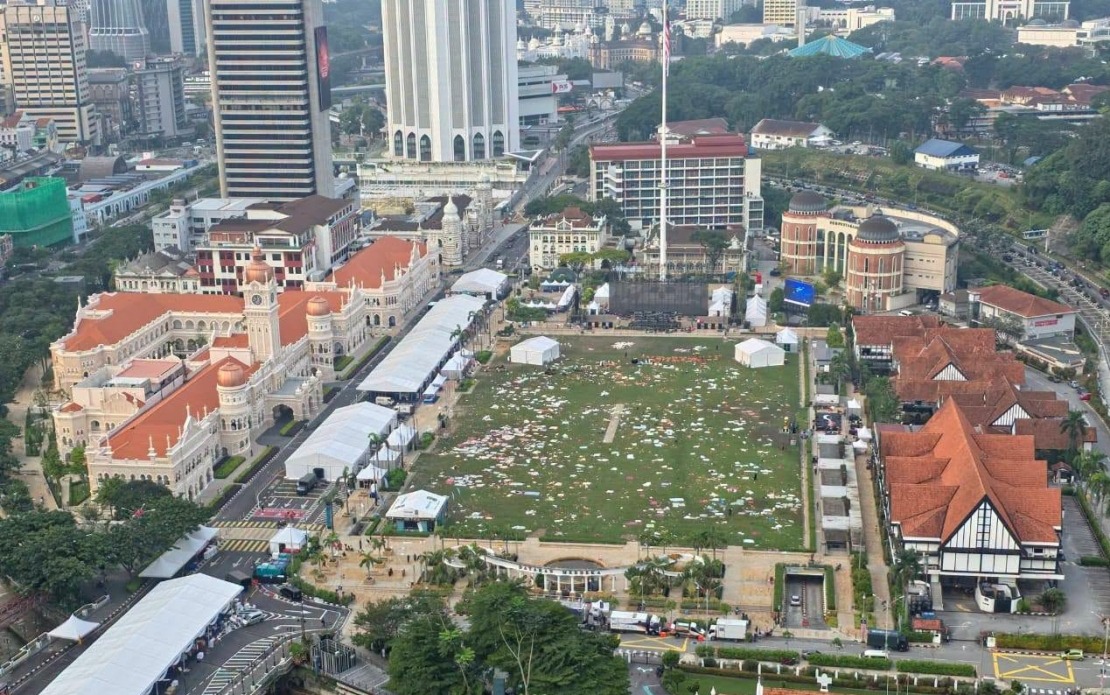
Minister in the Prime Minister's Department (Federal Territories) Hannah Yeoh has seized upon the aftermath of a public viewing event at Dataran Merdeka to deliver a broader message about civic responsibility and national values. Following the screening of the 2026 FIFA World Cup final at the historic venue on July 20, which left the grounds scattered with litter, Yeoh took to Facebook to acknowledge the efforts of Kuala Lumpur City Hall workers while simultaneously challenging Malaysians to examine their own relationship with shared public spaces.
The incident at Dataran Merdeka, which draws significant crowds for major sporting events, highlighted a persistent tension in Malaysia's urban landscape. While city authorities are tasked with maintaining cleanliness in public venues, the scale of debris left behind after large gatherings often overwhelms cleaning operations and raises questions about whether infrastructure investment alone can address the problem. Yeoh's intervention suggests that government bodies view this as more than a maintenance issue, but rather a fundamental question of how Malaysians engage with their shared environment.
In her statement, Yeoh explicitly rejected the notion that taxpayers can simply delegate all civic responsibility to public servants. She argued that disposing of rubbish properly represents a basic duty that individuals must fulfil themselves, rather than create additional work for municipal staff. This framing positions cleanliness not as a service to be provided, but as a prerequisite for civilised urban coexistence that requires active participation from every person using public facilities.
The minister's comments align with a broader government narrative about Malaysia MADANI, the administration's development philosophy that emphasises collective responsibility alongside government delivery. Rather than presenting these as competing interests, Yeoh suggested they are complementary: the government must fulfil its obligations to maintain public infrastructure and services, but citizens must simultaneously meet their own obligations to use those spaces respectfully. This dual-responsibility framework reflects an attempt to move beyond the transactional view of governance where citizens expect services without corresponding duties.
Dataran Merdeka itself carries symbolic weight beyond its practical function as an event venue. As Malaysia's historic heart—the site where independence was proclaimed—the location represents national identity and dignity. Yeoh's invocation of this heritage suggests that littering in such spaces amounts to more than poor behaviour; it represents a failure to honour the nation's history and collective identity. By connecting everyday actions to larger questions of national character, the minister attempted to elevate the discussion beyond complaints about rubbish to fundamental values about how Malaysians should regard their country.
The timing of Yeoh's intervention during FIFA World Cup promotional activities is noteworthy, as Malaysia continues efforts to enhance its global image and infrastructure standards ahead of potential major sporting events. Large public gatherings, particularly those broadcast internationally or attended by visiting fans, have become flashpoints where national cleanliness standards receive scrutiny. The contrast between sprawling entertainment events and the state of public spaces afterward reflects a growing challenge facing Southeast Asian cities as urbanisation accelerates and public usage intensifies.
Yeoh's statement also echoed positions previously articulated by Prime Minister Datuk Seri Anwar Ibrahim, who has argued that national progress cannot be measured purely through physical development and infrastructure investment. Instead, the prime minister has suggested that indicators of genuine advancement include how citizens conduct themselves in public and whether they demonstrate respect for communal property. This represents a philosophical approach to governance that seeks to cultivate behavioural and cultural change alongside physical improvements.
The minister's emphasis on personal responsibility carries practical implications for Malaysia's cities. As Kuala Lumpur and other major urban centres invest heavily in modernisation, tourism infrastructure, and event hosting capacity, the actual experience of public spaces depends substantially on user behaviour. Poor maintenance of facilities, even when caused primarily by litter from visitors, can undermine perceptions of cleanliness and safety that affect both resident satisfaction and tourist impressions. Addressing this requires engagement strategies that treat citizens as stakeholders in maintaining their environment rather than merely consumers of municipal services.
For Southeast Asian cities grappling with rapid urbanisation and large-scale public events, the Dataran Merdeka incident illustrates a common challenge. Kuala Lumpur, Bangkok, Jakarta, and other regional capitals have increasingly hosted international sporting events and entertainment activities that attract enormous crowds. The environmental impact of these gatherings extends beyond the event itself to broader questions about public space management and civic culture. Yeoh's framing suggests that addressing these challenges requires not just better cleaning operations or more bins, but shifts in how people understand their responsibilities as urban residents.
The practical effectiveness of such messaging depends on sustained reinforcement and whether it produces behavioural change. Previous public awareness campaigns about cleanliness in Malaysia have achieved mixed results, with compliance remaining inconsistent across different areas and demographics. Yeoh's statement represents one voice in what would need to be a much broader cultural conversation about civic values if it is to meaningfully alter patterns of public space use.
Looking forward, the incident at Dataran Merdeka may serve as a catalyst for more formal approaches to shaping behaviour during large public events. Some cities have experimented with incentive systems, increased penalties, real-time monitoring and feedback, and enhanced waste management infrastructure positioned strategically for high-volume periods. Malaysia's experience hosting major events will likely generate discussions about combining such practical measures with the values-based messaging that Yeoh articulated, creating a more comprehensive approach to public space management that acknowledges both government obligations and citizen responsibilities.

