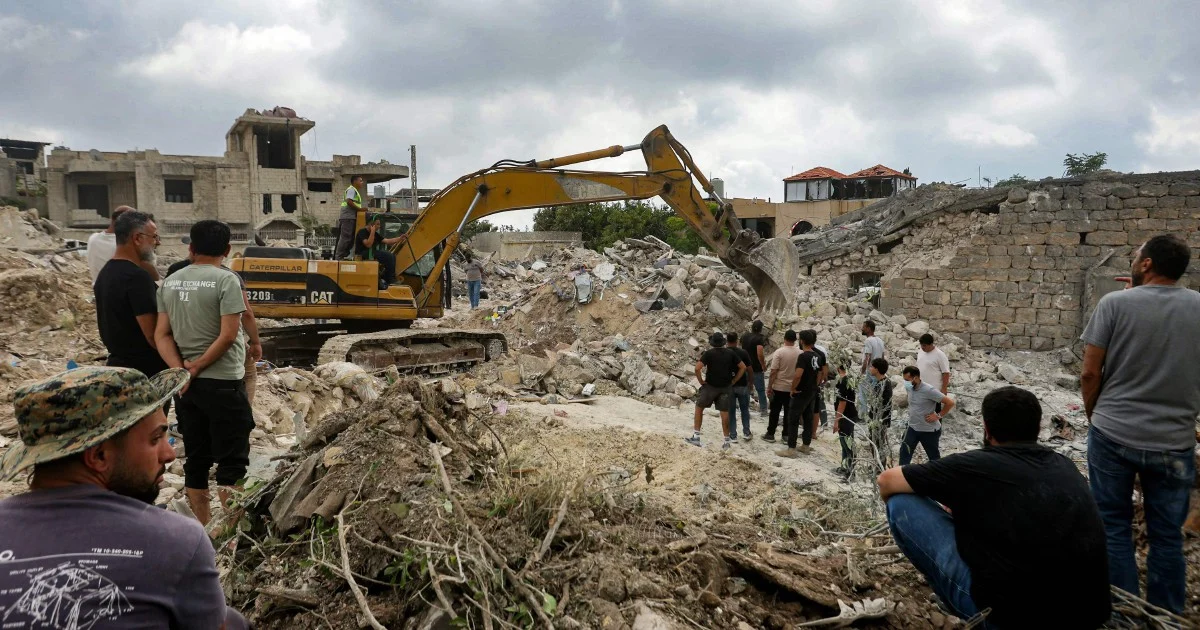
Hezbollah's political chief Naim Qassem issued a stark rebuke on Sunday to the prospect of Israeli forces establishing a security buffer zone within Lebanese territory, marking an escalation in rhetoric as international negotiations struggle to broker a lasting ceasefire. The statement came in direct response to Netanyahu's declaration that Israeli military personnel would maintain their position in Lebanon's southern regions for an undefined period, effectively rejecting any predetermined timeline for withdrawal.
The disagreement over military presence reveals a fundamental incompatibility between the Israeli and Lebanese positions that threatens to derail diplomatic efforts aimed at ending the latest phase of conflict. Netanyahu's insistence that Israeli forces cannot vacate the border region without guarantees of Lebanese state control over Hezbollah positions has become a sticking point in peace negotiations. For Hezbollah and its political allies, any extended Israeli military occupation of Lebanese soil represents a violation of national sovereignty and an unacceptable infringement on Lebanese territory.
The rejection by Qassem underscores the complexity of establishing permanent ceasefires in this disputed region, where decades of conflict have created overlapping claims and deep mistrust among regional actors. Israeli policymakers argue that security arrangements are necessary to prevent Hezbollah from reconstructing military infrastructure near the border, while Lebanese authorities maintain that such arrangements must respect territorial integrity and allow for the Lebanese military to assume security responsibilities across the entire border region.
For Malaysia and other Southeast Asian nations, this impasse holds particular significance in understanding the broader Middle Eastern security architecture. The unresolved Israeli-Lebanese border dispute continues to destabilise a region already fractured by competing geopolitical interests, affecting global economic flows, refugee movements, and the operational security of international organisations present in the area. The failure to achieve workable agreements creates conditions for periodic military escalations that can draw in regional and international powers, potentially impacting global trade routes and oil prices affecting Asian economies.
Hezbollah's categorical rejection of any security zone operates on multiple levels beyond simple military posturing. The organisation views such zones as mechanisms through which Israel can extend de facto control over Lebanese land indefinitely, allowing continuous surveillance and military operations without formal occupation. This interpretation aligns with Lebanese nationalist sentiment that fears creating precedent for foreign military presence, a concern amplified by Israel's historical occupation of portions of southern Lebanon from 1982 until 2000.
Netanyahu's framing of indefinite military deployment reflects Israeli security doctrine that prioritises buffer zones and forward defensive positions. However, this approach conflicts with international law principles regarding military occupation and the right of states to territorial integrity. The tension between Israeli security requirements and Lebanese sovereign rights remains one of the most intractable problems in Middle Eastern diplomacy, with no clear mechanism to reconcile these opposing imperatives.
The timing of Qassem's statement coincides with broader regional uncertainty about American engagement and international mediation efforts. Lebanon's economic collapse and political fragmentation have created a governance vacuum that complicates external efforts to broker durable arrangements. International powers, including France and the United States, have attempted to facilitate negotiations, but the fundamental disagreement over military presence and withdrawal timelines continues to frustrate diplomatic progress. Malaysia, as a non-aligned nation with experience in regional mediation, observes these dynamics closely as part of its broader Middle East policy engagement.
The practical implications of this deadlock extend beyond border security to encompass Lebanon's internal stability. A prolonged Israeli military presence would likely strengthen Hezbollah's political narrative about external threats, potentially consolidating support for the organisation among Lebanese constituencies. Conversely, Israeli withdrawal without security guarantees creates concerns in Tel Aviv about military threats to northern Israeli communities. This mutual vulnerability creates a security dilemma where each side's defensive measures are perceived as offensive threats by the other.
International humanitarian concerns add another dimension to the dispute. Prolonged military presence in southern Lebanon affects civilian populations, restricts freedom of movement, and prevents normal economic activity in border regions. The displaced Lebanese population awaiting return to their homes faces indefinite waiting periods as military and political negotiations stall. These humanitarian costs create pressure for rapid resolution, yet the fundamental disagreement on security arrangements prevents breakthrough solutions.
Looking forward, the trajectory of Israeli-Lebanese relations will significantly influence broader Middle Eastern stability and international engagement in conflict resolution. If current positions harden, the possibility of renewed military hostilities increases substantially. The international community, including regional actors like Malaysia, must remain engaged in promoting constructive dialogue and encouraging both parties to identify mutually acceptable arrangements that balance legitimate security concerns with respect for international law and territorial sovereignty. The alternative—indefinite tension and periodic escalation—serves neither Israeli nor Lebanese interests and destabilises an already volatile region critical to global economic and security interests.

