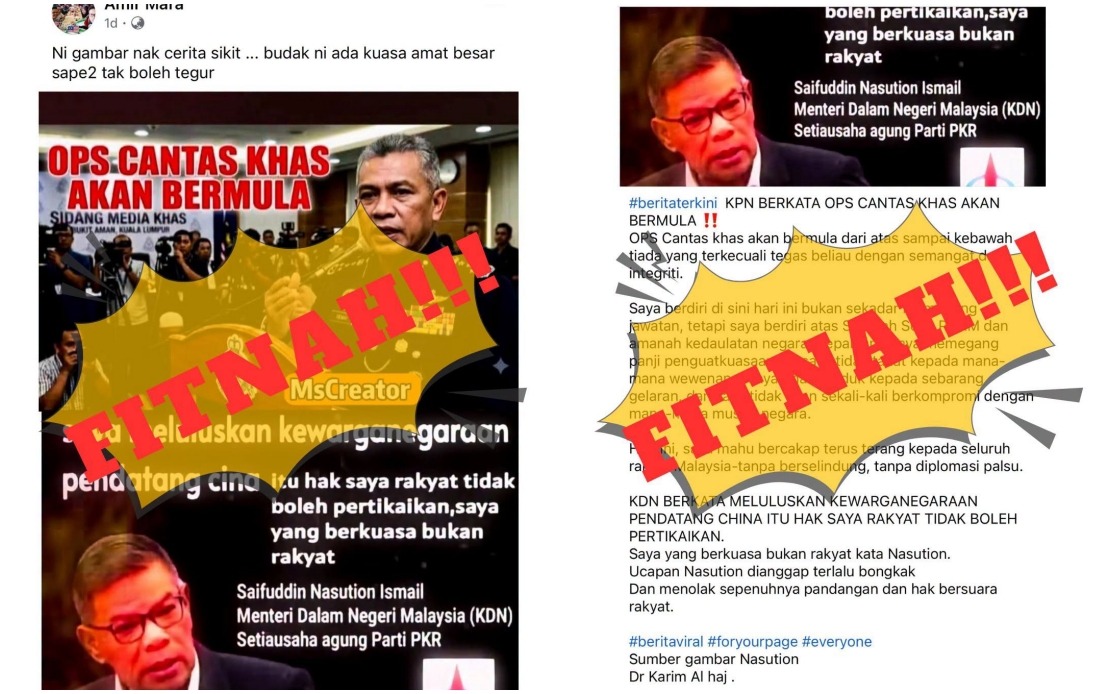
Home Minister Datuk Seri Saifuddin Nasution Ismail has strongly refuted allegations that the Home Ministry granted citizenship to large numbers of foreign nationals, declaring that such claims remain baseless despite persistent circulation on social media platforms. The minister's statement comes as posters and videos alleging irregular citizenship approvals continue to spread widely online, fuelling public debate over immigration governance and institutional integrity.
Saifuddin Nasution emphasised that he has repeatedly addressed these allegations through official channels and provided explanations grounded in factual evidence and government data. Yet despite his previous denials and clarifications, certain groups continue to deliberately recycle outdated videos, posters and narratives specifically designed to mislead the public and stoke communal tensions. The Home Minister's frustration is evident in his insistence that the matter has been thoroughly explained and properly documented through earlier ministerial statements and media coverage.
The circulation of such unverified claims extends beyond mere misinformation; according to the Home Minister, these allegations carry serious consequences for Malaysia's institutions and social fabric. By propagating defamatory narratives about the Home Ministry's operations, these campaigns risk eroding public confidence in government structures responsible for maintaining border security and immigration controls. This institutional erosion could prove particularly damaging in an era when faith in state institutions is already contested across multiple policy domains.
Beyond institutional concerns, Saifuddin Nasution warned that the deliberate spread of citizenship-related falsehoods can inflame racial tensions and potentially destabilise public order. In Malaysia's multicultural context, immigration and citizenship issues remain inherently sensitive topics capable of triggering strong community reactions. The weaponisation of these narratives for political advantage or social media engagement represents a calculated effort to exploit existing anxieties about demographic change and national identity. Such tactics threaten not only immediate public harmony but also the broader consensus required for rational policy discussion.
The minister's appeal addresses a critical challenge facing modern governance: controlling the spread of disproven claims in digital spaces where verification mechanisms remain weak and emotional narratives spread faster than corrections. The specific allegation that 1.2 million Chinese nationals were granted Malaysian citizenship or permitted to remain in the country without proper authorisation has become a fixture in online discourse, despite official denials. The persistence of such claims suggests that simple factual corrections, no matter how authoritatively delivered, may prove insufficient to counter deeply embedded misinformation.
Saifuddin Nasution called on all citizens to prioritise accuracy verification through official government sources before accepting or sharing information. This appeal reflects growing recognition among policymakers that combating misinformation requires active public participation rather than top-down institutional responses alone. By encouraging citizens to adopt more critical information consumption habits, the Home Minister attempted to shift responsibility partially toward individual media literacy. However, this approach assumes that access to official sources and capacity for critical evaluation are equally distributed across the population—an assumption that may not hold in practice.
The minister further urged responsible use of social media platforms, distinguishing between documented facts and unverified claims. His statement emphasised that factual information and statistical data must not be supplanted by false narratives, regardless of how persuasively they are packaged or widely they circulate. This framing positions the government's institutional data as the authoritative standard against which public claims should be measured. Yet the effectiveness of this appeal depends significantly on whether citizens trust government institutions to provide accurate information—a foundation that misinformation campaigns actively attempt to undermine.
The government's struggle against these citizenship allegations reflects broader Southeast Asian tensions regarding immigration, demographic composition and national identity. Malaysia, like several regional neighbours, has experienced significant intra-migration patterns and hosts substantial expatriate populations. Questions about citizenship processes, naturalisation rates and irregular immigration therefore carry particular weight in Malaysian political discourse. These concerns are not unique to Malaysia; similar debates occur across Thailand, Indonesia and other nations grappling with migration pressures and citizenship policy reforms.
From a governance perspective, the persistent circulation of unverified citizenship claims points to potential gaps in public communication strategy. While the Home Ministry has issued official denials, it appears insufficient communication of the actual citizenship approval process, statistics on annual naturalisations and procedural safeguards may leave space for speculative narratives to flourish. A more proactive approach involving regular public disclosures of immigration and citizenship data, transparent explanations of approval criteria, and clear communication of enforcement actions might gradually build public confidence in institutional processes.
The Home Minister's statements also underscore the distinction between addressing specific factual claims and confronting the underlying anxieties that make such claims believable to segments of the population. Citizens inclined to believe in mass irregular citizenship grants likely harbour deeper concerns about immigration control, national sovereignty and cultural preservation. Merely denying allegations without addressing these foundational concerns may do little to convince sceptics. Comprehensive public engagement addressing legitimate immigration governance questions could prove more effective than repeated factual corrections alone.
Moving forward, this episode highlights the necessity for Malaysian institutions to develop more sophisticated responses to misinformation campaigns that transcend simple denial. Establishing clearer institutional mechanisms for rapid fact-checking, maintaining higher transparency regarding immigration data, and building broader public understanding of citizenship procedures would strengthen resistance to false narratives. The challenge facing Home Ministry leadership involves not only countering existing misinformation but also creating informational environments in which baseless claims find less fertile ground for growth and spread.

