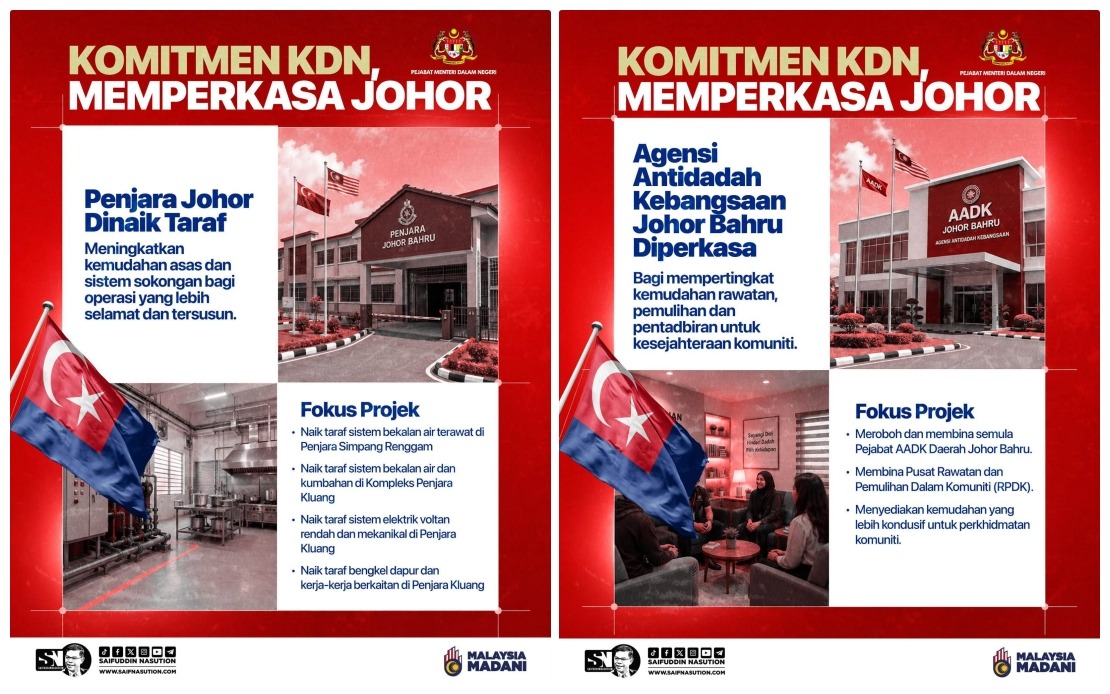
The Home Ministry has pledged to accelerate infrastructure development across Johor through a coordinated programme spanning multiple security and administrative agencies, positioning the southern state as a critical anchor for the nation's security apparatus and public service delivery. Home Minister Datuk Seri Saifuddin Nasution Ismail outlined the comprehensive initiative during a statement in Johor Bahru on July 10, emphasizing the strategic importance of Johor as a gateway state and security bulwark for the country's southern corridor.
Johor occupies singular significance within Malaysia's security and administrative framework. As the nation's primary international entry point through its land borders with Singapore and its maritime zones, the state requires continuously modernized infrastructure to manage the volume and complexity of cross-border movements. The Home Ministry's initiative recognizes this reality by directing resources toward facilities that handle immigration processing, law enforcement coordination, and maritime surveillance. Beyond security dimensions, Johor serves as a commercial and administrative hub whose operational efficiency directly influences broader regional stability and economic vitality.
The Royal Malaysia Police will benefit substantially from the development programme, with construction commencing on a new district police headquarters in Segamat and land procurement underway for a similar facility in Pengerang. These headquarters represent foundational investments in police operational capacity, enabling better coordination and response capabilities in districts that have experienced growth in population and commercial activity. Complementing the new structures, the Home Ministry has allocated resources for maintenance and renovation work on police quarters and mechanical systems at existing premises throughout the state, addressing the practical needs of operational personnel and facility sustainability.
Immigration infrastructure receives particular attention given Johor's role as the nation's busiest border crossing. Upgrading the Sultan Iskandar Building and the Sultan Abu Bakar Complex addresses capacity constraints and service quality concerns that have periodically emerged during peak travel periods. The improvements target organizational efficiency and procedural integrity, suggesting recognition that border management requires not merely infrastructure but also systems that maintain public confidence in official processes. Enhanced facilities at these complexes would streamline processing flows for the millions of travelers who transit through Johor annually, reducing congestion and potential bottlenecks that compromise both security screening and traveler convenience.
The National Registration Department's planned office in Batu Pahat expands the state's capacity to deliver identity documentation and registration services. This facility represents practical acknowledgment that rapid urbanization and population distribution across Johor necessitate decentralized access to essential administrative services. Accessible registration facilities reduce the administrative burden on citizens and enable more efficient record management across dispersed population centers, benefiting both residents and security agencies whose operations depend on reliable identity documentation systems.
Correctional facilities receive attention through systematic upgrades at Kluang Prison and Simpang Renggam Prison, where basic infrastructure and systems improvements will enhance operational conditions. Prison facility modernization, though often overlooked in public discourse, directly influences institutional effectiveness, staff safety, and rehabilitation outcomes. The Home Ministry's commitment to upgrading these facilities suggests a broader recognition that security infrastructure encompasses not only enforcement and border management but also the institutional systems that support the entire security continuum.
The National Anti-Drugs Agency's planned office expansion and treatment centre redevelopment address a critical public health and security nexus. Johor, like other Malaysian border regions, faces persistent drug trafficking challenges requiring both enforcement capacity and treatment infrastructure. Dedicated facilities enable the agency to expand both interdiction operations and rehabilitation services, creating complementary responses to substance abuse that address supply-side enforcement and demand-side health considerations. Modern treatment facilities with adequate capacity support the agency's mission to reduce drug dependency and associated social harms throughout the state.
Maritime enforcement capabilities receive investment through upgrades at Abu Bakar Maritime Base, including jetty renovations and building improvements. Johor's extensive maritime boundary requires constant surveillance and rapid response capability to detect smuggling, unauthorized border crossing, and other maritime security threats. Modern maritime bases equipped with updated facilities and infrastructure enable the Malaysian Maritime Enforcement Agency to maintain operational readiness and respond effectively to the maritime security challenges that characterize the state's ocean zones and territorial waters.
These development projects collectively reflect a strategic approach to state governance that prioritizes foundational infrastructure as the precondition for effective security and public service delivery. The Home Ministry's emphasis on simultaneous advancement across multiple agencies suggests coordinated planning rather than ad hoc improvements. Such coordination proves essential in border and security contexts where the failure of any single component—whether police headquarters, immigration facility, or maritime base—creates system-wide vulnerabilities that compromise the entire institutional framework.
For Malaysian citizens and residents in Johor, these improvements translate into more efficient access to public services, better-maintained security infrastructure, and enhanced capacity for law enforcement and border management. The modernization programme also carries implications for neighboring Singapore and the broader Southeast Asian region, as improved facilities at Johor's border crossings affect the entire transnational movement ecosystem that connects Malaysia to its regional partners. Enhanced border security infrastructure potentially reduces cross-border criminal activity while simultaneously enabling smoother facilitation of legitimate commerce and travel.
The Home Ministry's infrastructure focus also reflects broader budgetary priorities within Malaysia's federal system. By concentrating resources on foundational facility improvements rather than personnel expansion, the ministry signals an approach emphasizing operational efficiency and technological capability. This strategy proves particularly relevant in an era of constrained public finances, where maximizing the effectiveness of existing resources through infrastructure modernization offers an alternative to expansion-based responses. The improvements enable agencies to accomplish more with existing personnel through better-designed facilities, more efficient systems, and enhanced coordination mechanisms.
Johor's status as a politically significant state adds another dimension to the Home Ministry's development initiative. As one of Malaysia's most populous states with substantial economic output and substantial representation in national politics, Johor warrants continued federal attention and investment. The Home Ministry's announcement of comprehensive infrastructure improvements signals the federal government's commitment to maintaining and strengthening its institutional presence throughout the state. These investments in security and administrative infrastructure represent tangible manifestations of the federal government's engagement with one of its most strategically consequential states.

