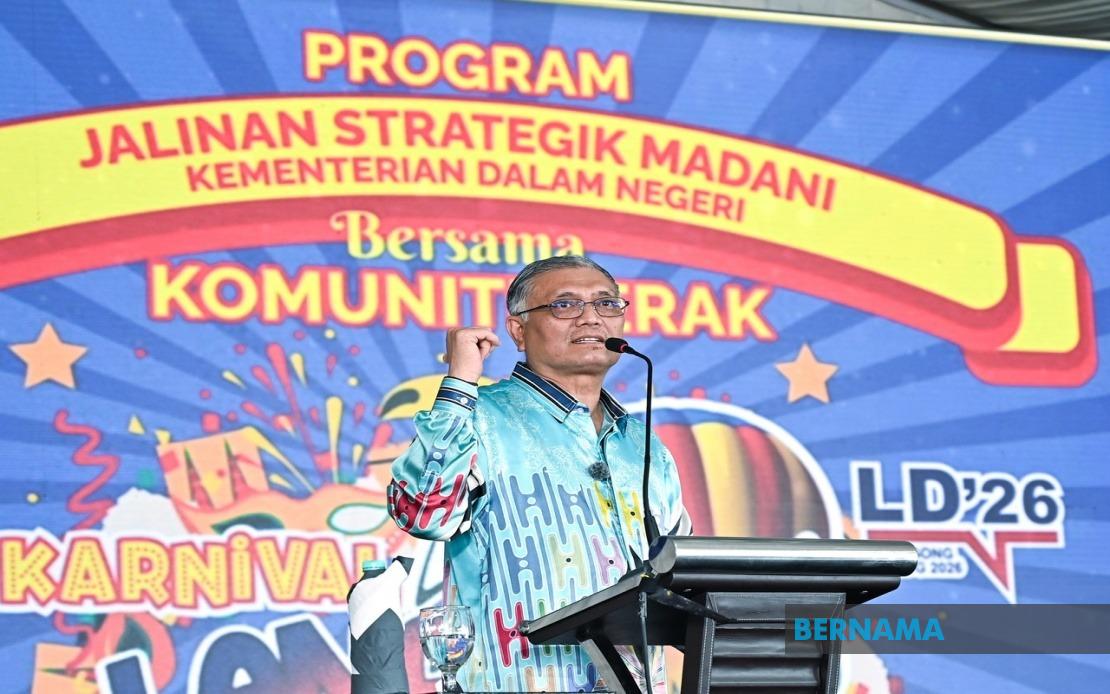
The Home Ministry's MADANI Strategic Partnership Programme launched a two-day community engagement initiative in Lenggong, reflecting the government's broader effort to decentralise access to public services and strengthen ties between security agencies and rural communities. Held at Dataran Lenggong, the programme represented a deliberate shift towards bringing ministerial services to citizens rather than requiring residents to travel to urban centres, addressing longstanding accessibility challenges in peripheral regions.
Deputy Home Minister Datuk Seri Dr Shamsul Anuar Nasarah, who also represents Lenggong as Member of Parliament, positioned the initiative as a cornerstone of the ministry's commitment to democratic engagement. He underscored that the programme functioned as a two-way dialogue mechanism, enabling security agencies to receive direct feedback from grassroots communities while simultaneously allowing residents to update personal records, seek guidance, or file complaints without bureaucratic delays. This accessibility dimension carries particular significance for rural populations who often face geographic and logistical barriers when interacting with federal agencies.
The event schedule encompassed diverse activities designed to appeal across demographic segments. Religious lectures provided spiritual engagement, while children participated in colouring competitions and creative performances, deliberately incorporating family participation to normalise interaction with government institutions. This multi-generational approach suggests a strategic recognition that trust in public institutions develops incrementally through repeated positive encounters, particularly when experiences occur within community settings rather than formal bureaucratic environments.
The Royal Malaysia Police, Immigration Department of Malaysia, and National Anti-Drugs Agency operated dedicated service counters throughout the event, reportedly generating substantial public interest. The concentration of multiple agencies within a single venue reduced transaction costs for residents and facilitated cross-agency awareness, allowing citizens to understand the full spectrum of services available beyond their immediate needs. Such consolidation proves particularly valuable in communities lacking permanent government office infrastructure.
Recreational components anchored the programme's public health messaging. Approximately 1,190 participants engaged in Fun Ride and Fun Run activities organised jointly by the People's Volunteer Corps and the National Anti-Drugs Agency, traversing villages within Lenggong's immediate vicinity. These activities served dual purposes: promoting physical wellness while simultaneously embedding government agencies within community leisure experiences, thereby softening the perception of law enforcement and security institutions as purely regulatory bodies.
Lenggong's designation as a UNESCO World Heritage Site added cultural resonance to the programme's design. The routing of recreational activities through heritage landscapes elevated the event beyond pure civic engagement, intertwining government accessibility initiatives with tourism promotion and cultural pride. This positioning reflects recognition that rural development strategies must integrate multiple policy objectives, combining security, health, tourism, and community development within cohesive programming.
The emphasis on addressing crime, drug abuse, and grassroots security challenges indicated that the programme extended beyond service delivery into substantive policy consultation. By creating informal channels for community members to articulate security concerns directly to relevant agency personnel, the initiative acknowledged that centralised policy formulation often overlooks locally-specific challenges. Perak residents, particularly those in peripheral districts like Lenggong, possess contextual knowledge regarding trafficking routes, substance abuse patterns, and community vulnerabilities that enriches agency understanding of regional security dynamics.
The programme's timing and structure reflect broader Malaysian governance trends emphasising inclusivity and decentralised service provision. Rather than positioning government primarily through formal institutional channels, the MADANI initiative reframed ministerial presence as community-embedded, approachable, and responsive. This representational shift carries implications for citizen confidence in institutions, particularly in constituencies where geographic distance historically created perceptions of government indifference.
For Perak specifically, the initiative demonstrated commitment to bridging urban-rural divides in service access. The state's topography and population distribution patterns have historically concentrated government infrastructure in central areas, marginalising communities in valleys and highland regions. By selecting Lenggong as a programme venue, the ministry acknowledged these structural inequalities and attempted remedial action through mobile service delivery.
The integration of voluntary organisations, particularly RELA, alongside formal security agencies demonstrated broader governance collaboration models. Volunteer corps bring community legitimacy and local knowledge that complement institutional authority, creating hybrid service-delivery networks more responsive to regional contexts than centralised bureaucracies alone. This collaborative approach suggests institutional recognition that sustainable community engagement requires multiple stakeholder participation rather than top-down implementation.
The programme's reception metrics, indicated by encouraging visitor engagement at service counters and substantial recreation participation rates, suggest resonance with community preferences for accessible, locally-based government interaction. However, sustainability remains crucial; programmes benefit communities only when followed by consistent service provision and responsiveness to feedback collected during engagement events. The initiative's long-term impact depends on whether the Home Ministry institutionalises mechanisms for translating community input into modified policies and expanded service accessibility within Lenggong and comparable regions.
For other Malaysian states, the MADANI programme offers a replicable model for community-centred governance. By combining service delivery, recreational engagement, and cultural recognition within integrated events, the Home Ministry demonstrated feasibility of decentralised accessibility without requiring permanent expanded infrastructure. As Malaysia continues developing its administrative framework, similar programmes addressing health, education, and economic services could extend the MADANI approach across multiple ministerial portfolios, progressively reshaping citizen-state interactions toward greater accessibility and responsiveness.

