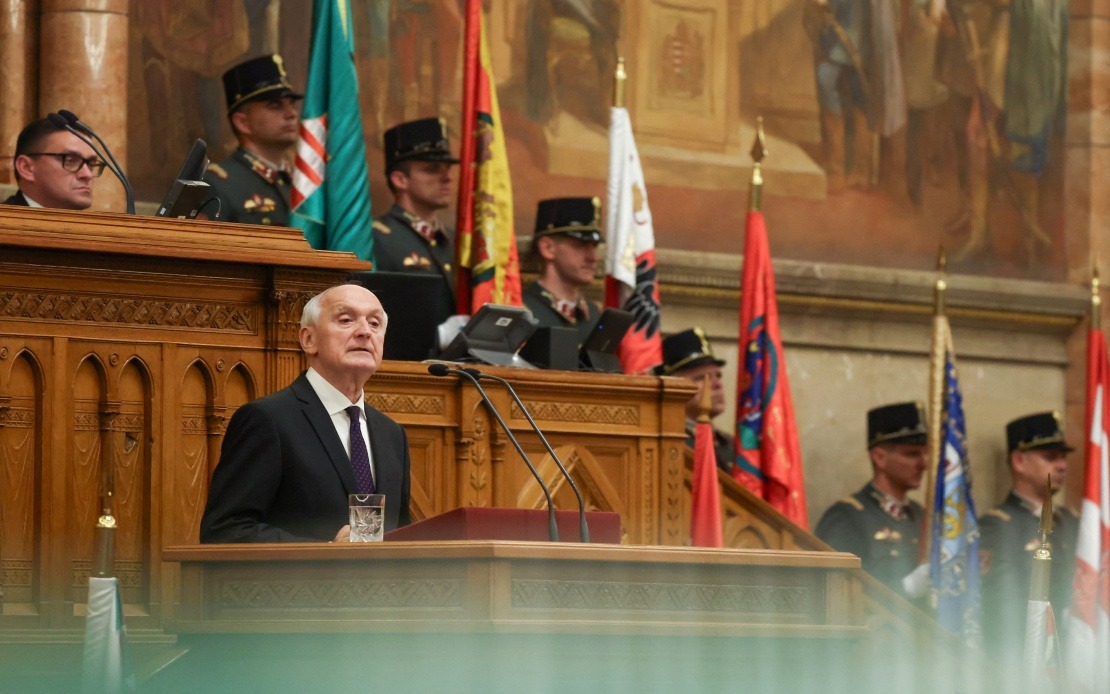
Andras Baka has formally assumed office as President of Hungary as of August 19, 2026, following his election by the Hungarian Parliament on August 11. Prime Minister Peter Magyar confirmed the transition on social media, offering congratulations to the incoming head of state and expressing hopes for his success and principled leadership throughout his tenure in what remains a constitutionally charged position within Hungarian politics.
Baka brings extensive judicial experience to the presidency, having previously served as president of Hungary's Supreme Court from 2009 to 2011. His earlier tenure in this position concluded during a period of significant institutional reform, when the judicial system underwent sweeping restructuring under the administration of former Prime Minister Viktor Orban. The circumstances surrounding his departure from that role underscore the turbulent nature of Hungarian judicial politics during that era, with Baka declining to remain in position as the country's highest court was fundamentally restructured.
Before taking on his domestic judicial responsibilities, Baka spent formative years working at the European Court of Human Rights in Strasbourg, where he developed deep expertise in international human rights jurisprudence and constitutional interpretation. This background in European legal institutions shaped his approach to judicial matters and his understanding of Hungary's obligations within the broader European legal framework, experience that informed his subsequent career trajectory within Hungary's domestic system.
Following the 2011 Supreme Court reform, Baka transitioned to leadership of the Hungarian Curia, the institution created to replace the previous court structure. He served as chairman of this reformed body from 2012 until 2020, maintaining judicial office throughout a period of considerable debate regarding judicial independence and institutional design within Hungary. His eight years directing the Curia positioned him as a prominent figure within the Hungarian judiciary during years of significant constitutional and political contestation.
The presidential election itself proved contentious within Hungarian political circles. Opposition parties, including Fidesz and the Christian Democratic People's Party, chose to boycott the parliamentary vote in protest against constitutional amendments that had removed the previous president, Tamas Szujok, from office. This boycott reflects deeper divisions over constitutional processes and the proper mechanisms for removing sitting heads of state, disagreements that continue to characterize Hungarian political debate.
For Malaysian and Southeast Asian readers, Baka's appointment illustrates challenges facing judicial independence and constitutional stability in democratic systems. Hungary's experience demonstrates how reform of judicial institutions can become entangled with political competition, particularly when different governmental administrations hold divergent views about proper institutional design. The tensions surrounding Baka's elevation highlight questions about whether judicial leadership should maintain distance from partisan political movements or whether close alignment with governing coalitions represents an unavoidable feature of democratic governance.
The boycott by opposition parties underscores fractures within Hungary's political establishment regarding the legitimacy of constitutional amendments and presidential transitions. Such divisions, whether occurring in Central Europe or Southeast Asia, complicate institutional reform efforts and can leave incoming officials managing reduced consensus about their mandate and appropriate role. Baka's presidency therefore begins amid acknowledged political disagreement about the constitutional processes that brought him to office.
Hungary's institutional journey offers comparative lessons for nations managing judicial reform and constitutional change. The country's experience demonstrates that restructuring courts and modifying presidential selection methods can generate sustained opposition if opposition factions perceive such changes as serving narrow partisan interests rather than serving broader public constitutional interests. The question of whether reformed institutions maintain independence from political pressure remains central to evaluating such transitions' ultimate significance.
Baka's background combining Hungarian judicial experience with exposure to international human rights norms positions him to potentially bridge institutional and political divides, though his presidency begins with opposition parties withholding participation in his formal election. Whether his appointment ultimately contributes to reconstructing constitutional consensus or reinforces existing divisions within Hungarian politics will depend substantially on his approach to the presidency's ceremonial and diplomatic dimensions and his capacity to articulate a vision of judicial integrity transcending partisan competition.

