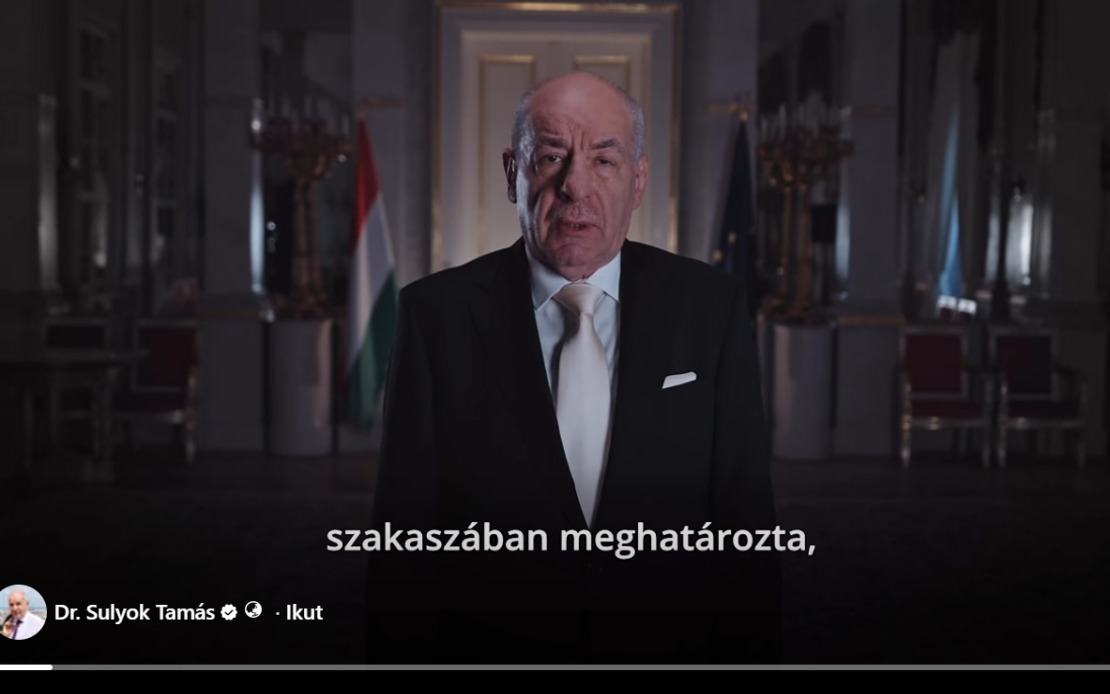
In a significant political reversal, Hungarian President Tamás Sulyok has agreed to countersign constitutional amendments that will force his departure from office, allowing Prime Minister Péter Magyar's reformist government to proceed with transformative institutional changes. Sulyok, who was elected with the backing of former Prime Minister Viktor Orbán before Orbán's ouster in April, initially hesitated before ultimately capitulating to parliamentary pressure and the threat of impeachment proceedings. The decision marks a watershed moment in Hungarian politics, signalling the effective end of Orbán's grip on the country's state apparatus and the beginning of what Magyar's administration characterises as a restoration of democratic safeguards.
The constitutional amendment passed parliament last Monday with sufficient support to force the issue, prompting Magyar to deliver an ultimatum to the president: countersign the changes within five days or face formal impeachment proceedings. Rather than pursue a constitutional legal challenge that experts indicated would likely fail on substantive grounds, Sulyok chose to comply. The president publicly acknowledged that while he believed parliament's decision to remove him was unconstitutional, he recognised that no viable legal mechanisms existed to contest it effectively. This capitulation, though reluctant, removes a significant institutional barrier to the government's reform agenda.
During the interim period until parliament elects a new head of state within thirty days, parliamentary speaker Agnes Forsthoffer will assume presidential responsibilities. In Hungary's system, the president is elected by members of parliament rather than through direct popular vote, a mechanism that has historically allowed the ruling party to exercise considerable control over the office. The vacancy created by Sulyok's removal beginning Monday will trigger this parliamentary election process, giving Magyar's coalition the opportunity to install a president more aligned with its reform objectives and less beholden to Orbán's political network.
Magyar has framed these constitutional modifications as fundamental to his government's mission of democratising Hungarian institutions. In a Facebook statement, the prime minister declared that the reforms would restore agency and choice to Hungarian citizens after years of what he characterised as systematic erosion of checks on executive authority. Magyar emphasised that the amendments would permit the state to function as a genuine servant of the people rather than an instrument of party control, and that the reclamation of common property—a reference to assets accumulated or controlled during the Orbán era—would become possible. This rhetoric underscores the administration's broader narrative of turning the page on what it portrays as a period of democratic backsliding.
Sulyok's grievance extended beyond his forced removal. In a video address distributed through Facebook, the departing president warned that Hungary's constitutional framework has been fundamentally compromised, with the presidency reduced to an office wholly dependent on the sufferance of the executive branch and parliament. He contended that the position now lacks any meaningful oversight or control function—a sharp indictment of how thoroughly executive authority has consolidated. This observation resonates with long-standing concerns among European Union observers regarding democratic deterioration in Hungary during the Orbán years, concerns that have repeatedly placed Budapest in tension with Brussels over rule-of-law standards and institutional independence.
The constitutional court, which might theoretically have intervened to block or delay the parliamentary decision, was constrained by the nature of the challenge. Legal experts noted that any constitutional objection could have been mounted only on procedural or formal grounds, not on substantive constitutional principles. This limitation underscores how the amendment process itself had been structured or configured in ways that left little room for judicial obstruction once parliament had acted. The absence of a credible legal shield left Sulyok with no practical alternative to compliance.
For Malaysia and other Southeast Asian democracies, Hungary's institutional crisis offers cautionary lessons about the fragility of constitutional safeguards when concentrated executive power reshapes institutional relationships over time. The ease with which parliament was able to engineer the removal of a sitting president reflects how constitutional frameworks can be hollowed out through successive amendments and political manoeuvring, even within a formal democratic structure. The situation demonstrates that having elections and legislative chambers is insufficient to guarantee institutional independence if those bodies become captured or aligned with dominant political movements.
The Magyar government's stated commitment to restoring institutional checks and reclaiming state property also signals a potential reversal of patterns observed across parts of Central Europe, where ruling coalitions have systematically repositioned state agencies and resources to entrench their political advantages. Whether the new administration can genuinely insulate institutions from political manipulation remains an open question, particularly given that the parliamentary majority that engineered Sulyok's removal will also select his successor. The risk of substituting one form of presidential capture for another cannot be entirely discounted.
International observers, particularly within the European Union, will be watching carefully to assess whether the Magyar administration's reforms genuinely strengthen democratic institutions or merely redistribute power among different factions. The speed with which constitutional amendments have been enacted and implemented will itself be noted, as will questions about whether adequate deliberation accompanied these changes. The resolution of Hungary's institutional crisis will have implications not only for Hungarian democracy but also for regional stability and the coherence of democratic norms across the European Union.

