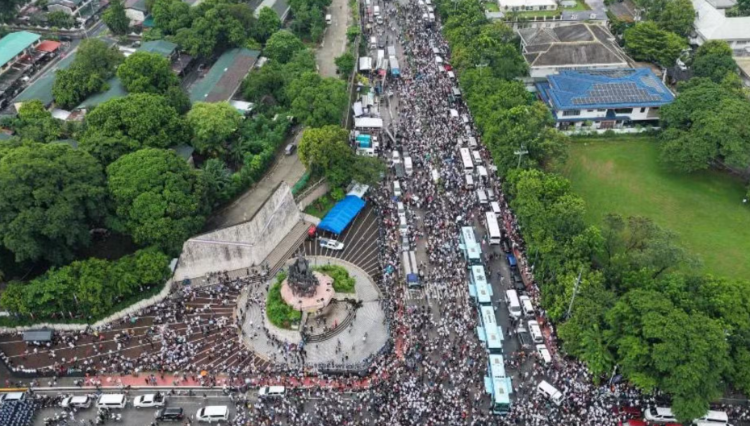
The Iglesia Ni Cristo demonstrated its considerable organisational muscle on Tuesday when tens of thousands of church members converged on Manila's main thoroughfare, EDSA, to defend one of their own facing serious criminal charges. The massive show of force paralysed the capital's rush hour traffic for several kilometres in multiple directions, underscoring the political clout wielded by the sect and its leadership over a disciplined membership estimated in the millions across the Philippines and abroad.
At the heart of the controversy is Senator Rodante Marcoleta, a prominent church member and staunch ally of Vice President Sara Duterte, who faces impending graft charges stemming from allegations that he failed to properly declare 75 million pesos—equivalent to roughly 1.2 million US dollars—in unspent election campaign funds. Government ombudsman Jesus Remulla announced the charges on Monday, triggering the immediate mobilisation of the Iglesia Ni Cristo's grassroots network. The timing could hardly be more consequential, arriving just as Duterte herself braces for a Senate trial beginning next week that threatens her position as the country's second-highest executive.
The intersection of religious organisation and electoral politics has long characterised Philippine democracy, and the Iglesia Ni Cristo represents perhaps the clearest and most disciplined example of this phenomenon. The sect's support has historically proven decisive during critical political moments, and its leadership demonstrated that institutional capability anew by assembling thousands on minimal notice. Police estimated the crowd at 8,000 at midday, with expectations that numbers would swell significantly as the day progressed, particularly during evening hours when more people could join after work.
Official messaging from the church framed the protest not as partisan defence of a single politician but as a principled stand against what it characterised as selective justice. Iglesia Ni Cristo spokesman Edwil Zabala, speaking through a Facebook video address, positioned the rally as demanding transparency and equal treatment before the law. The rhetorical strategy attempted to elevate the issue beyond Marcoleta's individual circumstances, instead casting the charges as symptomatic of broader injustice and political persecution. "We want to let them know that selective justice is an injustice and we will not remain silent," Zabala stated, a formulation that implicitly aligned the church's institutional interests with broader claims about democratic accountability.
Marcoleta's significance to the Duterte faction extends far beyond his position as a senator. Observers across the political spectrum regard him as virtually assured to vote against conviction when Duterte's trial reaches its crucial sentencing phase. With 16 votes required in the 24-member Senate to remove the Vice President and permanently bar her from elected office, Marcoleta's locked-in opposition represents a critical backstop for Duterte's remaining political survival. The timing of the charges—arriving just before a trial that could determine her political future—inevitably invites accusations of political manipulation from Duterte's supporters, regardless of the charges' actual merit.
The broader context reveals a Duterte political operation beleaguered on multiple fronts. Senator Jose "Jinggoy" Estrada, another Duterte loyalist, faces separate charges related to a massive corruption scandal involving bogus flood control projects that sparked genuine public outrage. Even more precarious is Senator Ronald "Bato" Dela Rosa, who fled into hiding to evade arrest on an International Criminal Court warrant concerning alleged extrajudicial killings during Rodrigo Duterte's bloody drug war. These cascading legal crises suggest a political movement in genuine distress, with its remaining allies increasingly isolated.
The Iglesia Ni Cristo's decision to mobilise massive protests also reflects the church's own strategic calculations regarding its political position. The organisation demonstrated comparable mobilising capacity in November by rallying hundreds of thousands to demand accountability over a spiralling flood control scandal—ironically positioning itself as demanding justice. That same month, many speakers at Iglesia Ni Cristo events directed blame toward President Ferdinand Marcos, then later in January, the church organised another massive Manila rally explicitly opposing Duterte's impeachment. This oscillation between appearing to demand accountability and visibly protecting Duterte allies reveals the church's fundamental interest in preserving political influence with whoever holds power.
The paralysis of Manila traffic on Tuesday afternoon sent a message beyond the senator's immediate legal predicament. The disruption affected ordinary workers, students, and commuters, potentially poisoning public sentiment toward both the Iglesia Ni Cristo and the Duterte faction. President Ferdinand Marcos notably cancelled a planned luncheon with foreign press to monitor the unfolding situation, treating the religious demonstration as a matter of sufficient consequence to disrupt his official schedule. The gesture underscored the event's political significance while demonstrating Marcos's concern about emerging coordination between the weakened Duterte faction and the Iglesia Ni Cristo.
For Malaysian observers monitoring Philippine politics, the episode illustrates how religious organisations embedded within partisan networks can mobilise populations at critical constitutional moments. The intersection of Sara Duterte's impeachment trial, her previous alliance rupture with Marcos, and the Iglesia Ni Cristo's calculated defence of Marcoleta demonstrates the degree to which religious identity and factional loyalty intersect across Southeast Asian democracies. The incoming Senate trial will reveal whether such demonstrations meaningfully influence senatorial behaviour or merely express underlying organisational capacity without shifting political outcomes.

