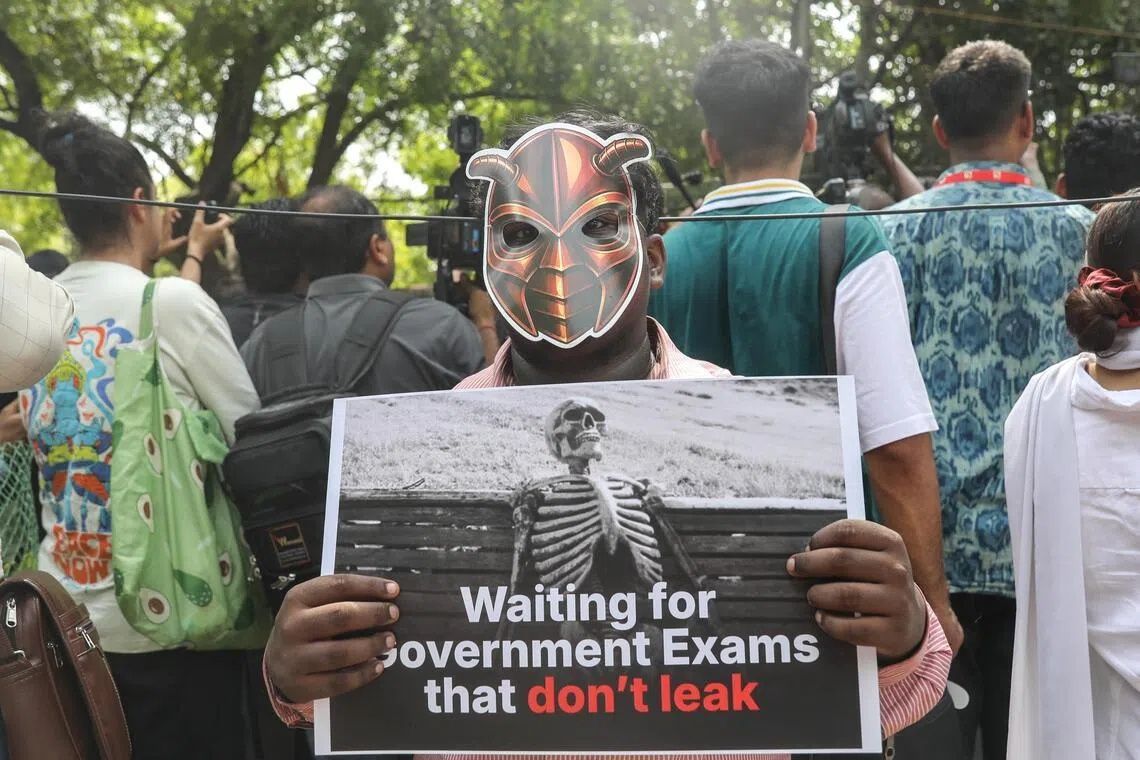
India's medical education system faced a critical juncture on Sunday as 2.2 million aspiring doctors entered examination halls across the country for a retake of the National Eligibility cum Entrance Test, one of the world's most competitive qualifying exams. The retest came after authorities scrapped the previous administration in May following a massive security breach that exposed exam questions to candidates before the official sitting, igniting fierce public anger and demanding calls for institutional accountability.
The original examination failure represents more than a procedural mishap; it exposed fundamental vulnerabilities in India's testing infrastructure at a moment when educational equity has become a flashpoint for broader public discontent. The leak triggered widespread youth protests and prompted Indian media outlets to document cases of teenage suicides linked to the scandal, underscoring the immense psychological pressure students face in a system where roughly 2.2 million candidates compete annually for slightly more than 100,000 undergraduate medical seats. This extraordinarily narrow pathway to professional success has created fertile ground for both legitimate anxiety and organised criminal networks seeking to profit from examination malpractice.
The government's response deployed unprecedented enforcement machinery, with authorities stationing more than 200,000 officials—encompassing police personnel, proctors, and administrative staff—across examination centres nationwide. Telecommunications authorities took the controversial step of restricting access to Telegram, the messaging application that investigation agencies identified as a primary conduit through which leaked question papers and advance answers circulated among cheating networks. The National Testing Agency, the semi-autonomous body responsible for administering the exam, articulated its determination to prevent recurrence through what it termed a "multi-layered security framework" incorporating cutting-edge technological safeguards.
These technological countermeasures reflected the sophistication of modern examination fraud. The framework incorporated biometric authentication systems requiring fingerprint or facial recognition before candidates could access test materials, effectively creating digital barriers against impersonation. AI-enabled camera surveillance within examination halls enabled real-time monitoring and pattern recognition to identify suspicious behaviour or communication attempts. Perhaps most novel, GPS tracking systems monitored question paper movements from printing facilities through distribution to examination centres, creating an electronic chain of custody designed to detect irregularities in the supply chain where previous leaks had occurred.
The examination began at 2 p.m. local time across multiple time zones, creating a logistical coordination challenge that demonstrated both the scale and complexity of India's educational apparatus. Behind this single exam lay decades of institutional growth: the NEET, as the test is colloquially known, has become the exclusive gateway to India's medical colleges, replacing a fragmented system of state-level examinations that previously allowed regional variations. This centralisation aimed to standardise quality and meritocratic fairness but inadvertently concentrated stakes and opportunities for fraud on a single high-profile event.
Investigative authorities have identified a chemistry lecturer as the alleged kingpin orchestrating the leak, suggesting that insider knowledge held by educational professionals proved critical to the breach. This revelation pointed toward a systemic challenge: security measures protecting external access to examination materials offered limited protection against compromised individuals within the testing apparatus itself. The involvement of a chemistry educator—someone with credibility and legitimate access to educational circles—illustrated how examination fraud operates not merely as a technical hacking problem but as a corruption network entangling educational institutions themselves.
Telegram's founder Pavel Durov publicly disputed the efficacy of the government's ban on his platform, arguing that restricting a single messaging application would prove ineffectual given that "leaks just moved to other apps." His observation highlighted a fundamental asymmetry in the security calculus: authorities could only control endpoints and platforms, whereas organisers of cheating networks retained flexibility to shift communications to alternative channels. Durov's counterargument that the underlying problem lay with "insiders who leaked the exam materials" rather than with the applications used to distribute them offered an uncomfortable truth—that preventing institutional corruption required addressing root causes rather than merely disrupting communications infrastructure.
The scandal extended beyond the medical entrance examination into neighbouring domains of India's educational system, compounding public frustration and lending momentum to demands for systemic reform. A separate controversy engulfed the marking system for tests administered to nearly two million high school students, where allegations emerged of incorrect grades or examination results assigned to wrong candidates. These parallel failures suggested not isolated malfeasance but systemic vulnerabilities pervading India's testing bureaucracy, prompting Indian parents and students to question whether centralised, high-stakes examination systems could function reliably at such massive scale.
The political fallout proved immediate and unprecedented. Public anger spawned the satirical "Cockroach People's Party," a social media movement that accumulated millions of followers within weeks of its May launch. The movement explicitly demanded the resignation of Education Minister Dharmendra Pradhan, transforming the examination scandal into a broader referendum on educational governance and ministerial competence. This phenomenon reflected how examination failures, particularly those affecting millions of students competing for limited opportunities, rapidly transcend technical policy debates and become expressions of public confidence in institutional leadership.
For Malaysia and neighbouring Southeast Asian nations, India's examination crisis carries instructive lessons about the challenges of scaling high-stakes testing systems across continental populations. Malaysia's own university entrance systems and professional licensing examinations, while operating at substantially smaller scales, face comparable pressures to maintain security and integrity while accommodating growing candidate volumes. The Indian experience suggests that technological solutions, while necessary, prove insufficient without addressing institutional vulnerabilities and insider threats that plague large bureaucratic systems.
The retest represented an attempt to restore institutional credibility through enhanced procedural rigour rather than addressing underlying structural questions about whether examination-dependent systems can equitably allocate opportunities within societies featuring vast disparities in access to preparation resources. The temporary ban on Telegram and deployment of biometric systems conveyed governmental resolve but did little to address why 2.2 million candidates competed so intensely for 100,000 positions, a ratio that makes examination fraud economically rational from the perspective of aspiring candidates and their families facing limited alternative pathways to professional advancement.

