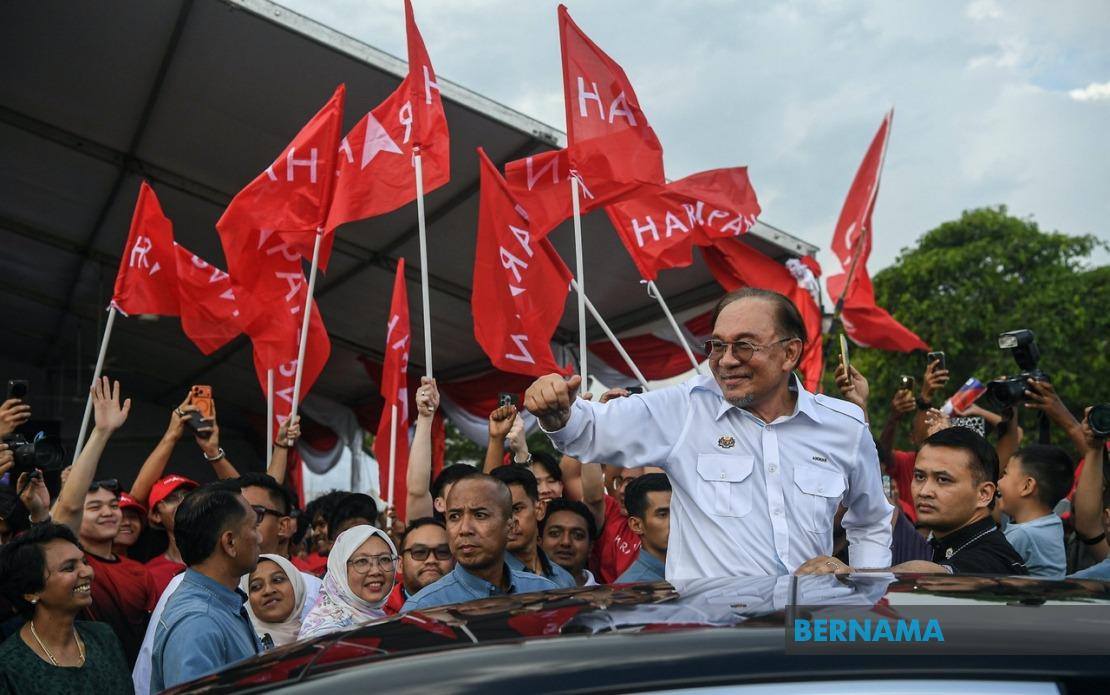
As Johor prepares for its 16th state election, Dr Gunaraj George, a prominent voice within PKR's central leadership, has mounted a direct appeal to the Indian community to evaluate the ruling coalition's record rather than fall prey to conventional political messaging. Speaking in Johor Bahru, Gunaraj framed the forthcoming ballot as a moment for voters to move beyond race-centric politics and assess which government delivers tangible improvements to daily life—a rhetorical shift that reflects broader efforts by Pakatan Harapan to expand its appeal beyond traditional support bases.
The concept of "Nambikei," or confidence, sits at the heart of Gunaraj's argument. He contends that Prime Minister Datuk Seri Anwar Ibrahim's leadership, underpinned by the Malaysia MADANI framework, has rekindled faith among Malaysians from all communities by championing unity, fairness and genuine opportunity. This messaging aims to counter narratives suggesting that the current government has neglected minority interests—a persistent anxiety in Malaysian electoral politics. For the Indian community specifically, which has historically oscillated between major coalitions based on perceived delivery of welfare and political voice, such reassurances carry strategic weight.
Gunaraj's critique of "old political tactics" and "empty promises" appears to reference both opposition strategies and the longstanding pattern of electoral promises made to Indian voters that have yielded limited results. He positioned Anwar's political trajectory as fundamentally distinct: a leader who has consistently advocated for merit-based governance and cross-ethnic solidarity rather than communal favours. Whether this framing resonates will partly depend on how voter sentiment has shifted after three years of Unity Government administration, particularly among those who have experienced economic pressures despite broader policy announcements.
The government's investment in Indian community-focused programmes forms the empirical backbone of Gunaraj's case. The Malaysian Indian Community Transformation Unit (MITRA) received an additional RM50 million on top of its existing RM100 million budget, signalling renewed commitment to institutional infrastructure supporting the community. Tekun Nasional, a microfinance scheme targeting entrepreneurs, was boosted to RM100 million, while Amanah Ikhtiar Malaysia (AIM) received RM100 million earmarked for women entrepreneurs—a deliberate signal that community development extends across gender lines. In January, the government unveiled RM50 million specifically for Tamil school development, addressing a longstanding concern about the fate of vernacular education in Malaysia.
These allocations carry particular significance in the Malaysian context, where fiscal commitments are frequently scrutinised as indicators of governmental sincerity. The cumulative scale of these investments—totalling several hundred million ringgit—represents a substantial deployment of resources toward Indian community priorities. Yet the translation of budgetary commitments into tangible improvements in entrepreneurship rates, school infrastructure quality or household incomes remains contested terrain, and Gunaraj's statement does not provide data on absorption rates or outcomes achieved through these funds.
Gunaraj's framing of the Indian community as increasingly sophisticated political actors reflects a broader trend in Malaysian electoral discourse: the notion that voters are growing weary of identity-based appeals and instead demand policy substance and demonstrable performance. This characterisation may overstate actual shifts in voter behaviour, but it signals Pakatan Harapan's attempt to elevate the conversation beyond grievance-mongering. For the Indian community in Johor, a state with substantial Tamil, Telugu and Malayali populations concentrated in urban and manufacturing-dependent areas, such messaging can resonate if linked to employment generation, skills development and business opportunity—areas where government initiatives are more easily evaluated.
The Malaysia MADANI agenda itself represents an attempt to rebrand governance around inclusivity, though critics argue it remains more rhetorical than substantively transformative. Gunaraj emphasised that Anwar believes Malaysia's complex, modern society cannot be adequately governed through race-based politics alone, requiring instead integrated policy solutions addressing cost of living, education quality, job creation and social protection. This philosophy contrasts sharply with opposition messaging, which often appeals to communal sentiment. Whether voters perceive MADANI as genuine reimagining or sophisticated repackaging of the same system will influence electoral outcomes.
Pakatan Harapan's candidate distribution across Johor's 56 seats—20 from PKR, 19 from Amanah and 17 from DAP—reflects internal coalition mathematics and organisational strength. For the Indian community, representation and candidate quality matter considerably; voters assess not merely party platforms but the individuals who will advocate for their interests in state assembly. Gunaraj did not address specific candidates or community representation within PH's slate, a potential weakness in an appeal intended to mobilise minority voters.
The broader Southeast Asian context suggests that Indian minority communities across the region navigate similar tensions between seeking targeted support for community welfare and desiring integration within broader inclusive governance frameworks. Malaysia's Indian community, constituting roughly 7 percent of the national population, faces particular pressures as the economy shifts toward higher-skill sectors where educational quality and opportunity access prove decisive. Government investments in Tamil schooling and entrepreneurial support thus address real vulnerabilities, though their adequacy remains debatable.
Gunaraj's appeal ultimately rests on a gamble: that Indian voters in Johor will prioritise demonstrated government performance and policy commitments over alternative inducements or opposition promises. This requires convincing voters that past three years of Unity Government administration have genuinely improved community welfare and that Pakatan Harapan offers superior governance compared to potential alternatives. The statement provides the coalition's argument but cannot resolve the fundamental uncertainty voters face: whether further backing of the current coalition will yield better outcomes than change.
The strategic emphasis on "Nambikei" and confidence signals that Pakatan Harapan recognises a trust deficit among Indian voters and seeks to rebuild it through performance narratives. Whether this succeeds depends partly on independent validation of programme effectiveness—information that voters often struggle to access in Malaysian electoral contexts dominated by partisan claims. As Johor's election approaches, the Indian community's voting patterns will offer a crucial indicator of whether cross-ethnic coalition-building and performance-based governance messaging can genuinely reshape Malaysian electoral dynamics or whether communal considerations remain determinative.

