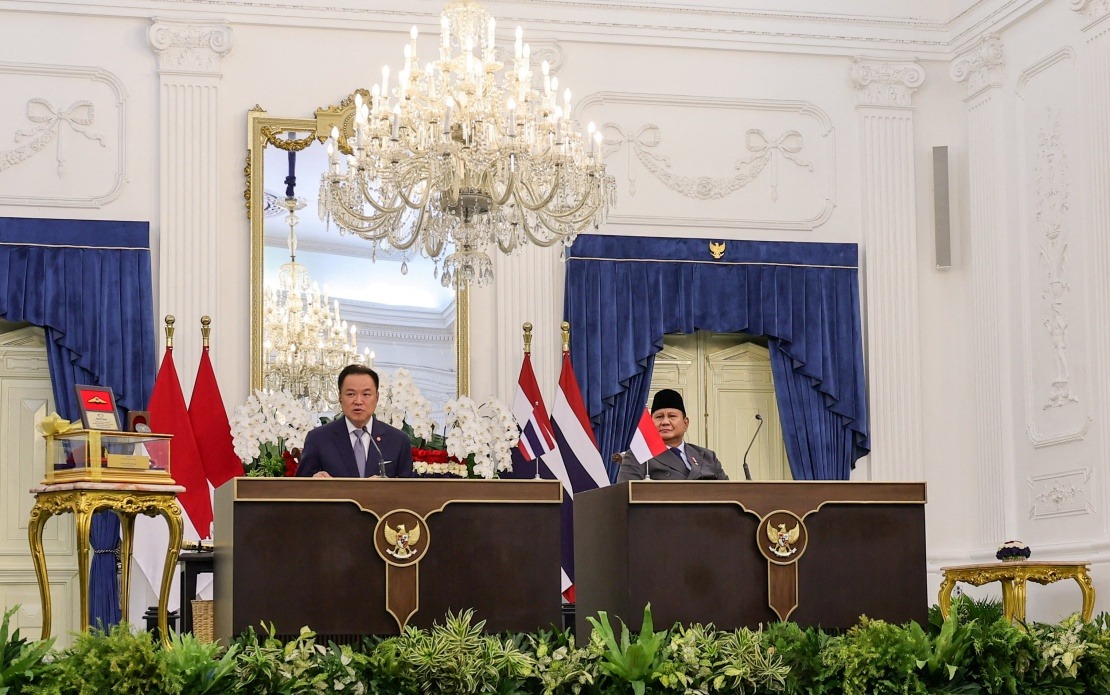
Indonesian President Prabowo Subianto and Thai Prime Minister Anutin Charnvirakul have reaffirmed their countries' commitment to advancing peace in Myanmar through ASEAN mechanisms during high-level talks in Jakarta, signalling a coordinated regional approach to one of Southeast Asia's most intractable conflicts. The second Leaders' Consultation between the two nations underscores the strategic importance of bilateral engagement in driving the bloc's efforts to implement the Five-Point Consensus, the ASEAN framework aimed at halting violence and restoring dialogue among Myanmar's competing factions.
Peace restoration in Myanmar remains a central preoccupation for Southeast Asian capitals, particularly for Indonesia and Thailand given their geographic proximity and stakes in regional stability. The Five-Point Consensus, adopted by ASEAN in April 2021, calls for an immediate ceasefire, dialogue between all parties, humanitarian assistance delivery, mediation by ASEAN envoys, and technical support. While progress has been fitful since the military coup in February 2021, Indonesia and Thailand's renewed emphasis on advancing this framework through what they term "inclusive dialogue" reflects the bloc's recognition that sustainable peace requires engagement with diverse stakeholders, not merely government and military actors. This inclusive dimension carries particular weight given the proliferation of armed resistance movements across Myanmar since the coup.
The Jakarta gathering, held at Merdeka Palace, represents a significant moment in Thailand's diplomatic calendar. Prime Minister Anutin's visit marks his inaugural official trip to Indonesia since assuming office as Thailand's 32nd prime minister in September 2025, and notably constitutes the first visit by a Thai premier to Indonesia in 15 years. This extended gap underscores how Myanmar's instability has recalibrated bilateral priorities within ASEAN, forcing member states to recalibrate their engagement schedules around regional crisis management. Prabowo's emphasis on "maintaining ASEAN unity and centrality" during the press conference reflects broader anxieties within the grouping about fragmentation over Myanmar policy, with some members sympathetic to the junta and others increasingly frustrated with slow progress on the consensus roadmap.
Beyond Myanmar, Jakarta and Bangkok have identified transnational crime as a critical security challenge demanding coordinated action, particularly the epidemic of online scam syndicates that have victimized thousands of Southeast Asian nationals. Indonesia reports that Thailand has facilitated the repatriation of nearly 1,000 Indonesians duped by such networks, illustrating the scale of organized criminal operations exploiting cross-border vulnerabilities. These scam rings typically exploit economic disparities across the region, targeting citizens in wealthier nations while operating call centres in countries with weaker law enforcement or political instability. The two governments have committed to deeper intelligence sharing, joint investigations, financial tracking mechanisms, and enhanced law enforcement coordination to dismantle these networks, recognizing that no single nation's security apparatus can effectively counter operations spanning multiple jurisdictions and utilizing sophisticated digital obfuscation techniques.
A notable institutional innovation emerging from these talks is the proposed Transnational Referral Mechanism, designed to accelerate identification, protection, and dignified repatriation of victims of cross-border crimes. Such mechanisms represent evolution in ASEAN security cooperation beyond traditional military and intelligence frameworks, addressing the humanitarian dimensions of transnational criminal activity. For Malaysian readers, this development carries direct relevance given Malaysia's own experience with regional scam networks and human trafficking operations, suggesting that bilateral Indonesian-Thai progress might inform multilateral ASEAN protocols that could enhance protections for Malaysian citizens abroad.
Thailand's proposal for expanded defence industry collaboration, including the supply of 36 amphibious wheeled armoured vehicles to Indonesia, indicates a deepening of military-technical partnerships between the two nations. Such arrangements reflect confidence in bilateral security relations and suggest efforts to diversify defence procurement within ASEAN rather than relying predominantly on external powers. The vehicles, specialized for terrain traversal in archipelagic and flood-prone environments, underscore Thailand's understanding of Indonesia's specific operational requirements and represent a practical dimension to Southeast Asian military interoperability.
The two nations have also committed to regular joint military training exercises and maritime security cooperation, domains where Indonesia and Thailand have complementary interests given their respective positions astride critical sea lanes and their shared concerns about piracy, smuggling, and territorial encroachment. Maritime security cooperation carries heightened importance as competition among major powers for influence in Southeast Asian waters intensifies, with Beijing's assertiveness in the South China Sea prompting littoral states to strengthen bilateral and multilateral maritime partnerships. Indonesia and Thailand's emphasis on this dimension signals their intent to maintain capacity and resolve to patrol their waters independently, a subtle but meaningful assertion of regional agency.
Combating wildlife trafficking represents an additional cooperation domain flagged by Prime Minister Anutin, connecting security cooperation to environmental preservation and international conservation frameworks. Southeast Asia serves as a critical transit corridor for illegal wildlife trade, with organized syndicates exploiting weak enforcement and corrupt officials across multiple jurisdictions. Thailand's reference to strengthening regional cooperation within ASEAN on this issue suggests these concerns are gaining traction among member states, potentially laying groundwork for more systematic bloc-level responses to wildlife trafficking networks that often overlap with other transnational criminal operations.
The timing of these bilateral consultations merits scrutiny in relation to broader ASEAN dynamics and Myanmar's civil conflict trajectory. With no immediate breakthrough in Myanmar peace efforts and violence continuing to displace populations and destabilize border regions, Indonesia and Thailand appear to be emphasizing what they can accomplish through focused bilateral cooperation while sustaining rhetoric about ASEAN-led solutions. This two-track approach—advancing shared security interests while maintaining commitment to collective ASEAN mechanisms—reflects pragmatic recognition that the bloc's consensus-based decision-making can constrain responses to crises requiring swift action or difficult trade-offs.
For Southeast Asia's strategic environment, this bilateral engagement signals that Indonesia remains committed to regional leadership on Myanmar even as it simultaneously pursues national security cooperation, while Thailand's elevated diplomatic profile in ASEAN affairs—indexed by hosting a Thai prime minister's first official Indonesia visit in 15 years—suggests Bangkok seeks greater prominence in shaping regional responses to transnational threats. Both nations' focus on crime syndicates and humanitarian protection mechanisms indicates that security cooperation in contemporary ASEAN increasingly encompasses non-traditional threats and victim-centred approaches alongside conventional military concerns. As Myanmar's crisis persists and transnational criminal networks adapt to enforcement pressures, the sustainability and effectiveness of Indonesian-Thai cooperation mechanisms will likely determine whether bilateral initiatives translate into measurable improvements in regional security and stability.

