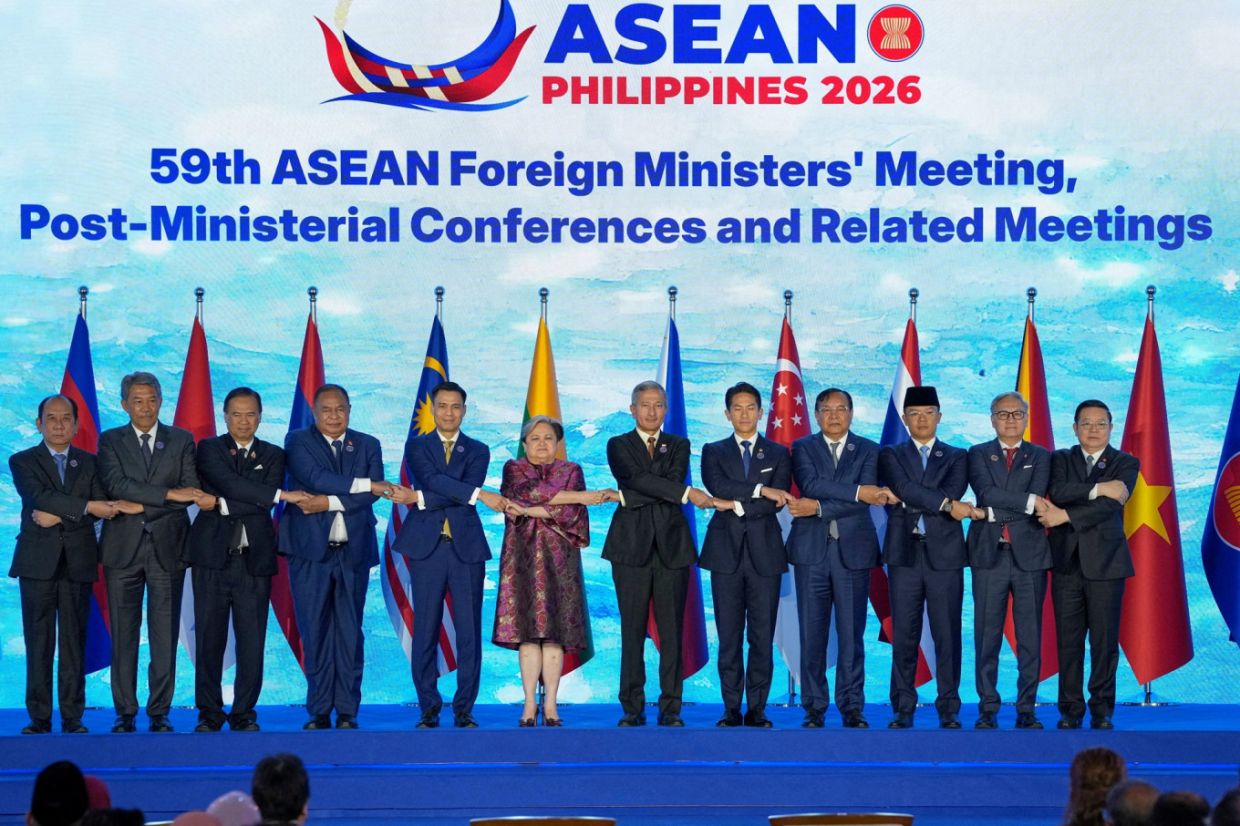
Indonesia has challenged Asean to move beyond rhetorical commitments and demonstrate genuine capacity to resolve regional crises, cautioning that the bloc's credibility hinges on its ability to convert agreements into measurable progress. The call came during the 59th Asean Foreign Ministers Meeting in Manila on Tuesday, where representatives from all 11 member states convened to align positions before engaging with external partners, signalling growing anxiety about the association's relevance amid a cascade of overlapping geopolitical shocks.
Indonesian Foreign Minister Sugiono articulated the tension facing Southeast Asia's premier regional grouping: mounting external pressures have created an opportunity for Asean to prove its institutional worth, yet deep internal divisions threaten to undermine its collective voice. He framed the moment as a test of whether Asean can operationalise the principles enshrined in its charter—political stability, economic prosperity, and social cohesion—when member states confront competing national interests and foreign powers wielding increasing economic leverage over the bloc.
The Middle East conflict emerged as an immediate concern during Tuesday's closed-door discussions, with ministers releasing a joint statement acknowledging the economic ripple effects sweeping across Southeast Asia. Beyond abstract acknowledgment, however, the statement revealed Asean's reactive posture: member states are merely discussing mitigation measures rather than coordinating a strategic response. For Malaysian and regional business interests, this passivity matters considerably. Disruptions to Hormuz Strait shipping, combined with energy market volatility, have already begun reshaping Southeast Asian trade patterns and investment flows in ways that individual nations cannot manage alone.
Perhaps more troublingly, data from Trade Data Monitor indicates the conflict is accelerating a structural shift in Asean's dependency relationships. The Philippines, serving as this year's chair, more than doubled solar panel imports from China during the first five months of 2024 compared to the same 2023 period—a trajectory mirrored across the region as nations scramble to secure alternative energy sources following Middle Eastern disruptions. This pivot toward Beijing for critical resources potentially weakens Asean's negotiating position precisely when member states should be unified on maritime governance issues, a paradox that Sugiono directly addressed.
The South China Sea Code of Conduct dispute exemplifies Asean's deepening credibility problem. For nearly a quarter-century, member states have negotiated frameworks to govern one of the world's most economically vital and militarily contested waterways, yet completion remains elusive. Sugiono's pointed statement—"Our people have waited 24 years for rules at sea. They should not wait for another year"—underscores frustration with the bloc's glacial pace on issues that directly affect Southeast Asian sovereignty and prosperity. The unspoken reality is that some member states benefit from the current ambiguity, while others suffer from it, creating incentive misalignment that institutional pressure alone cannot resolve.
The geopolitical context amplifies this vulnerability. As Asean members grow more economically dependent on China for alternative energy and critical imports, their leverage in Beijing negotiations diminishes correspondingly. A region already struggling to forge unified positions on the South China Sea faces an even steeper challenge when member states harbour divergent economic relationships with the disputant powers. Malaysia, Vietnam, and the Philippines have particular stakes in these negotiations, yet Indonesia's attempt to mobilise collective will depends on alignment among countries with fundamentally different strategic calculations.
Myanmar's ongoing civil crisis added another layer of complexity to Tuesday's discussions, with ministers dedicating a retreat session to reviewing progress on Asean's Five-Point Consensus peace roadmap. The exercise illustrated the bloc's institutional exhaustion: after months of engagement, fundamental disagreements persist over how to approach the military government in Nay Pyi Taw. Philippine Foreign Secretary Theresa P. Lazaro acknowledged that member states had proposed "progressive" views while skirting the fundamental question of whether Asean's consensus-based decision-making model remains compatible with contemporary crises requiring swift, sometimes controversial action.
The proposed review of the special envoy mechanism and assessment methodology for Five-Point Consensus implementation, scheduled for completion by November's leaders' meeting, represents modest procedural adjustment rather than strategic breakthrough. For Myanmar's suffering population and regional stability more broadly, incremental reforms to monitoring mechanisms offer limited practical benefit. Yet this measured approach reflects Asean's institutional constraints: member states with closer ties to Myanmar's junta resist measures that might provoke Naypyidaw, while others demanding stronger action accept diluted compromises to preserve bloc unity.
Sugiono's emphasis on Wednesday's engagement with external partners—including the United States, China, and Russia—hints at Asean's underlying dilemma. The bloc's relevance depends partly on demonstrating independent agency, yet addressing Middle East economic fallout, South China Sea governance, and Myanmar resolution increasingly requires external great power involvement. This dependency inversion, where external actors shape Asean's policy space rather than the reverse, represents a longer-term challenge to regional autonomy that the bloc has inadequately confronted.
The Manila meeting crystallised a broader Southeast Asian vulnerability: individual nations cannot independently manage globalised energy markets, great power competition, or transnational humanitarian crises, yet Asean's institutional architecture struggles to aggregate national interests into coherent regional strategy. Sugiono's challenge to "deliver promises" therefore extends beyond diplomatic rhetoric. It reflects Indonesia's concern that failure to demonstrate concrete results—whether on the South China Sea, Myanmar, or economic resilience—will further erode Asean's credibility and leave member states exposed to external pressures they lack individual capacity to resist.
For Malaysia and other Southeast Asian economies, the stakes are tangible. Unresolved maritime disputes create investment uncertainty, fragmented responses to Middle East disruptions increase energy costs and supply volatility, and Myanmar's instability generates refugee flows and regional instability that respect no borders. Asean's credibility crisis is ultimately a crisis of regional vulnerability, where the bloc's inability to convert commitments into outcomes leaves member states increasingly dependent on bilateral relationships with external powers—a trajectory that Indonesia has signalled it will attempt to reverse, even as structural constraints suggest such reversal may prove elusive.

