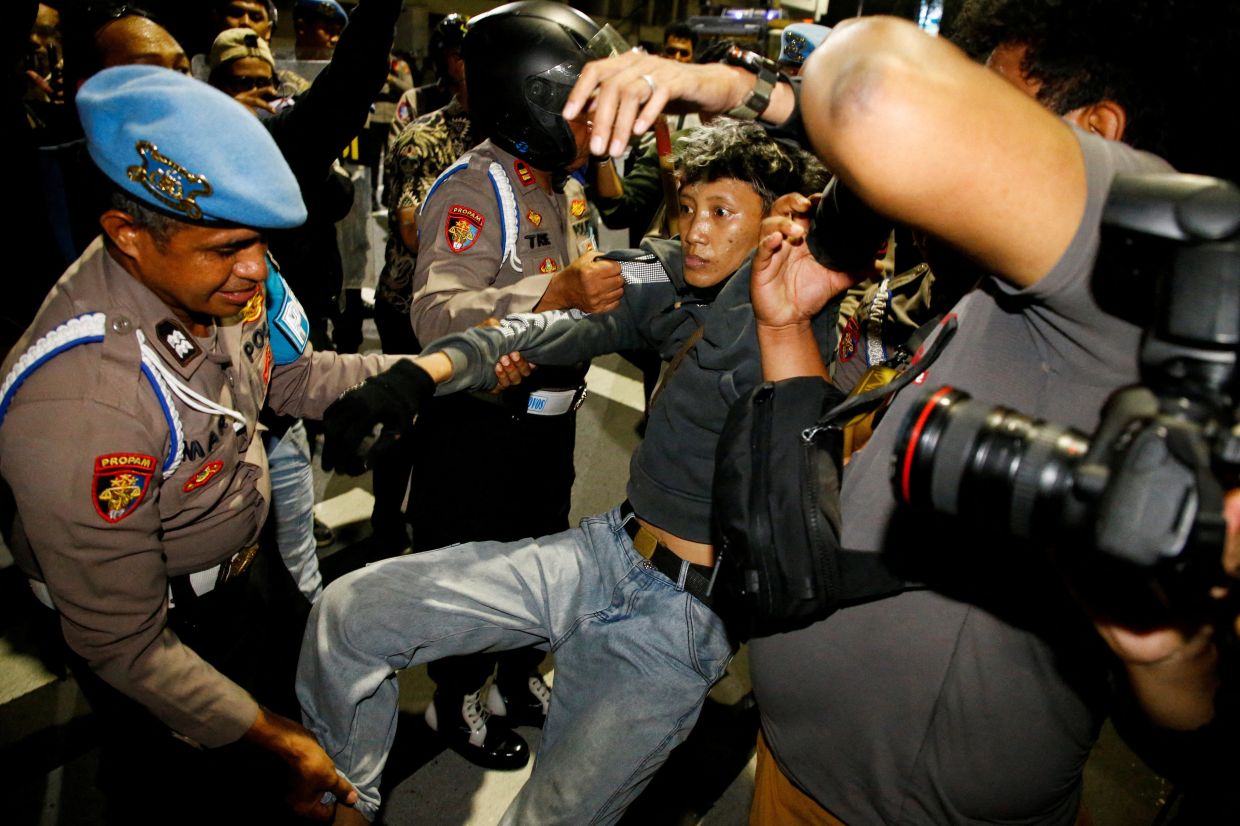
Indonesia's police have pressed charges against four individuals in connection with an anti-government demonstration held in Surabaya on Friday, marking the latest enforcement action against dissent over the government's recent fuel price adjustments. Surabaya police chief Luthfie Sulistiawan announced the charges on Sunday, describing the escalation as authorities' response to what police characterised as disruptive behaviour at the rally, which drew an estimated 100 participants to the vicinity of a government building in the country's second-largest city.
The protest centred on two significant policy decisions that have triggered widespread public discontent across Indonesia's urban centres. The first grievance concerns the government's decision to increase prices for non-subsidised petrol by approximately 30 per cent, a move authorities justified as necessary to reduce fiscal strain amid global energy market disruptions linked to Middle East geopolitical tensions. The second focuses on mounting criticism of a flagship free school meals initiative, which the government promoted as an instrument to combat childhood malnutrition but has instead become synonymous with mismanagement and health crises.
According to police accounts, some demonstrators engaged in behaviour that authorities deemed illegal, including hurling firecrackers and rocks toward government facilities. In response, Luthfie stated that officers deployed what he termed "firm actions" to break up the gathering. The police response saw the initial detention of 24 people on the day of the protest, though authorities subsequently released the majority without formal charges, reflecting a common pattern of mass arrests followed by selective prosecutions in Indonesian protest contexts.
The four individuals now facing charges stand accused of property destruction and assaulting police officers, allegations that carry potential criminal sanctions. Additionally, six detainees remain under investigation after authorities reportedly discovered drugs in their systems during processing. This dual-track approach—criminal charges for some coupled with drug-related investigations for others—illustrates how authorities sometimes employ multiple legal avenues to address protest participation.
Indonesia's particular vulnerability to fuel price fluctuations stems from its paradoxical position within global energy markets. Despite being a substantial oil-producing nation and Southeast Asia's largest economy, Indonesia imports more petroleum than it exports due to domestic consumption exceeding local production capacity. The government maintains a heavily subsidised fuel system intended to shield consumers from international price volatility, yet budgetary constraints force periodic adjustments. This month's 30 per cent increase represents authorities' attempt to reconcile fiscal sustainability with rising global energy costs exacerbated by regional conflicts.
The free school meals programme, officially positioned as a developmental priority addressing malnutrition among vulnerable youth, has become emblematic of governance failures. Since its launch, tens of thousands of individuals reported food poisoning incidents linked to the scheme, prompting partial suspension and triggering investigations into food safety protocols and potential corruption within procurement and distribution networks. The scandal has transformed what should have been a flagship social welfare initiative into a symbol of institutional dysfunction, further eroding public confidence in government competence.
Jakarta has emerged as the epicentre of coordinated student activism opposing both the fuel price increases and the beleaguered meals programme. Thousands of students have mobilised repeatedly to voice opposition, demonstrating that grievances extend beyond immediate economic impact to encompass broader concerns about governance quality and institutional accountability. The student movement's engagement reflects how discrete policy failures can catalyse sustained civic mobilisation when they intersect with youth interests and broader perceptions of state mismanagement.
The Surabaya charges must be understood within Indonesia's broader protest landscape, where demonstrations against government policies occur regularly but selective prosecution remains a contentious issue. International observers and human rights advocates have previously raised concerns about the proportionality of law enforcement responses to political expression, particularly regarding whether charges against protesters align with actual conduct or serve as a deterrent against future dissent. The charging of four individuals from a gathering of approximately 100 suggests authorities are employing focused prosecutorial strategies rather than mass criminalisation, though the selection criteria remain unclear.
For Malaysia and other Southeast Asian nations monitoring Indonesia's political stability, these events carry broader implications. Indonesia's governance challenges—particularly the combination of energy policy pressures, social programme failures, and protest management—reflect systemic issues shared across the region. As energy markets remain volatile and governments face fiscal pressures, similar fuel price adjustments may become necessary across Southeast Asia, potentially triggering comparable social unrest. Indonesia's approach to managing such dissent offers instructive lessons regarding the tension between maintaining public order and preserving space for legitimate political expression.

