President Prabowo Subianto's heavily publicised free nutritious meal scheme is facing a mounting credibility crisis as beneficiaries themselves question its value, with some mothers declaring they would rather abandon the assistance than continue receiving what they describe as inedible food. The controversy, initially driven by activist complaints about implementation failures, has now escalated to encompass the lived experiences of families on the ground, creating a groundswell of opinion that threatens the political viability of a programme budgeted at Rp 268 trillion (approximately US$18.74 billion) for 2026.
The turning point came when Nesti Nagari, a 29-year-old mother from Kediri in East Java, posted images on social media of her eight-month-old child's assigned meal—a lumpy white paste whose contents she could not identify. Her visceral reaction, "What mother would want to feed her child food like this?", struck a chord with thousands of readers. Rather than serve the meal to her infant, Nagari diverted it to her chickens, and the post subsequently accumulated over 11,000 likes within 24 hours. The incident proved galvanising: Nagari subsequently announced her rejection of the entire programme, reasoning that since she possessed the means to provide adequate nutrition independently, the government resources allocated to her family could be redirected toward more pressing needs such as education and healthcare infrastructure.
Nagari's stance is far from isolated. Diah Farika, a nursing mother in Semarang, Central Java, enrolled in the scheme since May, began documenting a consistent pattern of nutritional inadequacy across the meals provided to her. Her photographs showed portions she considered insufficient for proper child development, including unripe oranges and other items that appeared below accepted nutritional standards for infants and young children. When Farika raised these concerns with the nutrition fulfilment service unit (SPPG)—the decentralised kitchen infrastructure responsible for meal preparation—her complaints were dismissed rather than addressed. Like Nagari, Farika concluded that she would gladly accept a temporary halt to the programme if such a pause would permit comprehensive kitchen inspections and quality assurance measures overseen by the National Nutrition Agency (BGN).
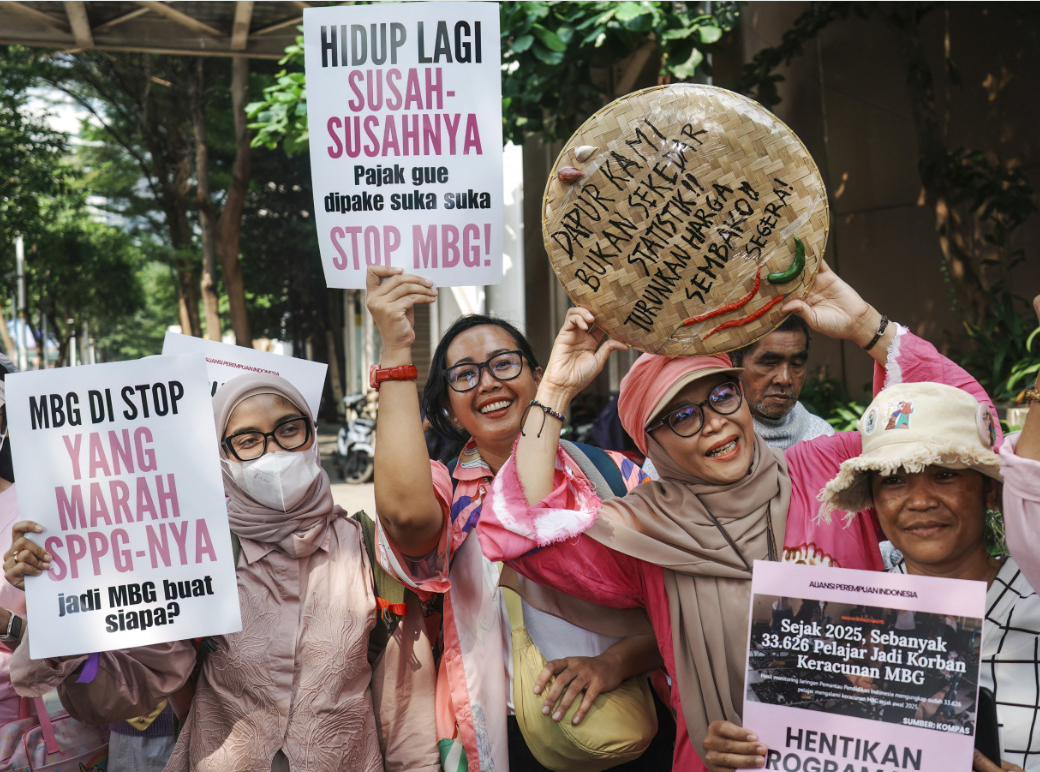
The willingness of beneficiaries to forfeit assistance rather than accept substandard provision represents a significant erosion of the programme's intended social legitimacy. Diah's observation that "the programme is good, but everything depends on the kitchen that manages it" points to a fundamental structural weakness: the scheme's success depends entirely on decentralised execution across some 27,000 kitchens, a sprawling network that appears to lack adequate oversight and quality control mechanisms. This vulnerability was thrown into sharp relief when dozens of women and rights activists, organised under the Indonesian Women's Alliance (API), conducted a public demonstration in Central Jakarta demanding that authorities suspend the entire initiative pending comprehensive review and remediation.
The institutional challenges are compounded by a recent corruption scandal involving former BGN leadership, which prompted the agency's new management to halt further expansion of the SPPG kitchen network. This suspension has sent ripples through the supply chain: investors who have reportedly sunk hundreds of billions of rupiah into establishing SPPG facilities have descended on BGN offices demanding clarity about the programme's future viability and seeking assurances regarding investment recovery should operations cease. Several kitchens temporarily shut down in early June owing to delayed government funding, though some have since resumed operations, adding another layer of uncertainty for dependent families.
MBG Watch, an independent oversight platform created by civil society organisations, has documented how these cascading failures have progressively undermined public confidence in the initiative. Isnawati Hidayah, a policy researcher at the Center of Economic and Law Studies (CELIOS) and initiator of the monitoring platform, articulated a pointed question that increasingly preoccupies taxpayers and beneficiaries alike: "What is this multi-billion-dollar budget actually for and who does it benefit?" This query cuts to the heart of programme legitimacy, suggesting that many Indonesians question whether funds are reaching intended recipients or being captured by intermediaries and service providers.
A CELIOS investigation has identified a fundamental targeting problem within the programme's beneficiary selection mechanism. The study estimates that approximately 34 percent of current recipients—roughly 61 million children and pregnant women—do not belong among the most economically vulnerable populations. Substantial numbers of families already possessing adequate nutritional access and economic stability have been enrolled, effectively misdirecting resources away from those facing genuine nutritional stress. This finding directly validates the concerns raised by beneficiaries like Nagari and Farika, who recognised that their own families did not warrant government assistance and that their inclusion represented an inefficient use of public money.
In response to mounting public criticism, the BGN has initiated a targeted recalibration of its beneficiary roster. The agency announced the removal of 76 schools across Java from the programme, affecting more than 39,000 children and pregnant women deemed capable of meeting nutritional needs independently. BGN deputy head and spokesperson Agustina Arumsari framed this contraction as a positive step toward "refocusing beneficiaries so the programme can be delivered effectively to Indonesian citizens who truly need government intervention." Simultaneously, the agency is implementing austerity measures, including termination of daily incentive payments to kitchens during non-operational periods and evaluation of kitchens assessed as underperforming.
The programme's predicament carries significant implications for broader policy discourse across Southeast Asia. Indonesia's investment of nearly US$19 billion annually in nutritional support represents one of the region's most ambitious attempts to address malnutrition and stunting, persistent challenges affecting childhood development across the developing world. Yet the scheme demonstrates that even well-intentioned interventions with substantial financial backing can falter when implementation quality deteriorates, oversight mechanisms prove inadequate, and beneficiary voices are marginalised in programme management decisions. The willingness of mothers themselves to reject assistance signals a profound break in the social contract underlying public nutrition programmes—a break that cannot be repaired through budget adjustments alone.
The pathway forward appears to hinge on whether BGN leadership can convince both beneficiaries and the broader public that quality concerns will be genuinely addressed rather than merely acknowledged. Isnawati's observation that beneficiary perspectives must anchor any future evaluation reflects a crucial lesson: those directly experiencing programme delivery are uniquely positioned to assess its worth and identify failures that surveys and bureaucratic reporting mechanisms might obscure. Until the government demonstrates sustained commitment to meeting the nutritional standards and operational consistency that mothers like Nagari and Farika rightfully demand, the scheme will continue haemorrhaging legitimacy—and the billions allocated to it will remain vulnerable to further reductions.

