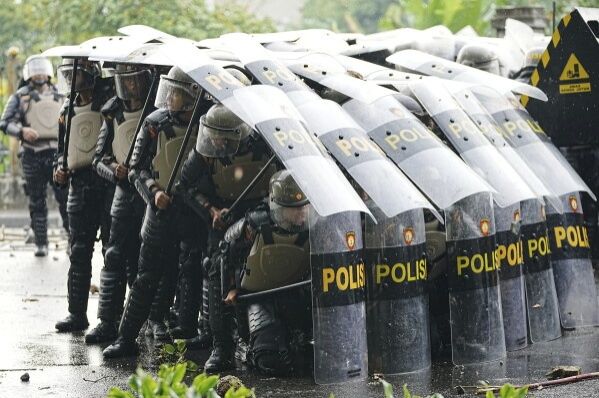
A significant institutional clash is unfolding in Indonesia's capital as competing security agencies find themselves at odds following a series of high-profile raids that have exposed alleged corruption networks while drawing the nation's most prominent graft prosecutor into controversy. The confrontation between police and military—ostensibly over the protection of Deputy Attorney General Febrie Adriansyah—reflects deeper fractures within Indonesia's law enforcement establishment and raises troubling questions about the stability of the country's democratic institutions at a moment when investor confidence and public trust are increasingly fragile.
Police operations conducted this week across Jakarta and surrounding areas recovered substantial assets including precious metals, domestic currency, and foreign exchange totalling tens of millions of dollars. The searches, authorities explained, targeted at least three separate investigations touching on corruption and money laundering. The cases range from irregularities in coal sourcing arrangements blamed for recent electricity supply failures, to mismanagement within state-owned insurance companies Asabri and Jiwasraya, and separately, complications surrounding debt settlement for enterprises affiliated with Krakatau Steel. The scope and coordination of these raids suggested a major corruption inquiry extending into multiple government sectors simultaneously.
The most dramatic seizure occurred at a private residence owned by Febrie in suburban Jakarta. Police reported discovering 74 kilograms of gold bars stored alongside substantial cash and foreign currency inside seven locked suitcases within a secured safe—assets valued collectively at approximately $26.3 million. In central Jakarta, a separate operation at a restaurant and adjoining money exchange yielded additional currency and valuables exceeding $3 million. The concentration of these raids on locations connected to a sitting prosecutor immediately transformed what might have been routine corruption enforcement into a political incident with implications for institutional balance.
Febrie occupies one of the most powerful positions within Indonesia's justice system. As the prosecutor overseeing the Attorney General's Office's special crimes unit, he directly supervises investigations into major graft cases spanning Indonesia's largest state enterprises and touching the highest levels of government. His portfolio includes ongoing probes affecting state miner Timah, energy giant Pertamina, and flag carrier Garuda Indonesia, alongside investigations touching the education portfolio and President Prabowo Subianto's prominent free-meals initiative. His institutional importance cannot be overstated—he essentially controls which powerful figures face prosecution and which escape scrutiny.
The prosecutor's predicament deepened when armed military personnel arrived at his residence, establishing a protective perimeter. The military characterised this deployment as a standard security arrangement requested by the Attorney General's Office under protocols governing protection for senior judicial officials. However, the optics proved immediately explosive. For many observers, the sight of soldiers surrounding a prosecutor under police investigation conjured spectre of institutional interference and suggested that the military might be deployed to obstruct civilian law enforcement operations. The military subsequently issued denials emphasising there was no conflict between institutions and that the armed forces fully supported all law enforcement activities.
Febrie himself responded with cautious language on Friday, acknowledging ownership of the residence while categorically denying any connection to the seized assets. He suggested that the assets may have belonged to others using his property without his knowledge or consent. He appealed to the public to refrain from premature judgment and emphasised that investigations must proceed according to legal principles respecting the presumption of innocence until conclusive evidence determines guilt. The statement struck observers as carefully calibrated to address public suspicion without providing substantive explanation regarding the origins or purpose of such substantial wealth concentrated on his property.
President Prabowo issued what appeared to be an indirect commentary on the unfolding situation on Friday while inaugurating infrastructure development on Lombok island. Speaking to gathered officials, military personnel, and prosecutors, he invoked an almost quasi-spiritual appeal for self-reflection and institutional humility, reminding assembled power-holders that their authority derives ultimately from the people they serve. His remarks notably encompassed the Attorney General's Office alongside the military and police, suggesting awareness that multiple institutions bore responsibility for restoring public confidence. The language was conspicuously vague, avoiding direct reference to Febrie or the raids, yet clearly signalling presidential concern about institutional conduct.
International and domestic human rights organisations have responded with alarm to the military deployment. Amnesty International Indonesia issued a formal warning that troop deployment near a prosecutor under investigation risked eroding civilian oversight of the military and compromising the credibility of law enforcement institutions generally. The organisation called for explicit assurances that investigators would face no pressure, intimidation, or obstruction. These warnings reflect broader regional concerns about democratic backsliding in Southeast Asia's largest economy and the creeping normalisation of military involvement in civilian affairs.
Analysts at Jakarta-based research institutions perceive the incident as symptomatic of more fundamental institutional deterioration. Nicky Fahrizal, a researcher at the Centre for Strategic and International Studies, characterised the standoff as reflecting systemic breakdown with dangerous implications. He argued that continued escalation risks accelerating what he termed creeping militarisation—the gradual normalisation of armed forces intervention into civilian law enforcement—thereby undermining the foundational principles of rule of law that Indonesian democracy depends upon. The consequence, he warned, would be the erosion of investor confidence and public trust essential to sustained economic performance and political stability.
For regional observers and Malaysia's business community, the unfolding Indonesian institutional crisis carries practical implications. Corruption networks operating at this governmental level directly affect multinational operations across Southeast Asia. When prosecutors themselves face credibility questions, confidence in legal proceedings affecting business disputes, regulatory compliance, and investment protection inevitably suffers. The military's apparent willingness to deploy forces to shield officials from police investigation suggests that institutional supremacy of law has become conditional rather than absolute—a troubling precedent in a region where capital allocation increasingly depends on predictable legal frameworks.
The coming weeks will prove crucial. How thoroughly police conduct their investigation into Febrie, whether military deployment genuinely ceases interfering with law enforcement operations, and whether the Attorney General's Office responds transparently will determine whether Indonesia manages to contain this institutional crisis or whether it signals the beginning of broader governmental dysfunction. The incident has already exposed how fragile the consensus among Indonesia's security institutions remains, and how quickly institutional rivalry can threaten the democratic architecture that has underlain two decades of relative stability and economic growth across Southeast Asia's largest nation.

