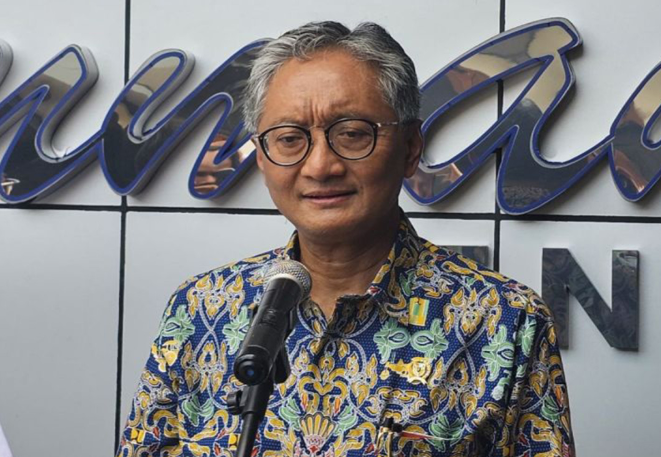
Indonesia's Public Works Ministry has descended into organisational chaos following the public leak of an official travel document that revealed Minister Dody Hanggodo's wife and daughter were scheduled to join him on a government mission to New York. The scandal has intensified pre-existing tensions within the sprawling agency, prompting widespread personnel reassignments and raising fresh questions about management practices in one of Southeast Asia's largest infrastructure bureaucracies.
The trouble began when a ministry document, signed by secretary-general Apri Artoto on June 29, circulated across Indonesian social media platforms early this month. The paper detailed plans for eight delegates to travel to New York from July 13 to 19 for a United Nations-organised meeting scheduled for mid-month. What ignited public outrage was the inclusion of Dody's spouse Irma Hermawati and daughter Aurellia Tsabitha Meidirama among the listed participants. The apparent use of state resources to fund family members' international travel triggered immediate criticism and accusations of administrative impropriety, ultimately leading to the cancellation of the entire trip.
In the aftermath of the document's viral spread, unverified claims flooded social media suggesting the minister had retaliatory motives. Multiple posts alleged that Dody had begun reassigning officials to regional postings, predominantly in areas beyond Java, as punishment for those suspected of leaking the sensitive file. When confronted by reporters on Wednesday, Dody neither fully acknowledged the retaliatory angle nor entirely denied it. Instead, he defended his authority to move personnel, rhetorically asking why he should be constrained from reassigning staff within his portfolio of 38,600 employees. The non-denial marked another instance of the minister's combative public posture.
Apri attempted damage control during a July 7 press briefing, offering explanations that remained unconvincing to many observers. He contended that listing Dody's family members was procedurally necessary to facilitate visa applications through the Foreign Ministry, while simultaneously pledging that no taxpayer funds would actually finance their participation. He pledged to identify whoever had leaked the document and threatened legal action against culprits. Yet his assurances did little to quell institutional anxiety or public scepticism about the ministry's governance standards.
Dody's stewardship since assuming office in October 2024 has been characterised by relentless organisational upheaval. The 60-year-old engineer and businessman, whose background includes connections to South Kalimantan entrepreneur Andi "Haji Isam" Syamsuddin Arsyad, has orchestrated wave after wave of personnel shuffles. Social media compilations document more than 100 reassignments spanning the organisational hierarchy, from director-general positions to lower administrative grades. The most recent major reshuffle occurred in May, when Dody appointed Apri and six other senior officials, displacing his predecessor Wida Nurfaida, who had held the secretary-general role for fewer than twelve months following an earlier restructuring in July 2025.
Lawmakers overseeing infrastructure have grown alarmed by the pattern. During a June meeting, Yasto Soepredjo Mokoagow of the House of Representatives Commission V remarked that aggressive disciplinary actions, including demotions of directors to non-structural positions, had fostered widespread dread among civil servants. The PDI-P representative warned that fear-driven management was compromising operational effectiveness and programme delivery. His concerns reflect a broader anxiety that Dody's management style, however well-intentioned, may be undermining the ministry's capacity to execute critical national infrastructure initiatives.
Dody has repeatedly invoked the existence of a "deep state" within the ministry as his justification for continuous restructuring. He employs the metaphor of termites silently destroying institutional integrity, thereby legitimising his aggressive personnel interventions as necessary institutional medicine. This framing, whilst providing rhetorical cover, has done little to address underlying concerns about departmental morale and administrative dysfunction. The constant reorganisation creates perpetual uncertainty that radiates through hierarchical structures, discouraging initiative and embedding risk-averse behaviour.
Complicated matters further, several senior ministry officials face ongoing corruption investigations related to water resources projects. In June, the Jakarta High Prosecutor's Office identified multiple suspects, including former water resources director-general Dwi Purwantoro and former acting irrigation and swamp director Yosiandi Radi Wicaksono. Dody responded by pledging non-interference and expressed support for law enforcement investigations into his subordinates. Yet for Malaysian observers, the convergence of internal purges, family perks in government travel, and separate corruption cases suggests deeper institutional pathologies than any single minister can readily address through personnel shuffling.
Public perception has been further damaged by resurfaced video footage capturing unflattering interactions between Dody and subordinates. One April recording from an East Java school construction site showed the minister publicly berating an employee, pointing fingers whilst dismissing his explanations as "dumb excuses." Such incidents, amplified across social platforms, reinforce impressions of a leadership style rooted in confrontation rather than collaborative problem-solving. For a ministry responsible for coordinating massive infrastructure programmes across the archipelago, such reputational damage carries operational consequences.
The Public Works Ministry's current trajectory offers important lessons for regional governance observers. Indonesia's infrastructure sector requires stable, professional management capable of commanding respect across complex bureaucratic systems. The escalating turmoil at the ministry reflects broader governance challenges common throughout Southeast Asia: the tension between reform-minded leaders seeking to eliminate entrenched dysfunction and institutional stability necessary for delivering sustained policy outcomes. Without resolving this fundamental tension through systematic rather than personalised approaches, Indonesian infrastructure development risks prolonged disruption. Malaysia, with its own infrastructure ambitions and bureaucratic complexities, can observe these dynamics as cautionary markers of what happens when ministerial authority becomes indistinguishable from institutional instability.

