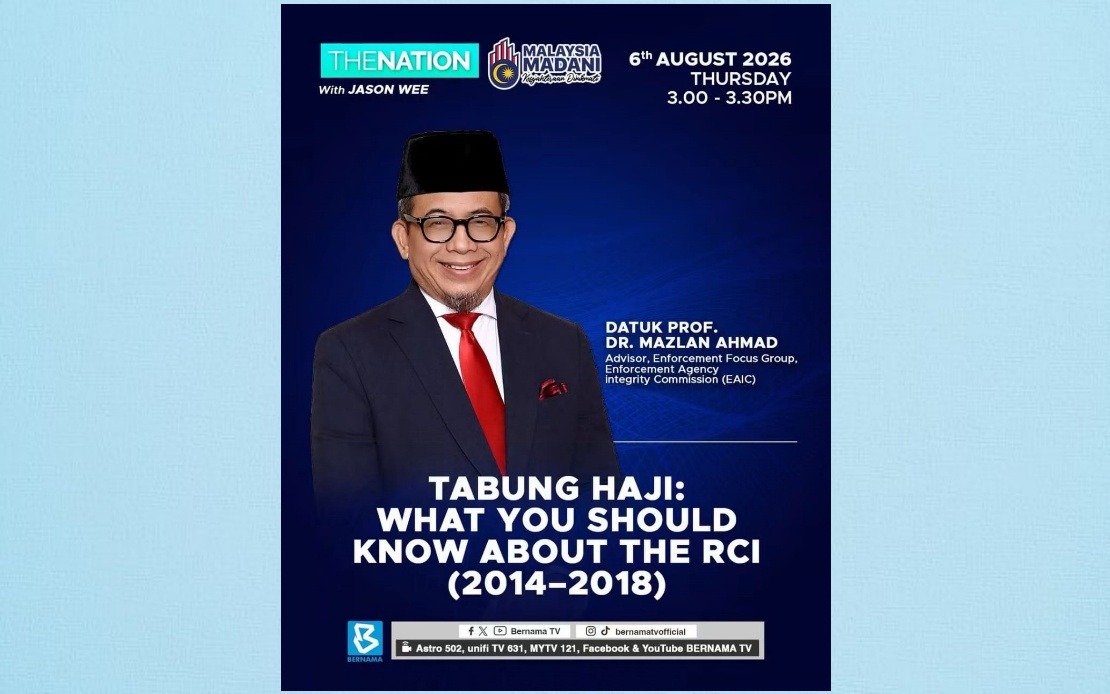
Malaysia's tax authorities face renewed pressure to launch a detailed investigation into potential tax evasion involving Tabung Haji and its affiliated companies, following damning findings from the Royal Commission of Inquiry that exposed serious governance failures at the Islamic pilgrimage savings institution. Prof Datuk Dr Mazlan Ahmad, advisor to the Enforcement Focus Group at the Enforcement Agency Integrity Commission, has publicly called for the Inland Revenue Board to act decisively on what he characterises as systematic misconduct spanning the 2014 to 2020 period.
The urgency of this investigation reflects mounting concern among senior enforcement officials that the RCI's findings represent merely the tip of a much larger problem. Rather than viewing the commission's report as a conclusive endpoint, experts argue it should function as the starting point for more penetrating enquiries that drill down into specific criminal culpability. Mazlan's intervention carries particular weight given his dual credentials as both an enforcement specialist and a chartered accountant with standing at the Malaysian Institute of Accountants, positioning him to speak authoritatively about the technical and procedural dimensions of complex financial investigations.
The proposed investigation must go well beyond surface-level compliance reviews. Mazlan advocates for sophisticated forensic accounting methodologies capable of meticulously tracing the movement of funds throughout the institution's complex financial architecture. Such work would illuminate not merely the sums involved, but crucially establish the originating sources of questionable transactions, their final destinations, and most importantly the individuals and entities who ultimately benefited from the schemes. This granular approach proves essential because it transforms what might appear as isolated irregularities into a coherent pattern demonstrating systematic malfeasance.
Beyond tax evasion concerns, Mazlan emphasises that enforcement authorities should simultaneously examine potential money laundering dimensions of Tabung Haji's conduct during this period. The intersection of suspicious financial flows and inadequate institutional controls creates ideal conditions for the layering and integration of illicitly derived funds into seemingly legitimate operations. Identifying and documenting such transactions would enable investigators to construct comprehensive cases that implicate multiple criminal offences rather than allowing culprits to escape through technicalities in any single charge category.
Central to Mazlan's analysis is the systemic nature of the suspected misconduct. He explicitly rejects any characterisation of the problems as stemming from isolated wrongdoing by individual executives or board members. Instead, he describes the situation as representing systemic risk emanating from fundamental institutional dysfunction. This systemic perspective demands that investigations encompass the entire organisational ecosystem, examining not only the formal management structures but also informal networks, decision-making processes, and the enabling environment that permitted impropriety to flourish unchecked across six years.
The governance failures identified by the RCI take on particular significance when viewed through the lens of fiduciary responsibility. Mazlan stresses that boards of directors bear statutory and ethical obligations to exercise proper oversight, establish effective checks and balances, and provide strategic direction. The directors of Tabung Haji demonstrably failed these fundamental duties by either abetting management misconduct or negligently allowing it to proceed without adequate scrutiny. This breach of fiduciary duty itself constitutes grounds for investigation and potential enforcement action independent of the underlying financial irregularities.
For Malaysian taxpayers and Hajj pilgrims who contribute to Tabung Haji, the implications of this prospective investigation extend beyond abstract governance concerns. The institution manages substantial public funds collected from millions of contributors over decades. Any systematic diversion or misappropriation of these resources represents a direct betrayal of public trust and potentially reduces the funds available to support pilgrims' religious obligations. The investigation's scope and rigour will therefore signal whether Malaysian authorities genuinely intend to protect ordinary citizens' financial interests or whether enforcement will remain symbolic and incomplete.
The timing of this push for deeper investigation also matters significantly. The RCI released its findings on July 29, with Parliament scheduled to debate the report during a special sitting on August 11. This compressed timeline creates a window during which political and public attention remains focused on Tabung Haji's failures, generating momentum for decisive action. Enforcement agencies must capitalise on this moment to secure necessary resources, political support, and public cooperation for investigations that may ultimately require accessing complex financial records and securing testimony from numerous witnesses.
Mazlan's emphasis on forensic accounting capability reveals a practical constraint facing Malaysian authorities. Such specialised investigation requires expertise not uniformly distributed across enforcement agencies. Building or accessing sufficient forensic capacity may necessitate seconding specialists from other institutions, engaging external consultants, or expanding the IRB's internal capability. The financial and temporal investment in these resources must be justified by serious institutional commitment to following investigations wherever evidence leads, rather than perfunctory exercises designed to demonstrate activity without genuine accountability.
The broader institutional implications of this investigation extend to Malaysia's financial regulatory architecture. If systematic fraud could persist at a major institution under existing oversight frameworks, the findings should prompt comprehensive review of regulatory gaps and supervisory failings that enabled the misconduct. The IRB, Bank Negara Malaysia, and other relevant agencies may require enhanced information-sharing protocols, more intrusive examination powers, or more frequent supervisory interventions to prevent similar failures elsewhere in the financial system.
For regional observers, the Tabung Haji investigation represents a test case for Malaysian enforcement capacity. Singapore, Indonesia, and other neighbouring jurisdictions monitor how Malaysia handles complex financial crime involving state-linked institutions. A thorough, credible investigation and subsequent prosecution of culprits would enhance Malaysia's reputation for financial integrity and rule of law. Conversely, if investigations stall or yield only minor sanctions against subordinate personnel, international confidence in Malaysia's financial system governance would suffer corresponding damage.
The coming months will reveal whether the RCI's findings translate into genuine enforcement action or remain confined to historical documentation. Mazlan's intervention as a respected technical expert suggests that pressure from within the enforcement establishment exists for serious investigation. Whether this expert advocacy can overcome institutional inertia, political sensitivities, or resource constraints remains the critical question determining whether Tabung Haji's victims achieve meaningful accountability.

