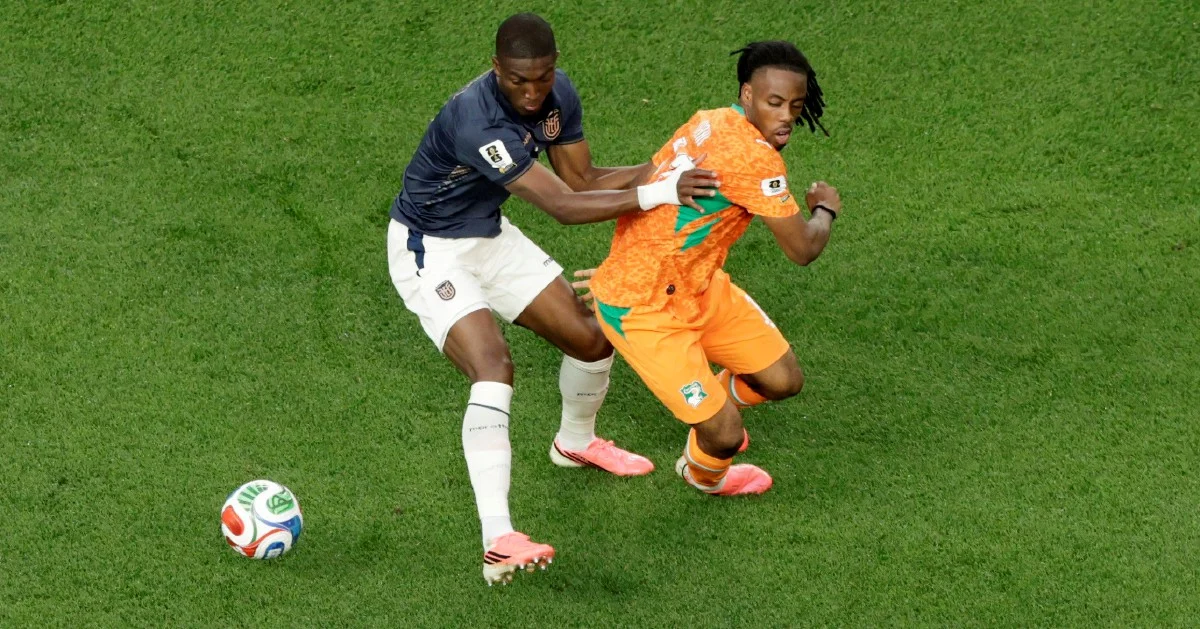
Ivory Coast forward Elye Wahi will not join his national team for this weekend's World Cup encounter against Germany, the Ivorian Football Federation announced Thursday. The decision came barely a day after Wahi's name surfaced in connection with an ongoing investigation into suspected match manipulation within France's top-tier Ligue 1 competition.
The timing of the announcement underscores the gravity with which Ivory Coast's governing body is treating the allegations. Rather than allow the situation to linger or risk further reputational damage, the federation opted for swift action, effectively sidelining one of the country's attacking talents from a crucial World Cup fixture. This decisive approach reflects broader institutional concerns about maintaining the integrity of both the national team and the sport itself at the international level.
Match-fixing investigations have become an increasingly prominent feature of professional football across Europe, with authorities in multiple jurisdictions stepping up enforcement efforts. The Ligue 1 case implicating Wahi appears to form part of a larger pattern of scrutiny targeting potential irregularities in outcomes and player conduct. Such investigations typically involve coordination between national sports authorities, police forces, and football governing bodies seeking to identify whether players, coaches, or other officials engaged in deliberate manipulation of results or match conditions.
For Malaysia and other Southeast Asian football communities, the Wahi suspension carries instructive significance. The region has itself grappled with match-fixing scandals in recent years, with investigators uncovering networks of corrupted fixtures across domestic and regional competitions. The swift action taken by Ivory Coast demonstrates an institutional willingness to prioritize competition integrity over short-term sporting advantage, a principle that resonates with ongoing anti-corruption campaigns throughout Asian football.
Wahi's exclusion removes a potentially dangerous attacking option from Ivory Coast's squad precisely when the team faces one of World Cup football's traditional powerhouses. Germany represents a formidable opponent, and the loss of a capable forward could meaningfully impact the Ivorians' ability to create scoring opportunities. This competitive consequence compounds what is fundamentally a matter of sporting ethics and legal accountability, creating multiple layers of difficulty for the national federation.
The investigation itself remains in preliminary stages, with details about specific allegations, match dates, and the precise nature of suspected manipulation remaining largely undisclosed at this stage. Authorities typically restrict public commentary on ongoing probes to preserve investigative integrity and protect the legal rights of those under scrutiny. However, the mere linkage of a player's name to such an inquiry carries substantial reputational implications, affecting not only individual career prospects but potentially the standing of the clubs and national associations involved.
Ivory Coast's decision also sends a signal to other African football associations and governing bodies about accountability standards. In a sport where continental and international reputations matter enormously for broadcasting rights, sponsorships, and developmental investment, the federation's willingness to visibly distance itself from corruption allegations suggests institutional maturity. This positioning becomes particularly relevant given football's central role in African economic and cultural life.
The World Cup context adds another dimension to the situation. World Cup tournaments represent the sport's highest-profile platform, and any hint of corruption threatens the credibility of the entire competition. Match-fixing revelations during or immediately before a World Cup cycle could potentially undermine global confidence in the tournament's integrity. By acting preemptively, Ivory Coast helps mitigate such risks while simultaneously protecting its own institutional credibility.
For Wahi personally, the situation presents acute professional challenges. Even if subsequent investigations clear him of wrongdoing, the damage to his reputation and marketability extends beyond this single tournament. European clubs increasingly conduct thorough due diligence on players given heightened regulatory scrutiny, and any association with corruption allegations complicates such evaluations. The player now faces the difficult task of rehabilitating his public image while remaining in legal limbo regarding the investigation's outcome.
The broader context of European football governance has shifted noticeably toward zero-tolerance stances on corruption. Regulatory bodies including UEFA and national football associations have significantly strengthened investigative capacity and enforcement mechanisms over the past decade. This tightening of oversight, while necessary, creates situations where even preliminary allegations can derail careers and opportunities before formal charges materialise.
Ivory Coast's federation must now navigate the delicate challenge of managing team preparations and public communications during this period. Explaining the suspension to supporters, sponsors, and media requires careful calibration to avoid either minimizing corruption concerns or appearing to prejudge Wahi's guilt prior to any formal adjudication. The federation's statement therefore carries implications extending far beyond the immediate sporting fixture.
As global football authorities continue developing more sophisticated tools for detecting and prosecuting match-fixing, similar situations are likely to recur. The Wahi case may ultimately serve as a case study in how national associations should balance their responsibilities to competition integrity, player protection, and institutional accountability. For Southeast Asian football development, observing how established African and European authorities handle such matters provides valuable lessons for strengthening local governance frameworks against corruption.

