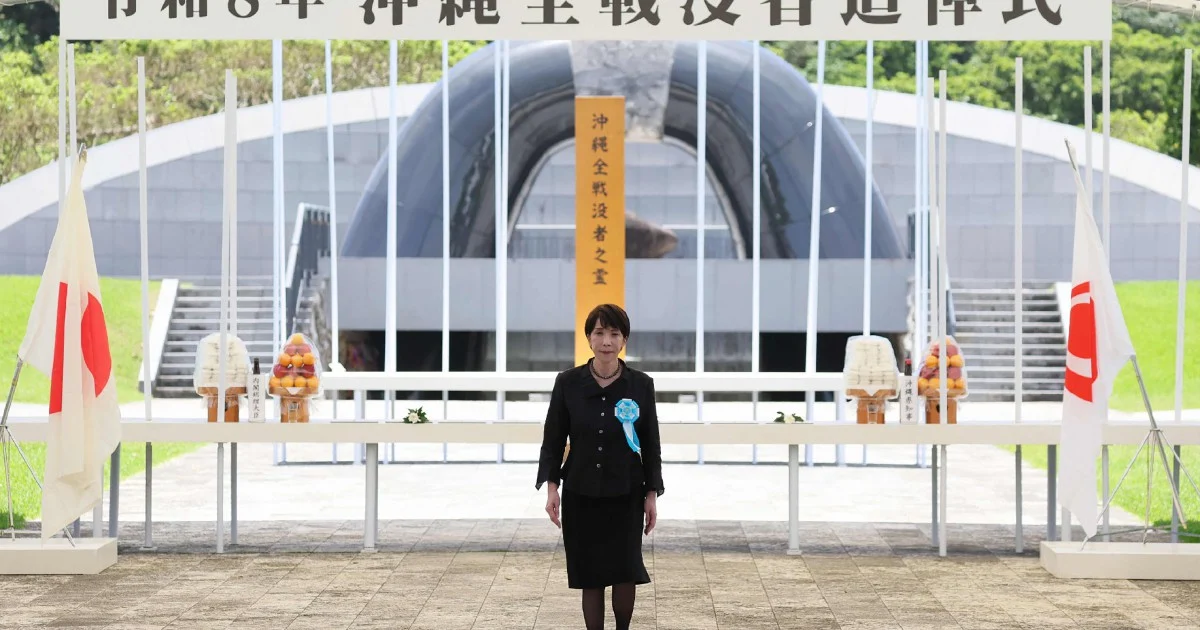
Japanese Prime Minister Sanae Takaichi encountered public resistance at a World War II memorial event when demonstrators voiced their objections to the nation's continuing military expansion, according to television reports of the incident. The confrontation highlights deepening domestic divisions over Tokyo's strategic pivot, a shift that has gained momentum under recent administrations but remains contentious among a segment of the Japanese population still influenced by postwar pacifist sentiment.
The heckling underscores an ongoing tension within Japanese society between those who view military strengthening as essential to regional security amid rising tensions with China and North Korea, and those who regard such moves as a fundamental betrayal of Japan's Constitution and the spirit of Article 9, which renounces war as an instrument of state policy. This constitutional commitment has defined Japan's defence approach for nearly eight decades and remains deeply embedded in the national consciousness, particularly among older generations who lived through the devastation of World War II.
Prime Minister Takaichi, who assumed office recently, represents a more assertive approach to national security compared to some predecessors. Her government has championed increased military spending, modernisation of Japan's Self-Defence Forces, and closer defence coordination with Western allies, particularly the United States. These policies represent a marked acceleration of strategic reorientation that has been building incrementally since the mid-2010s but has intensified significantly in response to the Ukraine conflict and Chinese military activity near Taiwan.
The protest at the memorial ceremony reflects how defence policy remains a deeply emotional issue in Japan, where collective memory of wartime suffering shapes political discourse. For many Japanese citizens, particularly peace activists and left-leaning groups, military expansion evokes uncomfortable historical parallels and raises concerns about the trajectory of national policy. The choice to stage the demonstration at a war memorial adds symbolic weight, suggesting protesters view the government's military shifts as dishonouring the sacrifice and pacifist commitments that emerged from Japan's defeat.
Japan's military budget has already grown substantially in recent years, with defence spending now among the highest in the world in absolute terms. The Takaichi administration has signalled intentions to increase spending further and pursue capabilities that previously would have been considered politically impossible, such as counterstrike weapons systems designed to strike enemy bases before they launch attacks on Japan. Such acquisitions represent a fundamental departure from the defensive-only doctrine that has governed Japanese military thinking for generations.
The geopolitical context driving these changes cannot be ignored by either supporters or critics. Rising Chinese military power, accelerated weapons development by North Korea, and the broader regional security environment have created genuine strategic anxieties among Japanese defence planners and sections of the public. However, this security rationale for rearmament does not automatically resolve the constitutional and philosophical questions that animate opposition movements, nor does it necessarily persuade citizens whose worldview emphasises non-militarisation.
The incident also reflects broader patterns in Japanese politics where defence debates have become increasingly partisan and visceral. Where military policy discussions once occurred within narrower elite circles, they now engage popular opinion more directly. Social media and digital platforms have amplified activist voices and made public demonstrations more visible, creating new channels for expressing dissent. Prime Minister Takaichi's encounter with heckling represents a modern manifestation of this democratisation of defence policy discourse.
For regional observers, particularly in Southeast Asia, Japan's military trajectory carries significant implications. Japan functions as a crucial stabilising force in East Asia and a counterweight to Chinese regional dominance. Japanese military capability and willingness to exercise it affects the security calculations of many countries in the region, including Malaysia. Simultaneously, Japan's domestic political debates about militarisation occur within a region where memories of Japanese imperial expansion remain significant, and where careful calibration of military postures remains diplomatically sensitive.
The contrast between government policy direction and public sentiment revealed at the memorial event suggests that Prime Minister Takaichi may face sustained pressure from peace movements and opposition forces as she pursues defence agenda items. Her ability to build broader consensus around military expansion will likely determine how smoothly her strategic vision can be implemented. Democratic societies require not merely policy decisions but also public acquiescence, and the heckling suggests this acquiescence cannot be assumed.
Moving forward, the Takaichi administration will probably need to invest greater effort in explaining and justifying defence policy changes to sceptical portions of the electorate. Educational campaigns, parliamentary debate, and coalition-building with moderate voices who accept defence modernisation while remaining sensitive to constitutional principles may become necessary. The challenge lies in maintaining strategic modernisation while respecting the pacifist legacy that remains central to Japanese national identity for many citizens.
Ultimately, the scene at the war memorial encapsulates a fundamental question facing Japan: how to evolve its security posture in response to genuine regional threats while preserving the constitutional and philosophical foundations that have defined the nation since 1945. This question will not be resolved through a single policy decision or budget allocation, but rather through sustained democratic engagement between government and society.

