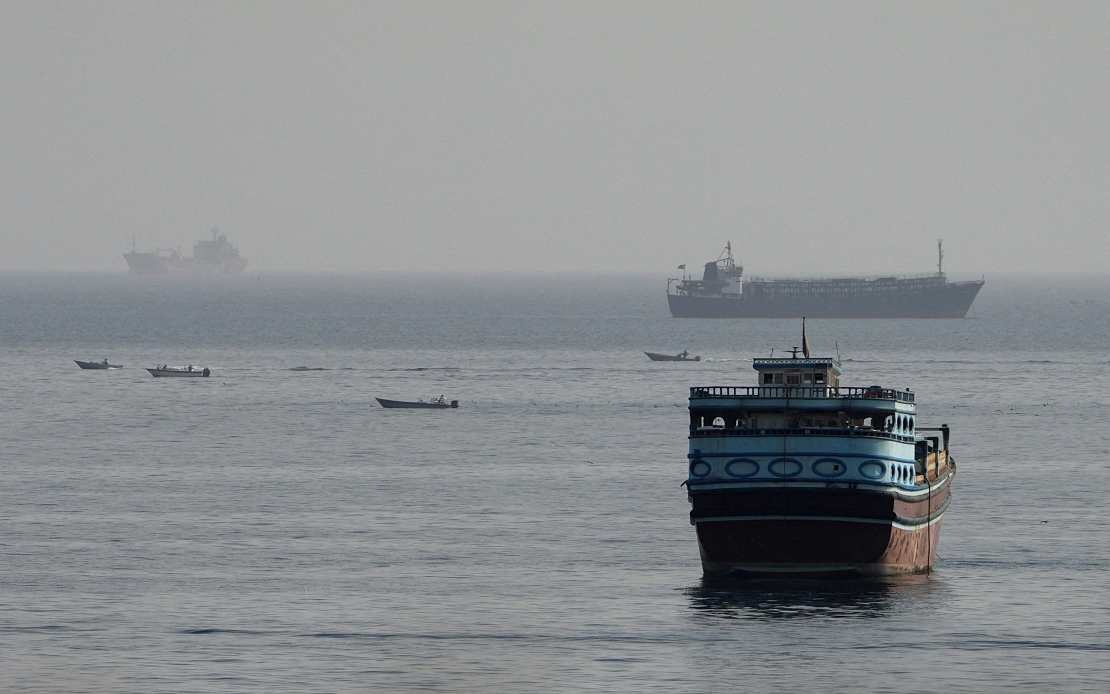
Japanese Prime Minister Sanae Takaichi has directly appealed to Iran not to levy additional fees on vessels transiting the Strait of Hormuz, underscoring Tokyo's concern about disruptions to one of the world's most strategically vital shipping corridors. The message was delivered during a telephone conversation on Wednesday between Takaichi and Iranian President Masoud Pezeshkian, marking their first direct communication since June and reflecting Japan's delicate diplomatic positioning as a longstanding US ally with historical commercial ties to Iran.
The Strait of Hormuz, which channels roughly one-fifth of global maritime oil trade, has become increasingly precarious as geopolitical tensions simmer across the Middle East. Japan's explicit concern about potential additional transit charges signals alarm among Tokyo's policymakers that the waterway's effective closure—a consequence of broader US-Iran diplomatic stalling—could trigger economic ripples far beyond the immediate region, with profound implications for energy-dependent Asian economies including Malaysia, Singapore, and South Korea. For Japan, which relies heavily on Middle Eastern crude oil, any impediment to free passage represents a direct threat to energy security and economic stability.
During the same conversation, Takaichi conveyed Japan's deep anxiety regarding security incidents in the Bab el-Mandeb Strait, the narrower chokepoint lying on the opposite flank of the Arabian Peninsula. She urged Pezeshkian to press Tehran-backed Houthi rebels operating from Yemen to exercise restraint and cease their destabilizing activities. This dual-front diplomatic maneuver reflects Japan's attempt to stabilize maritime commerce while acknowledging Iran's regional influence and its connections to non-state actors in Yemen.
The Houthi militia declared what it termed a "maritime blockade" targeting Saudi Arabian vessels in July, escalating their campaign of regional disruption. Their actions culminated in a deadly assault on a cargo vessel transiting the Bab el-Mandeb Strait on Tuesday, according to Yemeni officials. These attacks have transformed the Bab el-Mandeb into an alternative—though increasingly perilous—conduit for crude oil shipments seeking to circumvent the paralyzed Hormuz corridor. For maritime insurers, shippers, and energy traders, the situation has become untenable, with insurance premiums soaring and routing decisions becoming more complex and costly.
The Bab el-Mandeb's emergence as a substitute passage reflects the interconnected nature of global energy logistics, where disruption at one chokepoint cascades through alternative routes and ultimately affects global crude oil prices and availability. Malaysian petrochemical firms, refineries, and industrial consumers remain vulnerable to any sustained elevation in oil prices triggered by these ongoing disruptions. The broader geopolitical context—with the US-Israeli military campaign against Iran having commenced in late February—has created an environment where such maritime attacks appear likely to persist and potentially intensify.
Japan's diplomatic approach underscores a broader Asian strategy of maintaining pragmatic relationships across ideological divides. Although Tokyo remains firmly aligned with Washington on security matters, it has historically cultivated separate commercial and political channels with Tehran. This capacity for selective engagement allows Japan to voice concerns about maritime freedom while avoiding the confrontational posture adopted by some Western capitals. For smaller Asian economies and Southeast Asian nations like Malaysia and Singapore, which similarly depend on unobstructed passage through Middle Eastern waters, Japan's diplomacy offers a potential model for balancing alliance commitments with national economic interests.
The telephone exchange between Takaichi and Pezeshkian represents the fourth conversation between Japanese and Iranian leadership since February's escalation, suggesting that both capitals view regular dialogue as essential despite heightened regional tensions. Each of these interactions has carried specific significance: Japan attempting to preserve commercial interests while reassuring its American ally of continued strategic alignment. For Iran, accepting calls from a major Japanese leader—a nation with deep ties to the United States—signals a willingness to maintain economic relationships even amid confrontation with Washington and its allies.
The timing of Takaichi's appeal regarding transit fees remains significant. With global energy markets already vulnerable to supply shocks and alternative routes proving unreliable, Japan evidently fears that Iran might leverage its geographic position to extract financial concessions from shipping traffic. Such a move would represent a qualitative escalation from the current de facto closures caused by geopolitical uncertainty, transforming the strait's situation from a temporary crisis into a systematized revenue mechanism. For Japan, whose post-war economic model depends fundamentally on reliable access to international trade routes, such a development would constitute an unacceptable restructuring of fundamental assumptions underlying maritime commerce.
Malaysia and other Southeast Asian nations remain acutely aware that any formalization of transit fees or deliberate chokepoint manipulation by regional powers would establish dangerous precedents. The principle of free passage through international straits underpins the entire architecture of global commerce; capitulation on the Hormuz precedent could embolden other powers to impose similar demands elsewhere, ultimately fragmenting the open maritime system upon which regional prosperity depends. Japan's diplomatic intervention, therefore, carries significance extending far beyond bilateral Japanese-Iranian relations, potentially influencing how the international community responds to strategic leverage over vital waterways.
Looking forward, the sustainability of Japan's balancing act remains uncertain. Continued disruptions in Middle Eastern sea lanes will eventually force clearer choices between alliance solidarity and economic self-interest. For Asian economies watching this situation closely, Japan's efforts to preserve diplomatic channels while pressing for maintained freedom of navigation offer both inspiration and caution—inspiration that dialogue remains possible even amid geopolitical turbulence, but caution that economic vulnerabilities stemming from geographic dependence on contested corridors remain fundamentally unresolved.

