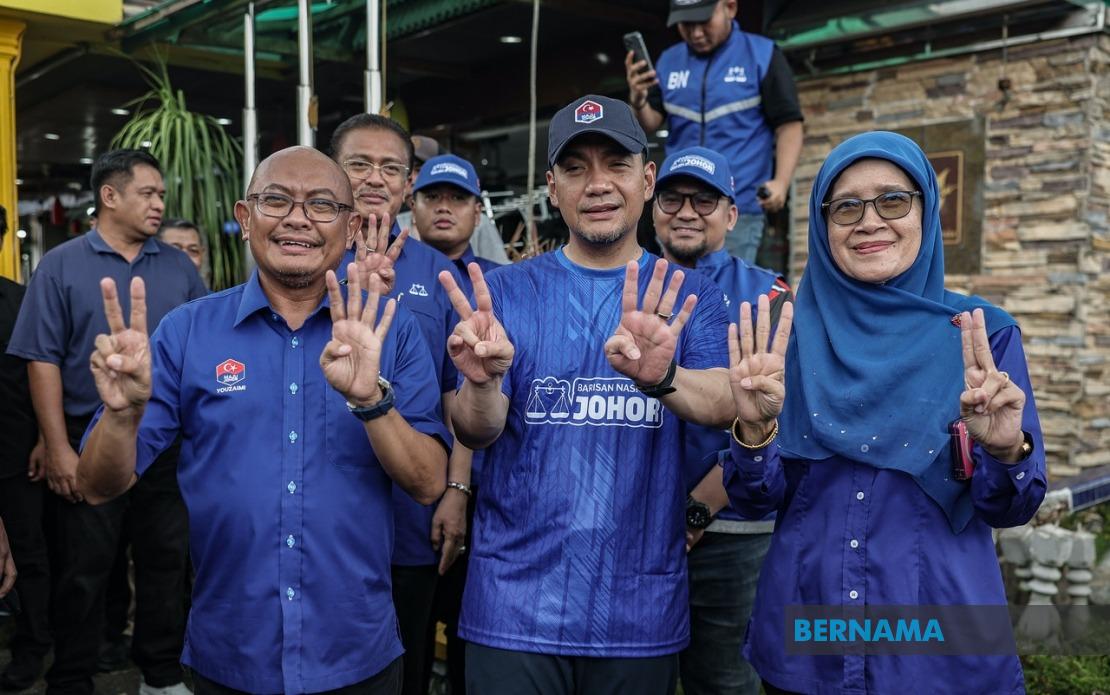
The Barisan Nasional coalition's durability rests fundamentally on a power-sharing arrangement that demands reciprocal sacrifice and unwavering loyalty from its member parties, according to Johor Menteri Besar Datuk Onn Hafiz Ghazi. Speaking at a machinery meeting in Mersing on June 29, Onn Hafiz underscored how this principle has sustained BN's internal cohesion and electoral effectiveness, offering a striking example from the Tenggaroh constituency where party discipline has been tested across four decades of political competition.
The commitment UMNO has shown to the MIC-held Tenggaroh seat exemplifies the maturity required within BN's framework. For 40 years, the Malay-majority party has foregone attempts to claim this seat, despite multiple electoral contests where victory appeared feasible. Rather than fracturing coalition unity through internal recrimination or defection, UMNO's machinery has channelled its energies into supporting the MIC candidate and BN's broader agenda. This pattern of restraint, repeated across numerous election cycles, reflects a deeper understanding that short-term electoral gains must be subordinated to the coalition's long-term institutional survival.
Onn Hafiz framed this sacrifice as evidence of organisational discipline and political maturity. He stressed that the coalition's decision-making on seat allocation carefully balances the competing interests of UMNO, MCA and MIC while strengthening the bonds between them. Such balancing acts are essential in a pluralistic coalition where different communities maintain distinct political organisations and where electoral arithmetic requires strategic coordination rather than winner-take-all competition. The Johor Menteri Besar's remarks suggest that BN views its power-sharing model as intrinsically valuable, not merely as a tactical convenience.
The Tenggaroh example is instructive precisely because the demographic argument for UMNO control appears weak on the surface. The constituency contains approximately 39,000 registered voters, of whom around 500 are Indian electors—seemingly insufficient to determine the seat's outcome. Yet Onn Hafiz explicitly rejected demographic determinism, noting that BN's multi-racial cooperation model transcends simple communal headcounting. This assertion carries particular weight in Malaysian politics, where ethnic voting patterns have historically determined electoral outcomes. By maintaining the Tenggaroh seat under MIC despite its small Indian voter base, BN signals commitment to an inter-communal arrangement that extends beyond narrow electoral calculation.
The upcoming Johor state election on July 11 presents an opportunity to test whether this power-sharing consensus can translate into electoral momentum. Onn Hafiz has set an ambitious target for Mohd Youzaimi Yusof, the BN-UMNO candidate for Tenggaroh, aiming for a majority of 3,000 votes compared to the previous winning margin of 1,356. This significant increase would validate both the BN machinery's cohesion and public endorsement of the coalition's organisational model. The three-cornered contest involving Perikatan Nasional's Muhamad Amerul Muhamad and Pakatan Harapan's Md Yusof Dawam means the election will also serve as a barometer of voter sentiment toward competing political formations.
From a broader Southeast Asian perspective, BN's power-sharing model offers an alternative to winner-take-all democratic governance in plural societies. Malaysia's coalition politics, whatever its contemporary challenges, has provided institutional mechanisms for managing ethnic and communal tensions that have erupted elsewhere in the region. The willingness of UMNO—as the dominant Malay-Muslim party—to consistently honour commitments to minor coalition partners suggests that even within hierarchical political structures, subordinate groups can secure guaranteed representation and influence. This institutional arrangement differs markedly from systems where majority communities marginalise minority interests once electoral power is consolidated.
However, the sustainability of BN's power-sharing principle faces mounting pressure from rising political competition and shifting voter preferences. Perikatan Nasional's emergence as a serious alternative coalition, combined with Pakatan Harapan's continued challenge to BN's historical dominance, creates incentives for individual parties to abandon coalition discipline in pursuit of independent electoral advantage. If UMNO concluded that competing openly in every seat would yield greater individual electoral returns than honouring power-sharing commitments, the coalition's foundation would fracture. Onn Hafiz's emphasis on sacrifice and loyalty thus functions partly as a rhetorical reinforcement of commitments that market logic might encourage parties to breach.
The Tenggaroh seat specifically illustrates the tension between institutional loyalty and individual party interest. UMNO's continued acceptance of the seat allocation, despite 40 years of electoral frustration, demonstrates extraordinary restraint. Yet this same restraint cannot be indefinitely extended without generating internal pressure within UMNO's rank-and-file membership. Younger party activists may increasingly question why UMNO should forgo electoral opportunities to service coalition agreements. Maintaining the power-sharing model thus requires not merely elite commitment but deep institutional buy-in from party members who perceive personal sacrifices.
The demographic composition of Tenggaroh—with Indian voters representing a small minority of the electorate—adds another layer of complexity. If MIC derives its primary electoral strength from Indian voters concentrated in specific constituencies, its relevance to BN's overall electoral calculus continues to diminish as Indian voter proportions decline across Johor and Malaysia more broadly. This demographic reality may gradually erode the political logic underlying power-sharing arrangements that privilege MIC representation. Onn Hafiz's insistence that BN's multi-racial model transcends narrow demographic calculation may reflect an attempt to persuade both coalition partners and the broader electorate that institutional principles matter even when demographic trends work against minority-party interests.
For Malaysian readers assessing the 2023 Johor election, Onn Hafiz's remarks illuminate how BN leadership understands coalition governance and the ideological commitments underpinning electoral alliances. The emphasis on sacrifice, loyalty and institutional stability, rather than on policy achievements or economic performance, suggests BN views its primary appeal as providing predictable, consensual governance in a plural society. Whether voters increasingly prioritise this institutional stability or instead demand more dynamic policy responses and individual party accountability remains a critical question for Malaysian electoral politics.
The July 11 Johor election will reveal whether BN's power-sharing model continues to command voter confidence or whether fragmentation pressures are intensifying. The test in Tenggaroh—whether the UMNO machinery can deliver a substantially increased majority for its coalition partner—will indicate whether BN's message of solidarity and multi-racial cooperation resonates with contemporary voters or whether electoral competition increasingly transcends coalition boundaries. The results will consequently influence whether power-sharing arrangements remain central to Malaysian political organisation or whether they gradually dissolve under pressure from more competitive, less hierarchical political formations.

