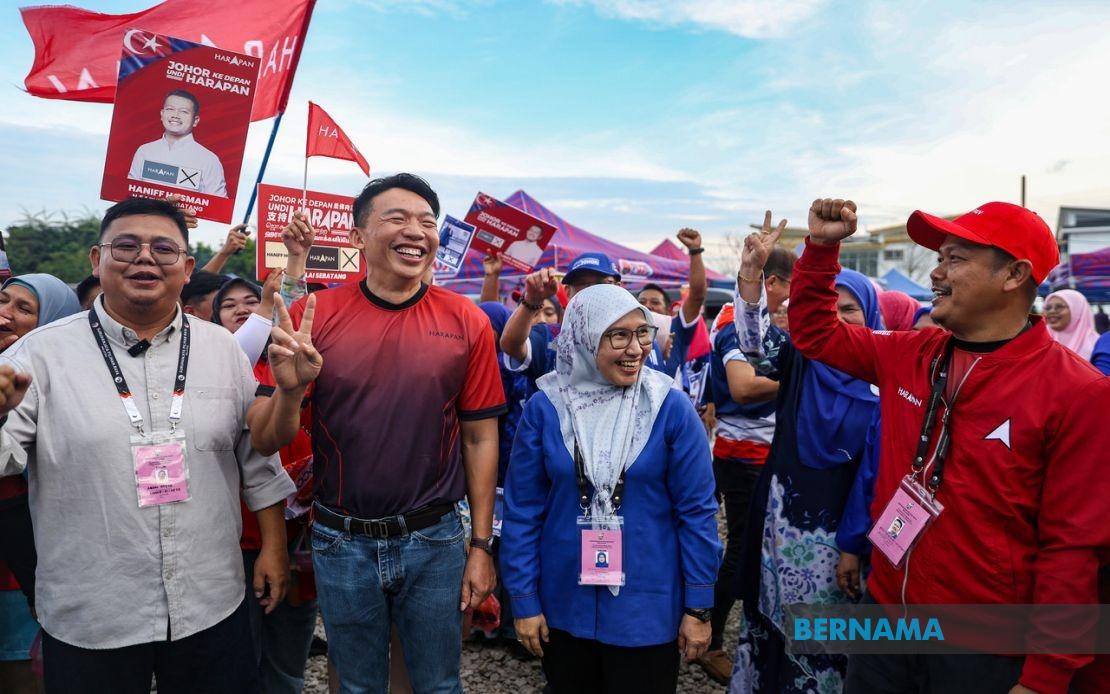
The Johor state election campaign took on a notably civil tone on June 29 when four candidates representing opposing political coalitions encountered each other while working the Taman Megah night market in Pontian. The impromptu meeting between Pakatan Harapan campaigners and their Barisan Nasional rival demonstrated that electoral competition in the state can coexist with personal civility, a dynamic that observers of Malaysian politics have increasingly scrutinised in recent years.
The PH contingent comprised Haniff @ Ghazali Hosman, who is vying for the Pulai Sebatang seat, alongside Abd Razak Ismail from Benut and Cheah Chee Hong contesting Kukup. Their campaign trail crossed with Hasrunizah Hassan, the Pulai Sebatang candidate representing BN and its Johor-based ally Maju Johor. The encounter, which might have sparked tension given the high stakes of electoral politics, instead unfolded as an amicable exchange that caught the attention of night market patrons who momentarily paused their shopping to observe the rare sight of rival campaigners interacting peacefully.
What made the encounter particularly noteworthy was the visual contrast on display. Teams carrying red flags for PH and blue flags for BN converged at a junction within the market, the sort of symbolic clash that has occasionally animated Malaysian electoral discourse. Yet rather than confrontation, the candidates greeted each other warmly, setting a tone that reflected growing awareness within political circles that elections can be contested robustly without sacrificing basic human courtesy. Traders and voters present at the venue responded with curiosity rather than concern, suggesting that residents of Pontian have grown accustomed to and perhaps even appreciate candidates who respect one another despite their partisan affiliations.
When questioned by media representatives at the scene, Haniff characterised the moment as consistent with established democratic norms. He emphasised that the Pontian campaign had maintained a peaceful atmosphere free from disruptions or hostile incidents, and he framed his encounter with Hasrunizah as a natural extension of healthy electoral competition. His comments reflected a position held by segments of the Malaysian political establishment that acknowledge competition and civility need not be mutually exclusive concepts.
Cheah, meanwhile, used the opportunity to reinforce his coalition's messaging. He expressed pride in campaigning alongside his PH colleagues and appealed directly to voters in the three constituencies they were contesting—Pulai Sebatang, Benut, and Kukup—to maintain their support for Pakatan Harapan. His remarks suggested that personal cordiality with opponents does not imply any softening of political convictions or campaign intensity, a distinction that remains important for candidates seeking to appear both principled and mature.
Hashrunizah's perspective on the encounter conveyed similar sentiments. She characterised such meetings between candidates from rival parties as unremarkable occurrences that in fact demonstrate the sophistication of Johor's democratic culture. Rather than viewing the encounter as awkward or problematic, she presented it as evidence that the state's electoral environment remains stable and controlled. Her assertion that the Johor campaign, despite intensifying competition, continued without disturbances or untoward incidents aligned with official assessments of the state's political atmosphere.
The notion that such encounters demonstrate democratic maturity deserves examination. Malaysia's electoral history includes periods marked by heightened partisan tensions, occasional violence, and inflammatory rhetoric. That candidates can meet cordially at public spaces, exchange greetings, and continue their respective campaigns speaks to either a genuine shift in political culture or, alternatively, the disciplined public conduct that major parties increasingly demand from their representatives. For voters considering their choices in Pulai Sebatang, Benut, and Kukup, the civility on display may signal candidates committed to representing constituents across factional lines once elected, or it may simply reflect campaign professionalism.
The timing of this encounter carries significance given that the Johor state election is scheduled for July 11, with early voting commencing on July 7. Campaigns in the final weeks before polling day often reach peak intensity, making incidents of hostility more likely statistically. The Pontian night market encounter thus serves as a counternarrative to potential conflict, suggesting that even as candidates compete fiercely for votes, they remain anchored to principles of civility and mutual respect.
For regional observers, the Johor campaign provides a case study in how electoral competition functions when major parties are relatively closely matched and when both coalitions possess genuine prospects of victory. The civility displayed in Pontian may reflect confidence rather than comity—candidates secure in their respective positions can afford to be gracious to opponents. Conversely, it may indicate that Johor's political leadership across party lines has collectively determined that maintaining electoral legitimacy and public trust requires demonstrating that the democratic process itself remains robust and dignified.
The encounter also highlights the role of local campaigning in shaping perceptions of politicians. Night market walkabouts place candidates directly among constituents in informal settings where personality and demeanour carry particular weight. Voters observing their candidates interact respectfully with opponents gain a different impression than they would from televised debates or formal campaign rallies. This grassroots dimension of campaigning, though less visible to national audiences, significantly influences how residents evaluate the calibre of individuals seeking their votes.
As the campaign enters its final stretch toward July 11, the Pontian encounter offers a reminder that electoral politics in Malaysia need not be defined by hostility or divisiveness. The image of Haniff, Abd Razak, Cheah, and Hasrunizah exchanging greetings at the night market—candidates who represent genuinely different political visions and competitive interests yet capable of basic civility—encapsulates a democratic ideal worth reinforcing. Whether this civility persists in the final days of campaigning and translates into respectful acceptance of electoral results on July 11 will test whether such encounters represent genuine maturation or merely tactical gestures.

