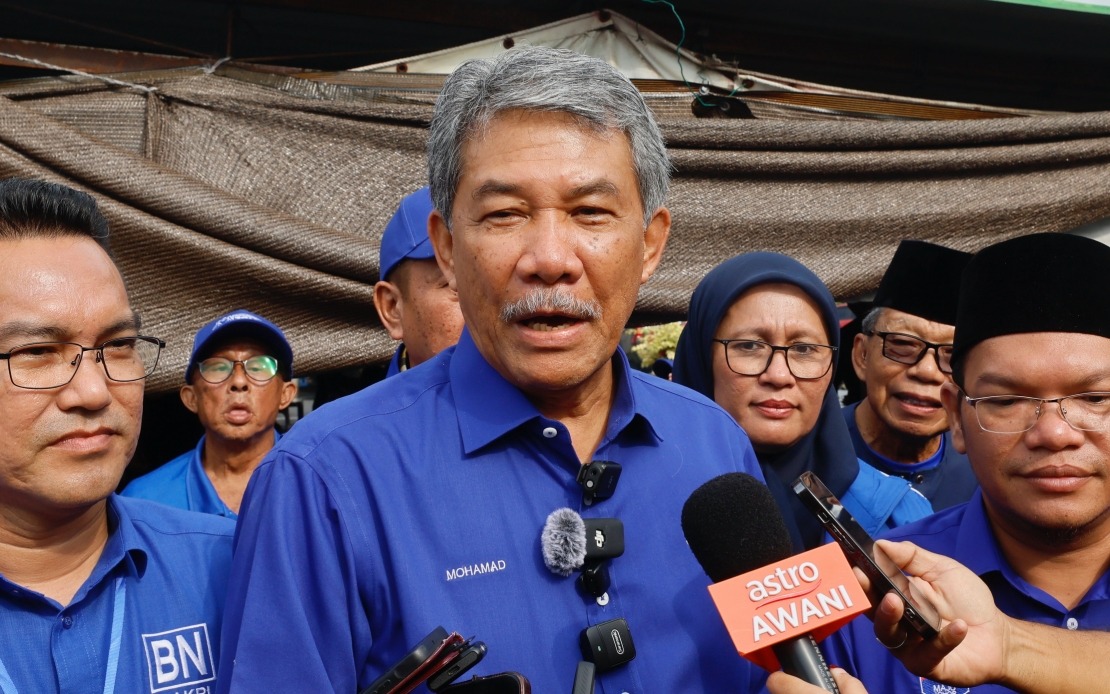
The Johor state election campaign must be conducted with maturity and restraint, avoiding personal attacks that could jeopardize the nation's stability, according to UMNO deputy president Datuk Seri Mohamad Hasan. Speaking at a voter engagement session in Tiram state constituency, the Foreign Minister underscored the importance of distinguishing between robust policy debate and damaging personal rhetoric as the state heads toward polls scheduled for July 11, with early voting beginning the following day.
Mohamad Hasan drew a careful line between legitimate political competition and conduct that could undermine the broader governance framework. While acknowledging that all contesting parties possess the right to articulate their policies and present their vision to voters, he stressed that such engagement must not fracture the cooperative mechanisms within the Unity Government operating at the federal tier. This distinction reflects a delicate political balance Malaysia maintains, where coalition partners sometimes contest elections within their respective states whilst maintaining administrative unity at the national level.
The UMNO leader characterized healthy political discourse as one focused on contrasting ideas rather than character assassination or personal vilification. He offered his own experiences as evidence that politicians across the spectrum routinely engage in verbal sparring and friendly criticism without crossing into acrimony. For Mohamad Hasan, the threshold lies in avoiding language or accusations that become deeply personal or damaging to individuals, thereby preserving the possibility of continued collaboration once electoral contests conclude.
Central to his message was an appeal to prioritize national governance and institutional stability over electoral ambitions. Mohamad Hasan emphasized that the machinery of state cannot afford disruption caused by campaign rhetoric that spills into hostile post-election environments. The stewardship of Malaysia's affairs at the federal level demands that coalition partners, despite their competing interests in state-level contests, maintain sufficient rapport to function effectively in collective decision-making. This perspective acknowledges the inherent tension between competitive elections and collaborative governance that characterizes Malaysia's political system.
Addressing speculation that has circulated within certain political circles, Mohamad Hasan firmly rejected suggestions linking the Johor state election to efforts aimed at securing the release of former Prime Minister Datuk Seri Najib Tun Razak. Such allegations, he contended, misunderstand both the constitutional framework and the practical limitations of state-level executive authority. A Menteri Besar, irrespective of their political affiliation or personal inclinations, possesses no institutional mechanisms through which to influence federal-level decisions regarding pardons or criminal proceedings.
The Foreign Minister grounded his rebuttal in Malaysia's constitutional architecture, reminding the public that the nation operates under the supremacy of the law—a principle UMNO ostensibly upholds. The power to grant pardons resides exclusively with the Yang di-Pertuan Agong, whose prerogative in such matters remains absolute and beyond the reach of state governments or electoral outcomes. By framing the issue this way, Mohamad Hasan sought to insulate the Johor election from becoming a referendum on matters of clemency or criminal justice that lie entirely outside its legitimate scope.
Implicit in his statement was a warning against those who might attempt to politicize the institution of the Agong or suggest that electoral victories could translate into pressure on the sovereign's decision-making. Such framing serves to protect both the dignity of the monarchy and the integrity of judicial and executive separation at the federal level. For Malaysian observers, this underscores how state elections can become entangled in national controversies unless political actors consciously maintain institutional boundaries and resist instrumentalizing electoral contests for extraneous purposes.
The broader context of Mohamad Hasan's appeal reflects the complexities facing Malaysia's ruling coalition. With 172 candidates vying for 56 seats in the Johor State Legislative Assembly, the contest carries significant implications for the state's political direction. Yet the participation of UMNO—a key federal coalition partner—in a state election where the outcome could reshape Johor's governance creates potential friction within the Unity Government if campaigns become unnecessarily acrimonious or if electoral results are interpreted as endorsements or rejections of federal policy.
From a Southeast Asian perspective, Malaysia's experience demonstrates how federalist systems navigate the tension between localized political competition and national coalition politics. Other regional democracies face similar challenges, balancing state-level autonomy with the imperatives of federal cooperation. The Johor election thus serves as a case study in how mature political systems can compartmentalize conflicts, allowing electoral competition to proceed without destabilizing broader institutional relationships or constitutional frameworks.
Mohamad Hasan's intervention, timed just days before polling, appears designed to establish behavioral boundaries that, if observed, would allow the election to proceed without triggering cascading tensions within the Unity Government. His emphasis on maturity and prudence reflects an understanding that electoral outcomes, no matter how decisive, carry less weight than the continuity of functional governance structures. By appealing to shared interest in national stability and constitutional propriety, he positioned reasoned restraint as a marker of political sophistication rather than weakness.
The timing and content of such statements from senior federal figures inevitably shape campaign atmospheres at the state level. When the Foreign Minister publicly advocates for measured conduct, subordinate party figures and candidates receive implicit guidance on acceptable boundaries. This mechanism of elite signaling helps maintain discipline within party structures and discourage candidates from pursuing strategies based on personal attacks or institutional transgression, even when such approaches might yield short-term electoral gains.
Looking forward, the Johor election will test whether Malaysia's political class can sustain such equilibrium. The results on July 11 will indicate whether voters reward parties that adhered to Mohamad Hasan's prescriptions for maturity or whether state-level competitions inevitably escalate beyond the bounds of institutional propriety. Regardless of the outcome, the election offers insight into how Malaysia continues to grapple with the perpetual challenge of maintaining democratic competition whilst preserving governmental functionality and respect for constitutional structures.

