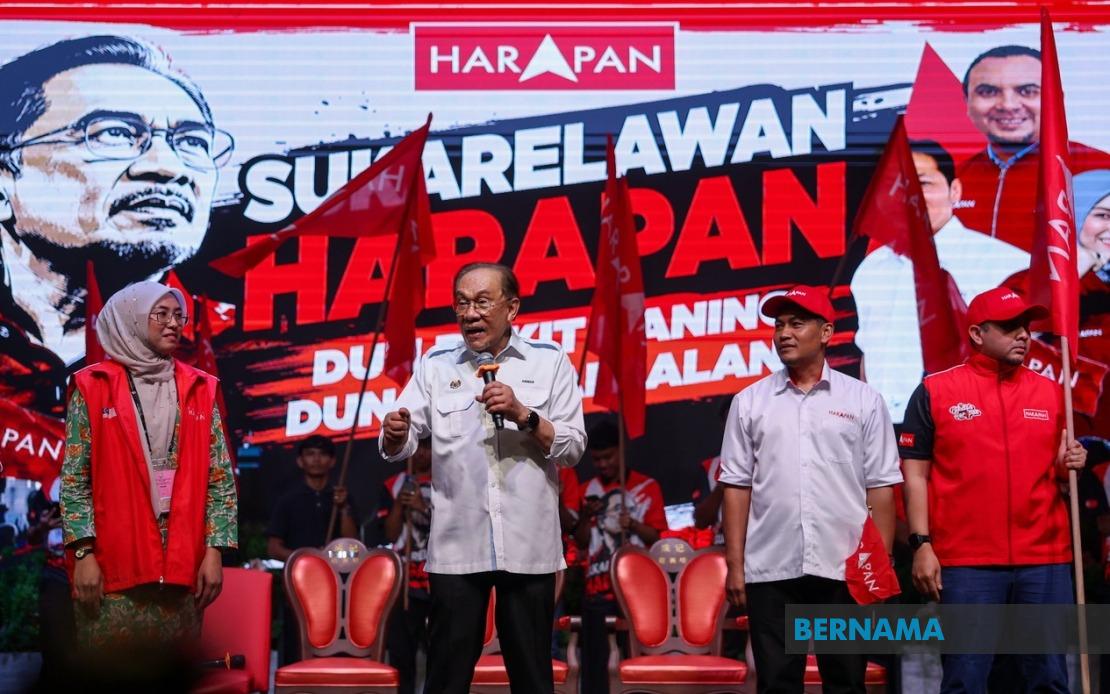
Prime Minister Datuk Seri Anwar Ibrahim has appealed to young voters in Johor to set aside race-based political narratives and use the forthcoming state election to install leaders genuinely committed to building their futures. Speaking at a volunteer campaign launch in Muar, Anwar—who chairs Pakatan Harapan—emphasised that voters should assess candidates based on their ability to address practical concerns affecting communities daily, particularly schooling, job creation, and economic growth in the state, rather than allowing themselves to be swayed by appeals to ethnic sentiment.
The Prime Minister articulated a pointed critique of what he characterised as deliberate efforts to manufacture discord among Malaysia's diverse populations. He highlighted how certain political actors persistently attempt to cultivate fear of the Chinese, animosity toward Indians, and fractures between Malay and Chinese communities, questioning the underlying motivation for such divisiveness. Anwar suggested that while ordinary Malaysians engage in such manufactured conflicts, those wielding power concentrate on accumulating wealth, a pattern he argued benefits no one but entrenched elites.
Addressing the assembled audience, Anwar spoke directly to young Malays, Chinese, and Indian voters, framing the election as a pivotal moment for generational agency. He urged them to reject what he termed the "rotten political system" that has long characterised Malaysian politics, positioning youth as agents capable of driving meaningful transformation rather than passive recipients of inherited institutional arrangements. His remarks reflected a broader Pakatan Harapan strategy targeting younger demographic cohorts who demonstrate greater openness to cross-ethnic coalition-building and appear less responsive to traditional communal political appeals.
Anwar noted with evident satisfaction the substantial turnout of young people at the Bukit Naning volunteer programme, interpreting their presence as evidence of a generational shift toward demanding change and accountability. Having conducted political campaigns for more than a decade, he described the gathering as extraordinary in its composition and energy, suggesting that younger Malaysians are increasingly conscious of their capacity to reshape political outcomes. He encouraged attendees to leverage this momentum by systematically reaching out across villages, neighbourhoods, and districts to communicate a coherent message centred on the feasibility of political transformation.
The Johor state election represents a significant electoral contest within Malaysia's fractious political landscape, with 172 candidates competing for 56 state seats. The polling exercise is scheduled for July 11, with early voting opportunities available on July 7. The election comes amid broader uncertainty about the trajectory of Malaysian politics, with various coalitions attempting to mobilise support around competing visions for the nation's direction.
Anwar separately emphasised that divisive political messaging designed to fragment Malaysia's multi-ethnic fabric has become increasingly anachronistic and illegitimate in a mature independent nation. He characterised attempts to incite racial animosity as fundamentally undermining the national cohesion that has historically constituted Malaysia's principal asset and competitive advantage. Such divisive narratives, he contended, represent a form of self-sabotage that weakens rather than strengthens the country.
The Prime Minister condemned certain political discourses circulating in the public sphere as poisonous in nature, specifically targeting messaging that discourages cross-ethnic friendships, cultivates hostility toward particular communities, and promotes generalised distrust along ethnic lines. He dismissed such narratives as relics of an earlier political era, products of what he termed the "old guard," fundamentally incompatible with the requirements and possibilities of contemporary independent Malaysia. This characterisation implicitly positions Pakatan Harapan as forward-looking while positioning rival political forces as backward-oriented and obsolete.
Anwar expressed gratitude for Malaysia's enduring internal peace and stability, noting that Malays, Chinese, Indians, and Orang Asli communities coexist within the same national space. He stressed that such coexistence is neither accidental nor inevitable, but rather depends on deliberate cultivation of mutual respect and reciprocal care among communities. His optimism about Malaysia's future, he indicated, derives substantially from his observation of younger Malaysians, whom he regards as possessing greater instinctive understanding of the necessity and desirability of inclusive national citizenship.
The Prime Minister issued a specific exhortation to the younger generation, emphasising that passive observation of political processes and outcomes constitutes an abdication of responsibility. Rather, he argued that young people must embrace active engagement and shoulder the burden of shaping a more inclusive and equitable future for the nation. This framing transforms electoral participation from a civic duty into a generational imperative, positioning voting and campaign involvement as essential components of youth identity and contribution to national development.
Anwar's remarks reflect Pakatan Harapan's broader electoral strategy in Johor, which involves mobilising younger, more educationally advanced, and increasingly urbanised voter segments through appeals to competence, inclusivity, and developmental performance rather than ethnic or religious identity. The coalition's emphasis on education, employment opportunity, and inclusive governance appears calibrated to attract voters dissatisfied with what it characterises as the ethnically divisive and corruption-prone practices of established competitors. Whether such messaging proves sufficiently compelling to shift electoral outcomes in a state with historically strong ties to the United Malays National Organisation remains a matter for the July 11 polls to determine.

