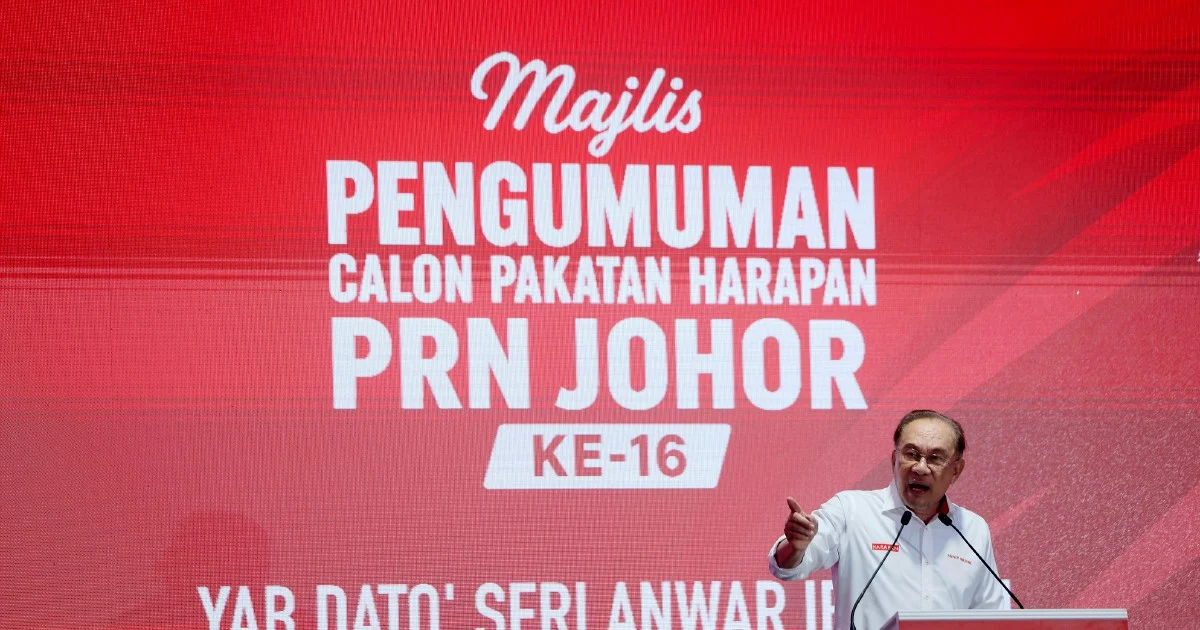
Prime Minister Datuk Seri Anwar Ibrahim has highlighted the federal government's commitment to Johor's development, revealing that the state has received substantially more financial support from Kuala Lumpur than it has contributed in tax revenues. Speaking in Tangkak, Anwar pointed out that over the past three years, Johor contributed RM14 billion to federal coffers while the federal government channelled RM16 billion back to the state, resulting in a net transfer of RM2 billion to support local development and services.
This disclosure underscores a broader pattern of fiscal redistribution aimed at balancing economic development across Malaysia's states. The federal system ensures that wealthier or more productive states contribute a larger share of national taxation while receiving allocations calibrated to their development needs, population size, and infrastructure requirements. Johor's position as one of Malaysia's most economically significant states—home to major petrochemical, manufacturing, and tourism sectors—typically generates substantial federal tax revenue, yet the state's continuing development challenges justify additional federal investment.
The RM2 billion differential represents a significant commitment during a period when the federal government has navigated fiscal constraints and competing budgetary pressures across all states. This positive cash flow to Johor reflects several policy priorities under the current administration, including investment in transportation networks, education facilities, healthcare infrastructure, and industrial zones that support job creation across the southern corridor. Such allocations are critical for maintaining Johor's competitiveness within the region and sustaining its role as an economic engine for Southeast Asia's wider development framework.
Understanding these fiscal flows is essential for Malaysian readers, particularly those in Johor who benefit from federal investments in local projects. When the federal government allocates funds exceeding a state's direct tax contribution, those resources often translate into visible infrastructure improvements, enhanced public services, and economic opportunities that ripple through communities. Schools receive better facilities, hospitals expand capacity, and major infrastructure projects—whether highways, ports, or industrial parks—create employment and attract private investment.
The Tangkak statement carries particular significance given ongoing discussions about state autonomy and equitable resource distribution in Malaysia's federal structure. Johor, like several other states, has periodically raised concerns about adequate federal funding for specific development initiatives. Anwar's comments provide concrete figures demonstrating that, at the aggregate level, federal allocation to the state actually exceeds direct revenue extraction, a fact that may reshape some stakeholders' perceptions about fiscal fairness in Malaysia's federation.
This fiscal arrangement also reflects demographic and infrastructural realities. Johor's population of over 4 million residents requires substantial investment in public services, transportation, and social infrastructure. The state's geographical position as a gateway to Singapore makes it strategically vital to national economic strategy, justifying prioritized federal spending on cross-border connectivity, port facilities, and border infrastructure. Additionally, Johor hosts significant but dispersed population centers beyond Johor Bahru, creating demands for services that federal budgets are designed to address.
The three-year period Anwar referenced coincided with the government's post-pandemic recovery phase and transition toward a new administration. During this time, stimulus packages, infrastructure acceleration programs, and sectoral support initiatives shaped the overall fiscal picture. Federal allocations to Johor likely encompassed both routine operational funding for federal agencies and special development grants aligned with national economic priorities, including digital transformation, green energy transition, and regional competitiveness objectives.
For Malaysian policymakers and economists, these figures provide useful baseline data for assessing fiscal federalism effectiveness. If federal allocations consistently exceed state contributions without generating proportional development outcomes, questions arise about implementation efficiency and accountability. Conversely, if those funds demonstrably improve living standards, infrastructure quality, and economic opportunity in Johor, the investment justifies itself through tangible outcomes measurable by residents and investors alike.
The disclosure also carries implications for other states monitoring their own fiscal relationships with the federal government. Readers in Sabah, Sarawak, Kedah, and other states will naturally wonder whether their allocations reflect similar positive differentials or whether Johor receives preferential treatment. The federal government's approach to state funding involves complex formulas incorporating population, poverty rates, revenue generation capacity, and strategic priorities, yet transparency about actual flows remains limited in public discourse.
Regionally, Malaysia's federal fiscal system attracts attention from other Southeast Asian nations managing similar questions about equitable resource distribution between wealthy urban centers and developing areas. Johor's experience—demonstrating substantial federal investment in a significant state—offers lessons about sustaining subnational development within a federated framework.
Moving forward, the question becomes whether this fiscal support translates into demonstrable improvements in Johor's infrastructure quality, public service standards, and inclusive economic growth. Federal allocations represent necessary but insufficient conditions for development; effective deployment, transparent spending, and accountable management determine whether RM16 billion genuinely benefits Johor's residents or whether inefficiencies diminish impact.

