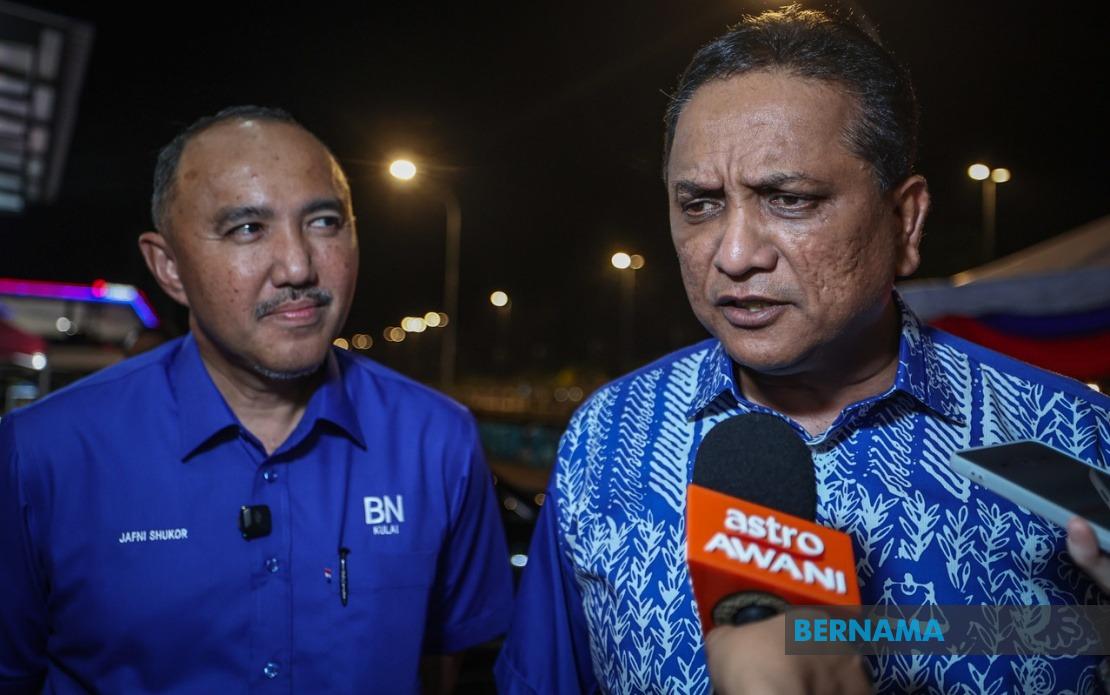
The Johor state government is not a puppet of the palace, according to senior UMNO politician Datuk Seri Reezal Merican Naina Merican, who has moved to quash a controversy that threatens to muddy the political waters ahead of Johor's impending state election. Speaking in Johor Bahru on June 25, Reezal Merican dismissed as wildly overblown the suggestion that Tunku Mahkota Ismail, the Regent of Johor, has manoeuvred himself into controlling the day-to-day operations of the state government. The remarks come amid growing tensions within Johor's political establishment, with Reezal Merican questioning the credibility and motives of those levelling such accusations.
The controversy erupted after Datuk Dr Mohd Puad Zarkashi, a former Speaker of the Johor State Legislative Assembly, announced his departure from UMNO and alleged that Menteri Besar Datuk Onn Hafiz Ghazi had become subservient to the palace. Reezal Merican characterised these claims as an attempt to weaponise the royal institution for political advantage, particularly troubling given the proximity of the election scheduled for July 11. The Election Commission has set June 27 as nomination day, placing the controversy squarely in the midst of campaigning.
As a member of the UMNO Supreme Council, Reezal Merican stated unequivocally that he has never encountered any suggestion within party circles that Johor UMNO operates under palace control. This assertion carries weight given his position within the party hierarchy and his direct involvement in state-level decision-making. His comments reflect an effort by party leadership to contain what could become a damaging narrative if allowed to gain traction among voters and party members alike.
The core of Reezal Merican's defence rests on a distinction between the Regent's constitutional role and accusations of governmental domination. He articulated that Tunku Mahkota Ismail, in his capacity as Regent, possesses both the right and responsibility to offer guidance on matters affecting Johor's development and welfare. This function, he argued, represents a legitimate system of checks and balances rather than evidence of undue influence. The Regent's public statements on Johor's affairs, Reezal Merican suggested, should be understood as an exercise of his constitutional prerogatives rather than evidence of interference.
The mechanism through which this oversight operates deserves closer examination. The Regent serves as a check on the Menteri Besar and the State Secretary, institutional arrangements that exist in Malaysia's constitutional framework specifically to ensure accountability and sound governance. Reezal Merican contended that misinterpreting this arrangement as puppetry fundamentally misunderstands the separation of powers built into Malaysia's hereditary sultanate system. The Regent's firmness in articulating positions on state development, he maintained, reflects his responsibility to the people rather than any improper assertion of authority.
The timing of these accusations raises questions about their underlying purpose. With Johor poised to hold state elections, the introduction of claims about palace interference in state administration injects uncertainty into a campaign already complicated by coalition dynamics and intra-party tensions. Reezal Merican's scepticism about Mohd Puad's motives reflects a broader concern that such allegations might represent a tactical manoeuvre by a departing politician seeking to justify his exit from UMNO or to bolster standing elsewhere.
Mohd Puad's decision to quit UMNO carries its own political implications for Johor. As a former Speaker, he occupies a position of some prominence, and his departure signals potential fractures within the party structure. His contemporaneous claims about palace dominance appear designed to frame his exit not as a personal or factional disagreement but as a principled stand against constitutional overreach. However, Reezal Merican's counter-narrative suggests that the party establishment views these assertions as fundamentally lacking credibility and substantiation.
For Malaysian political observers, this dispute illuminates broader tensions within Johor's governance structures. The relationship between hereditary rulers and elected governments exists in a state of perpetual negotiation across Malaysia's states, but rarely does this dynamic become as openly contentious as in this case. Johor's political prominence—as Malaysia's largest state by landmass and home to a traditionally powerful royal family—means that controversies here can reverberate throughout the federation. How this particular dispute resolves may influence perceptions of royal-executive relations elsewhere.
The constitutional framework governing these relationships remains unchanged regardless of political rhetoric. Malaysian sultans retain significant ceremonial and consultative authority, and the balance between their prerogatives and those of elected administrations varies by state and by circumstance. Johor's particular history, including the reign of the late Sultan Ibrahim Iskandar and the current regency arrangement, creates a specific context in which palace-government interaction operates differently than in other states.
Reezal Merican's defence of the status quo reflects an UMNO institutional interest in maintaining stability during the election period. Any narrative suggesting governmental dysfunction or loss of executive authority could damage party standing among voters concerned about Johor's effective administration. By dismissing the allegations as baseless and questioning the accuser's credibility, party leadership seeks to inoculate itself against what might otherwise become a powerful talking point for opposition parties.
Looking ahead to the July 11 polling day, this controversy represents one of several fault lines in Johor politics. The outcome of the state election will largely determine whether these claims about palace influence persist as a political issue or fade as an electoral cycle concludes. Should Onn Hafiz's administration secure a strong mandate, the allegations will likely be overshadowed by voter endorsement. Conversely, any weakening of his position might resurrect questions about the Regent's role in state governance, creating pressure for clarification of constitutional boundaries.

