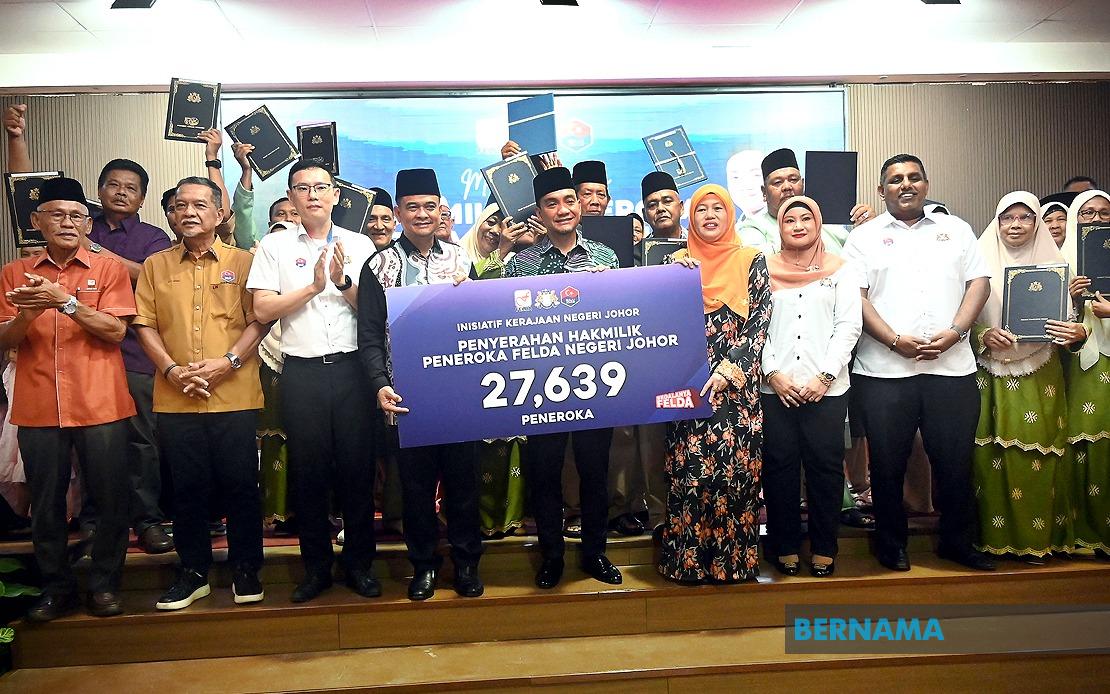
Johor has reached a watershed moment in resolving one of the most persistent grievances affecting Federal Land Development Authority (FELDA) communities across the state, with the government successfully processing 27,639 out of 27,642 land title applications—a completion rate of 99.99 per cent. The milestone was formally marked during a land title presentation ceremony in Kluang on June 23, where 210 settlers from Kluang, Kota Tinggi and Mersing received official documents securing ownership of their plantations and residential properties.
Menteri Besar Datuk Onn Hafiz Ghazi framed the achievement as a testament to the state government's sustained priority on addressing historical land ownership uncertainties that have weighed on FELDA communities for decades. These settlers, who have often operated under informal or incomplete property arrangements, faced significant obstacles in accessing credit, transferring assets to heirs, or leveraging their holdings for economic development. The resolution of nearly 28,000 cases signals a major step toward formalising property rights across Johor's rural agricultural landscape.
The FELDA scheme, established in the 1950s as Malaysia's flagship land settlement programme, created opportunities for landless peasants and small farmers to establish productive livelihoods on federal land. However, administrative delays and bureaucratic complications meant that many settlers never received formal title deeds despite decades of occupancy and productive investment. This gap between practical ownership and legal recognition created significant hardship, particularly for elderly settlers seeking to pass holdings to the next generation or younger farmers attempting to modernise their operations through institutional financing.
Johor's approach to clearing this backlog reflects a broader regional concern. FELDA settlements exist across multiple states, and unresolved land titles represent a bottleneck affecting rural economic mobility and generational wealth transfer. The state's capacity to process nearly 28,000 applications efficiently demonstrates that with adequate administrative resources and political commitment, such legacy issues can be systematically tackled. This success may provide a template for other state governments grappling with similar land ownership documentation challenges in their own FELDA communities.
The presence of Datuk Zahari Sarip, chairman of the Johor Agriculture, Agro-based Industry and Rural Development Committee, underscores the government's positioning of this initiative as integral to its rural development strategy rather than merely a bureaucratic housekeeping exercise. By linking land title resolution to broader agricultural modernisation and rural welfare objectives, the state frames secure property rights as foundational to enabling FELDA settlers to participate more fully in value-added agriculture, agro-tourism, and other income-diversification opportunities.
For Malaysia's broader development agenda, the significance extends beyond Johor's borders. Rural land security remains a critical factor in poverty reduction, agricultural productivity, and regional inequality. Settlers with formal title deeds can access agricultural extension services more readily, qualify for development grants, secure bank loans for equipment or infrastructure improvements, and participate more confidently in agricultural cooperatives. The knock-on effects of 27,639 titled properties in Johor include enhanced capacity for sustainable farming practices, generational business continuity, and reduced vulnerability to property disputes.
The resolution of 99.99 per cent of applications also reflects improved governance capacity within Johor's land administration. Processing large volumes of historical property claims demands coordinated effort across multiple agencies—land offices, survey departments, state administration bodies, and settler verification mechanisms. The near-complete resolution indicates that institutional systems have been strengthened, workflow processes streamlined, and inter-departmental coordination improved. Such administrative gains often persist beyond the immediate initiative, enhancing the state's overall service delivery capability.
The remaining three unresolved cases out of 27,642 warrant attention not as a failure but as a cautionary indicator of the complexity inherent in some land title disputes. These may involve disputed claims, multiple claimants, or historical documentation gaps requiring legal resolution rather than administrative processing. Their persistence highlights that while systematic approaches can resolve the vast majority of straightforward cases, a small subset of genuinely complicated disputes may require individual investigation and potentially legal adjudication.
From a political economy perspective, the timing and publicity of this achievement reflects the Johor government's recognition that FELDA constituencies represent significant electoral blocs with long memories of historical grievances. By delivering tangible improvements in settlers' property security and signalling ongoing attention to rural welfare, the state government strengthens its standing among communities that have sometimes felt marginalised in national development discourse. However, the achievement also carries obligations—settlers with secured titles will have higher expectations for government support in accessing markets, technology, and institutional services.
The broader implication for Southeast Asian land policy is that formalising property rights in rural agricultural communities requires sustained political commitment rather than one-off policy announcements. Johor's success in reaching 99.99 per cent resolution suggests that with adequate budget allocation, skilled personnel, and genuine political will, governments can overcome historical documentation gaps. This offers encouragement to neighbouring countries and other Malaysian states facing similar challenges in rural land administration and property rights security.
Moving forward, the focus shifts from documentation to utilisation. Settlers now hold formal titles, but their economic potential depends on complementary services—reliable rural infrastructure, market access, agricultural extension support, and access to credit. The Johor government's stated intention to continue prioritising FELDA settlements will require translating property rights security into tangible improvements in productivity and incomes. Success will ultimately be measured not merely by the completion of a bureaucratic exercise, but by observable improvements in rural livelihoods and agricultural enterprise development across Johor's FELDA communities.

