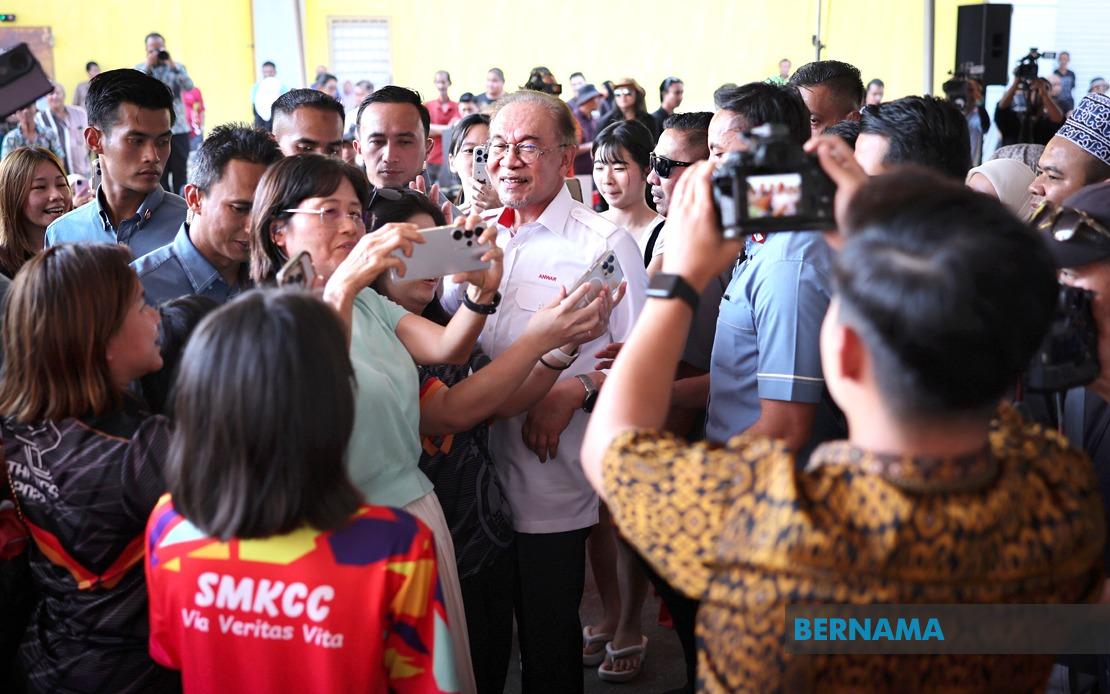
The 16th Johor State Election entered its decisive closing phase today as political parties scrambled to extract maximum advantage from the final hours of campaigning before the official cutoff at midnight. With voters set to head to polling stations tomorrow, party machinery across the ideological spectrum engaged in a frenetic display of last-minute mobilisation, deploying everything from grassroots walkabouts to elaborate concert-style rallies designed to energise supporters and sway undecided voters.
Prime Minister Anwar Ibrahim led the Pakatan Harapan charge with a whirlwind tour spanning five key constituencies in what the coalition framed as a closing argument for maintaining public confidence in PH leadership. The itinerary stretched from Bukit Gambir through Bukit Batu and Layang-Layang, culminating in a headlining 'Johor Ke Depan, Undi Harapan Grand Finale Programme' scheduled for Pasir Gudang tonight. Beyond the symbolic value of his direct engagement, Anwar's final swing underscored PH's strategy of leveraging national leadership visibility to shore up state-level performance, a calculation that reflects broader anxieties within the coalition about defending its position against resurgent opponents.
The coalition's ground operations simultaneously demonstrated the granular intensity characteristic of competitive state elections in Malaysia. PH's Larkin candidate Suhaizan Kaiat adopted a markedly different tone from the prime minister's set-piece rallies, choosing instead to conduct unscripted engagement sessions in shopping malls alongside Amanah Vice President Dzulkefly Ahmad. Such tactical diversity, moving between large-format spectacle and intimate community interaction, reflects how modern Malaysian electoral campaigns orchestrate multiple registers of persuasion, each calibrated to particular voter constituencies. Suhaizan's framing of campaign feedback as a moral responsibility to be shouldered if granted a mandate represents a common rhetorical pivot in closing arguments, translating voter input into obligations binding upon victorious candidates.
Barisan Nasional's closing approach diverged markedly in tone, with Deputy Prime Minister Ahmad Zahid Hamidi anchoring party messaging through a 'BN Grand Supplication & Doa Selamat' ceremony in Kulai district. The invocation of spiritual legitimacy alongside political mobilisation mirrors a broader pattern in Malaysian electoral practice, where religious sentiment and practical governance appeals are woven together. This strategy carries particular resonance in Johor, a state with a substantial Muslim-majority population where appeals to divine blessing carry genuine electoral currency.
Incumbent Johor Menteri Besar Onn Hafiz Ghazi, the BN candidate defending his Machap seat, adopted a notably contrasting stance by publicly apologising for administrative shortcomings throughout his tenure. Such preemptive acknowledgment of performance gaps represents a delicate electoral calculation, potentially acknowledging voter dissatisfaction while framing any loss as reflecting systemic challenges rather than personal failure. The move also subtly prepares ground for post-election scenarios, particularly if BN underperforms relative to its historical positioning in Johor.
Bersatu's final campaign posture, articulated through President Tan Sri Muhyiddin Yassin's video appeal, centred on an appeal for considered voter decision-making. Muhyiddin's invocation of the two-week campaign period as an information-gathering window for voters reflects a tacit acknowledgment that electoral choice involves rational deliberation, a framing that contrasts with emotionally charged appeals elsewhere in the campaign landscape. The implicit logic suggests that voters possessing adequate comparative data about competing parties will make informed determinations aligned with Bersatu's interests.
The opposition Bersama party, operating from a significantly smaller baseline than the major coalitions, nonetheless mounted a structured closing effort featuring prominent personalities Rafizi Ramli and Nik Nazmi Nik Ahmad in their 'Ceramah Finale BERSAMA' event. Rafizi's promise to synthesise and rebut major campaign issues in his final speech reflects how smaller parties attempt to punch above their institutional weight through rhetorical precision and intellectual positioning, a strategy particularly pronounced when contesting against better-resourced political machinery.
MUDA, the newer entrant to Malaysia's electoral landscape, deployed the 'Puteri Wangsa Grand Finale Lecture' as its closing spectacle, with party president Amira Aisya Abd Aziz emphasising voter agency and individual power. Such framing resonates particularly among younger demographic cohorts potentially receptive to narratives of empowerment and democratic efficacy, constituencies where newer parties often find their most sympathetic audiences.
The substantive electoral contest involves 172 candidates competing for 56 state assembly seats, a concentration of contests that will determine not merely legislative composition but also coalition viability across Malaysia's second-most-populous state. Johor's electoral trajectory carries implications extending beyond state boundaries, as outcomes influence broader calculations about coalition durability and regional political momentum heading into potential federal elections. The state's economic significance, stemming from its position as a major manufacturing and trade hub adjacent to Singapore, means that governance questions about infrastructure investment, business environment quality, and regional integration carry stakes transcending purely local politics.
Weather forecasts from the Malaysian Meteorological Department predict clear morning conditions transitioning to afternoon rain or thunderstorm potential, a meteorological reality that campaign planners must factor into turnout projections. Historically, inclement weather has produced variable effects on electoral participation across Malaysian constituencies, sometimes suppressing voter engagement while occasionally accelerating voting among motivated supporters racing against weather deterioration.
The compression of all major parties' closing arguments into a single evening reveals the intensifying professionalisation of Malaysian electoral campaigning, where victory calculations depend upon coordinating messaging across digital platforms, traditional media, community gatherings, and symbolic ceremonies. Each coalition's final-night positioning represents a culmination of strategic choices made throughout the campaign, from target constituency prioritisation to messaging hierarchy to resource allocation. Tomorrow's results will render immediate verdicts on these calculations, while longer-term analysis will assess how effectively competing visions of governance, regional development, and inclusive prosperity resonated with Johor's electorate.

