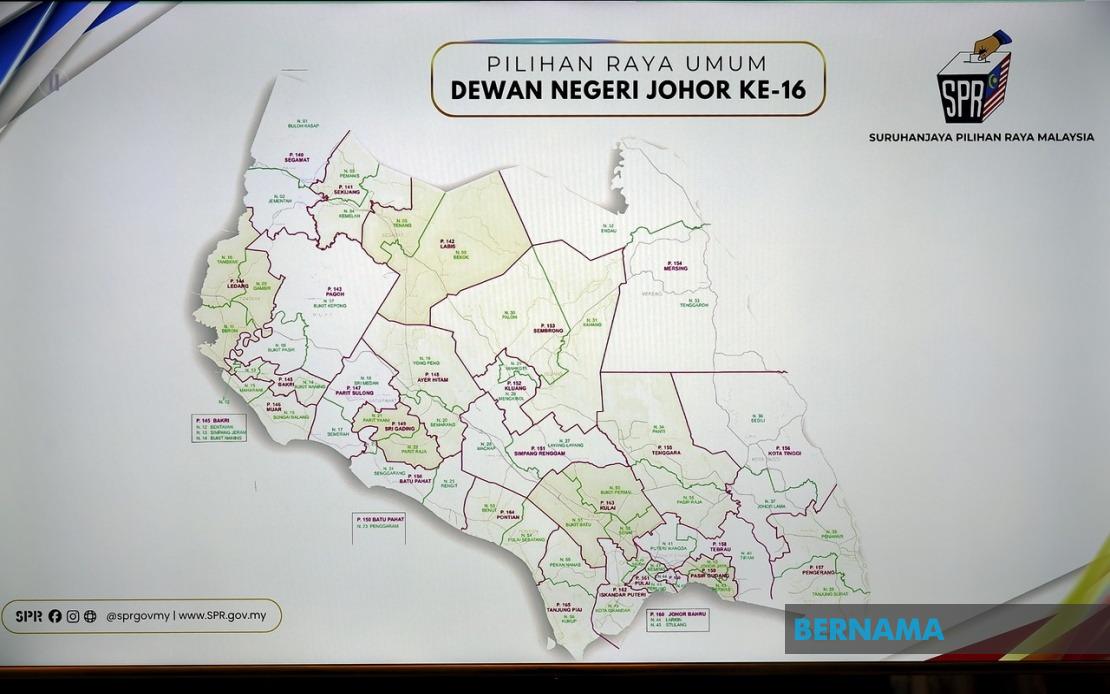
The 16th Johor state election officially commences tomorrow with nomination day, marking the beginning of an intensely competitive campaign season that will culminate in polling on July 11. The election process represents a significant democratic exercise for Malaysia's southern state, with candidates from seven political parties preparing to contest across all 56 state assembly constituencies. The Election Commission has established designated nomination centres where contenders must register between 9 am and 10 am, after which an official screening process will determine the final roster of approved candidates.
Johor's electoral landscape has expanded considerably since the previous state election in 2022, with nearly 2.8 million registered voters now eligible to participate. The electorate comprises approximately 2.7 million ordinary voters, supplemented by 12,041 military personnel and spouses alongside 12,710 police officers and spouses. This expanded voter base reflects population growth and demographic changes across the state, presenting both opportunities and challenges for political parties seeking to mobilise support across diverse communities and constituencies.
The ruling Barisan Nasional coalition is presenting a comprehensive campaign strategy by fielding candidates in all 56 seats, with UMNO dominating the slate at 36 nominees, supported by 16 from the Malaysian Chinese Association and four from the Malaysian Indian Congress. This unified approach demonstrates BN's confidence in defending its 2022 performance, when the coalition secured a commanding 40-seat majority that has allowed it to govern Johor with substantial parliamentary backing.
Opposition coalition Pakatan Harapan has similarly committed to contesting every single constituency, showcasing its determination to challenge BN's dominance. The coalition has divided seats strategically among its three components, with Parti Keadilan Rakyat fielding 20 candidates, Amanah presenting 19, and the Democratic Action Party contributing 17. This distribution reflects ongoing negotiations within the coalition regarding seat allocation and signals the parties' relative influence within the PH framework heading into the election.
The Perikatan Nasional coalition, which emerged as a significant political force during the previous federal election cycle, has also entered the Johor contest with a diversified candidate slate. PAS will contest 11 seats, Bersatu 16, and the Malaysian Indian People's Party five, totalling 32 nominees. PN's participation reflects broader efforts to consolidate what its leaders view as an alternative political platform distinct from both the established BN and the reform-oriented PH.
Beyond the three major coalitions, smaller parties and newer entrants are also testing the electoral waters. The Malaysian United Democratic Alliance, which made waves in the 2022 federal election by winning parliamentary seats despite competing in a crowded field, is fielding candidates in four constituencies. The Socialist Party of Malaysia has nominated a single candidate, while Parti Bersama Malaysia is making its debut in state-level politics by contesting 15 seats across Johor. This proliferation of candidates from diverse political organisations reflects growing political contestation and voter appetite for alternatives.
The Election Commission has issued practical guidance to prospective candidates to ensure smooth nomination processes and prevent administrative obstacles. Candidates are encouraged to verify their nomination forms in advance at either the Returning Officer's Office or State Election Office, a precautionary measure designed to eliminate last-minute documentation problems that could invalidate candidacies. Additionally, candidates must settle deposit payments promptly and retain receipts as proof when formally submitting nomination papers, underscoring the administrative rigour underpinning Malaysia's electoral system.
Anti-corruption enforcement will assume heightened importance throughout the campaign period. The Malaysian Anti-Corruption Commission has issued formal directives to all candidates and political parties, warning them against violations of the MACC Act 2009 or the Election Offences Act 1954 as amended in 2012. To monitor compliance and investigate alleged infractions, the MACC has established five dedicated 24-hour operations rooms strategically located in Tampoi, Batu Pahat, Kluang, Segamat, and Mersing. These operations centres provide citizens with direct channels to report suspected corruption or abuse of power, institutionalising oversight mechanisms intended to maintain electoral integrity.
The election timeline reflects careful planning by the Election Commission, with early voting scheduled for July 7 to accommodate those unable to cast ballots on the main polling day. This arrangement acknowledges practical constraints faced by voters and aims to maximise participation rates across the state. The compressed campaign period between nomination day and polling day creates substantial pressure on political parties to mobilise supporters efficiently and communicate their policy platforms effectively to voters.
The background to this election traces to the dissolution of the Johor State Legislative Assembly on June 1, which was necessitated by constitutional requirements and political developments within the state. The 2022 election result, where BN captured 40 seats compared to PH's 12, PN's three, and MUDA's one, provides the crucial context for understanding party strategy and voter sentiment heading into this contest. That result consolidated BN's control over Johor despite the federal government being led by PH, demonstrating the state's divergent political trajectory and the complex interplay of state and national political dynamics that characterise Malaysian electoral politics.
For observers monitoring Malaysian politics, the Johor contest carries significance beyond the state itself. The result will indicate whether BN's 2022 performance reflects enduring voter preference or whether opposition parties have successfully strengthened their ground machinery and messaging. The election also provides insights into the viability of emerging political forces like PN and MUDA within the southern state context. Ultimately, nomination day tomorrow will crystallise the actual competitive landscape, revealing which candidates successfully cleared administrative hurdles and which parties must adapt their strategies in response to unexpected withdrawals or last-minute changes.

