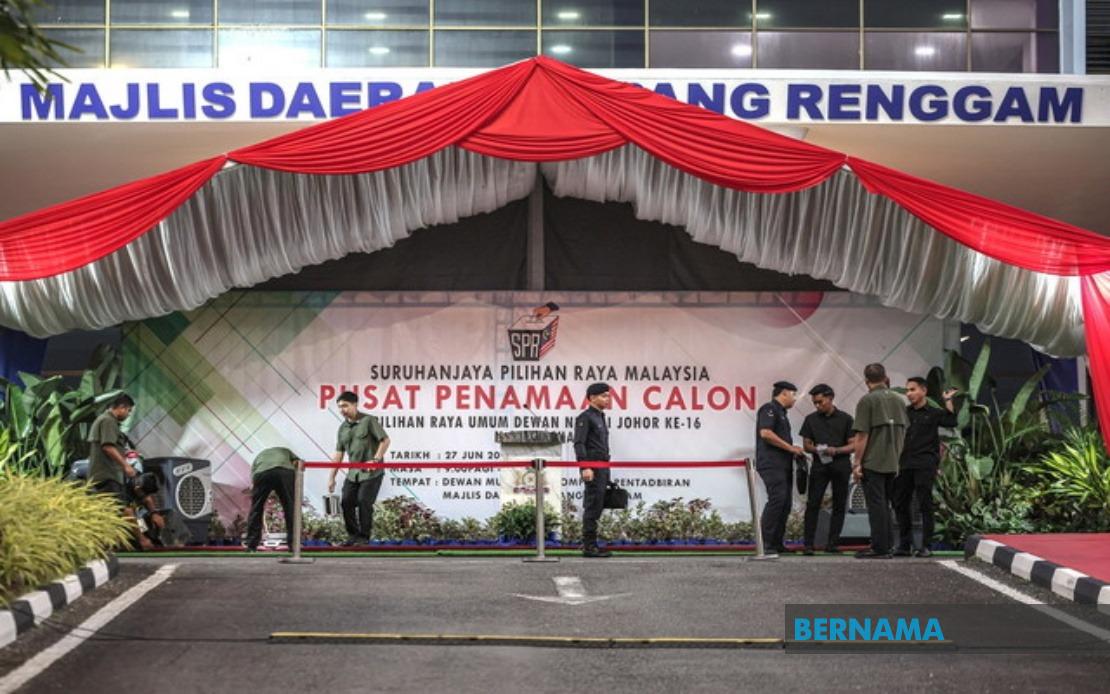
The 16th Johor State Election moved into its critical nomination phase on June 27 as all 56 submission centres across the state opened their doors simultaneously at 9am, marking the formal beginning of the electoral race. The tight one-hour window for nomination filing—closing at 10am—created a decisive moment for political parties to formally enter their candidates, with returning officers positioned at each centre to receive and process the required documentation from nominees, their proposers, and seconders.
The nomination submission process, though compressed in its time window, follows established electoral protocols that allow flexibility in how candidates present their papers. The regulations permit the candidate alone, the candidate with proposer and seconder, or any combination of two or even one party to lodge the nomination forms, acknowledging the practical challenges of coordinating multiple individuals during the compressed timeframe. This procedural accommodation reflects lessons learned from previous electoral cycles and seeks to prevent unnecessary technical rejections on administrative grounds.
Once the Election Commission completes its verification of all submitted nominations, the official campaign period formally commences for what has been designated as a 14-day sprint. This campaign window extends until 11.59pm on July 10, giving political parties and candidates a fortnight to conduct ground operations, hold rallies, distribute campaign materials, and attempt to sway the 2,727,926 eligible voters registered across Johor. The tight timeline concentrates electoral activity and means political machinery must operate at peak efficiency from the moment candidates are officially confirmed.
The electoral roll for this election reflects Johor's substantial population and voting strength within Malaysia's federal framework. The 2,703,175 ordinary voters constitute the bulk of the electorate, but the inclusion of 12,041 military personnel and spouses alongside 12,710 police personnel and spouses demonstrates how security force votes are carefully enumerated and accommodated within the democratic process. This total of nearly 2.73 million eligible voters underscores Johor's political significance, as the state represents one of Malaysia's most populous and economically important regions.
Despite the early morning nomination deadline, party supporters demonstrated their enthusiasm by assembling at nomination centres from as early as 6.30am, creating visible displays of political affiliation and grassroots mobilization. These gatherings serve multiple purposes—they energize party machinery, provide media opportunities for candidate photographs and statements, and signal organizational strength to potential voters and rival parties. The early congregation of supporters reflected the competitive intensity expected throughout the campaign period.
Weather presented a variable factor across Johor's geographic expanse on nomination day, with the Malaysian Meteorological Department issuing forecasts highlighting the state's climatic diversity. While Johor Bahru, Muar, Batu Pahat, Kota Tinggi, Pontian, Tangkak, and Kulai faced rain prospects during the morning nomination period, districts including Segamat, Kluang, and Mersing were expected to remain clear. The afternoon brought predictions of thunderstorms across most districts including Johor Bahru, Segamat, Kluang, and Kota Tinggi, potentially affecting campaign activities and candidate movements between nomination centres.
Security arrangements for nomination day involved coordinated efforts between the police and the People's Volunteer Corps (RELA), with personnel deployed around all 56 nomination centres to maintain order and manage traffic flow. The preventive security posture aimed to forestall any untoward incidents that could disrupt the electoral process or create security concerns, reflecting the Election Commission's commitment to maintaining the integrity and safety of Malaysia's democratic machinery. Such visible security presence also reassures the public and candidates that the nomination process occurs within a controlled and protected environment.
The Election Commission's timeline for the subsequent phases is now locked in place. Early voting has been scheduled for July 7, providing an opportunity for military and police personnel to cast their ballots before the general polling day. The main polling day itself falls on July 11, by which point the campaign period will have concluded and all campaign materials must be removed from public spaces. This structured sequence—nomination, campaign period, early voting, general polling—represents the standard Malaysian electoral calendar and allows voters adequate time to consider their choices before marking their ballots.
For Johor specifically, this state election carries significance beyond the immediate contest for state assembly seats. As one of Malaysia's most developed and economically vibrant states, Johor's political complexion influences broader national political dynamics and demonstrates voter sentiment on governance performance, development delivery, and political representation. The results will be closely watched by political analysts examining whether constituencies demonstrate satisfaction with incumbent administrations or appetite for alternative governance approaches. Furthermore, the state's geopolitical position adjacent to Singapore and its role as a major commercial and manufacturing hub mean that investor confidence and business stability may be influenced by the perceived political stability emerging from these electoral results.

