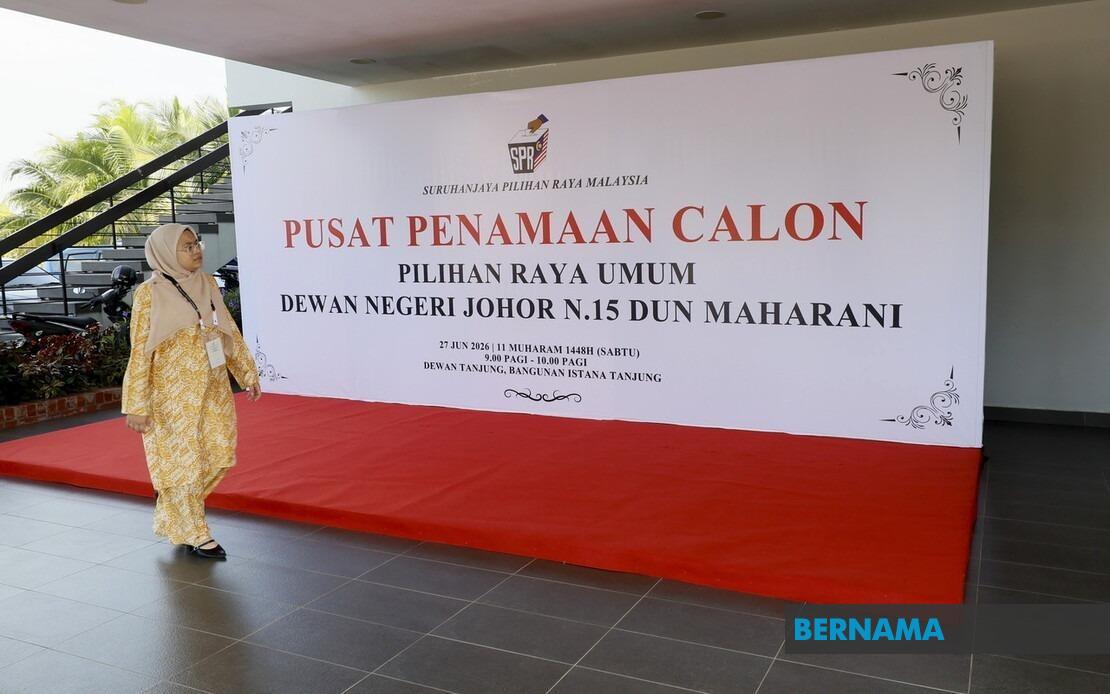
The 16th Johor State Election has officially commenced, with nomination proceedings unfolding simultaneously across 56 nomination centres throughout the state from 9 am today. Prospective candidates have a narrow one-hour window, closing at 10 am, to lodge their nomination papers with Returning Officers before the state announces which candidates have been cleared to contest. This marks a critical juncture in the electoral calendar, as the state looks to replace its dissolved assembly following the June 1 dissolution of the State Legislative Assembly.
The formal campaign period will spring to life immediately upon candidate announcement, giving parties exactly 14 days to mobilise supporters, promote their manifestos, and contest ground-level debates ahead of polling day on July 11. Early voting has been scheduled for July 7, allowing voters who cannot attend on election day to cast their ballots. The Election Commission has structured this timeline to maximise voter participation while maintaining orderly proceedings across Malaysia's second-largest state by electoral population.
Interest in contesting the Johor seats has been substantial, with 593 nomination forms distributed and 133 prospective candidates having paid their election deposits to confirm participation as of yesterday morning. This figure suggests a competitive election landscape, with multiple candidates likely vying for several seats. The involvement of nomination forms and deposits indicates serious intent from candidates and reflects the scale of political engagement across the state's constituencies, ranging from established urban seats to rural and semi-urban areas.
Johor's electoral roll encompasses 2,727,926 registered voters, comprising 2,703,175 ordinary voters alongside 12,041 military personnel and their spouses, and 12,710 police personnel and their spouses. This voter base gives the state considerable influence within Malaysia's broader political architecture, and the outcome is expected to shape not only Johor's governance but potentially ripple effects across regional politics and federal-state relations. The inclusion of military and police voters reflects constitutional provisions for security personnel participation in state elections.
The contest will feature an increasingly crowded political marketplace. Pakatan Harapan is fielding a full slate across all 56 seats through its three component parties: PKR contesting 20 seats, Amanah with 19, and DAP fielding 17 candidates. This represents the established opposition coalition's comprehensive effort to reclaim ground in a state historically dominated by Barisan Nasional. The coalition's strategy reflects confidence in its appeal to Johor voters following federal-level gains in recent years.
Barisan Nasional, which held 40 seats before the assembly dissolution, is contesting all 56 constituencies through UMNO (36 seats), MCA (16) and MIC (four). This represents the governing coalition's determination to retain control of this economically important state. The seat distribution demonstrates UMNO's continued dominance within the BN machinery in Johor, though the significant ground it must defend suggests a genuinely competitive environment rather than a forgone conclusion.
Perikatan Nasional presents a more distributed challenge, contesting through multiple vehicles: PAS in 11 seats, Bersatu in 16, Malaysian Indian People's Party in five, and Parti Pejuang Tanah Air in one. This multi-party approach reflects PN's attempt to broaden its appeal across different demographic and religious constituencies, though the fragmentation across four separate parties may complicate messaging and voter coordination. The relative strength of Bersatu within PN's Johor strategy is notable given the party's origins in the remnants of former Prime Minister Mahathir Mohamad's movement.
The electoral field has expanded with newer entrants reshaping the competitive dynamic. Parti Bersama Malaysia is making its electoral debut in Johor by contesting 15 seats, marking a significant entry for a newcomer. MUDA, which won a seat in the previous assembly, is contesting four constituencies, while Parti Sosialis Malaysia fields one candidate. This proliferation of political options reflects growing voter sophistication and willingness to consider alternatives beyond the traditional three-coalition framework that has dominated Malaysian politics. For Malaysian and Southeast Asian observers, Johor's willingness to entertain multiple political offerings suggests evolving voter preferences toward policy-focused politics rather than purely identity-based or coalition loyalty voting.
Nomination day procedures have been established to ensure orderly conduct, with the Election Commission reminding all participants of their obligations under the Election Offences Act 1954. Campaign activities utilising loudspeakers and musical instruments mounted on vehicles face restrictions, a measure designed to prevent noise pollution and maintain public order during the nomination process. Security arrangements reflect the scale of this exercise, with 4,832 police personnel deployed across the state to manage traffic, implement road closures near the 56 nomination centres, and maintain public order.
Weather conditions may influence turnout and logistics throughout the day, with the Malaysian Meteorological Department forecasting morning rain across several Johor locations and afternoon thunderstorms expected. Such weather patterns could affect candidate supporters gathering at nomination centres and potentially slow the nomination process, though prepared nomination centres should accommodate proceedings smoothly regardless of conditions. The state's police deployment includes traffic management provisions anticipating congestion around 19 major roads adjacent to nomination centres, indicating authorities expect substantial public movement throughout nomination day.
The numerical shift in seat allocation before dissolution provides a baseline for measuring this election's outcome. Barisan Nasional's 40-seat holding before dissolution represented a commanding majority, though not overwhelming enough to dismiss opposition gains as impossible. Pakatan Harapan held 12 seats, Perikatan Nasional three, and MUDA one. If these numbers remain static, Barisan Nasional would retain control, but electoral dynamics often differ from previous baselines, particularly when new entrants fragment the vote or when voter sentiment shifts between elections.
For Malaysian politics more broadly, Johor's election serves as a significant bellwether. The state's economic importance, its ethnically diverse population including substantial Indian and Chinese communities, and its position as a gateway to Singapore mean outcomes reverberate across the country. A major swing toward opposition forces or established governing structures would signal broader voter sentiment potentially relevant to federal calculations. The emergence of new political players and their performance in Johor will provide data on whether Malaysia's electorate is genuinely diversifying beyond established coalitions or whether traditional structures retain firm voter loyalty. This election thus transcends state-level significance to encompass Malaysia's evolving political trajectory.

