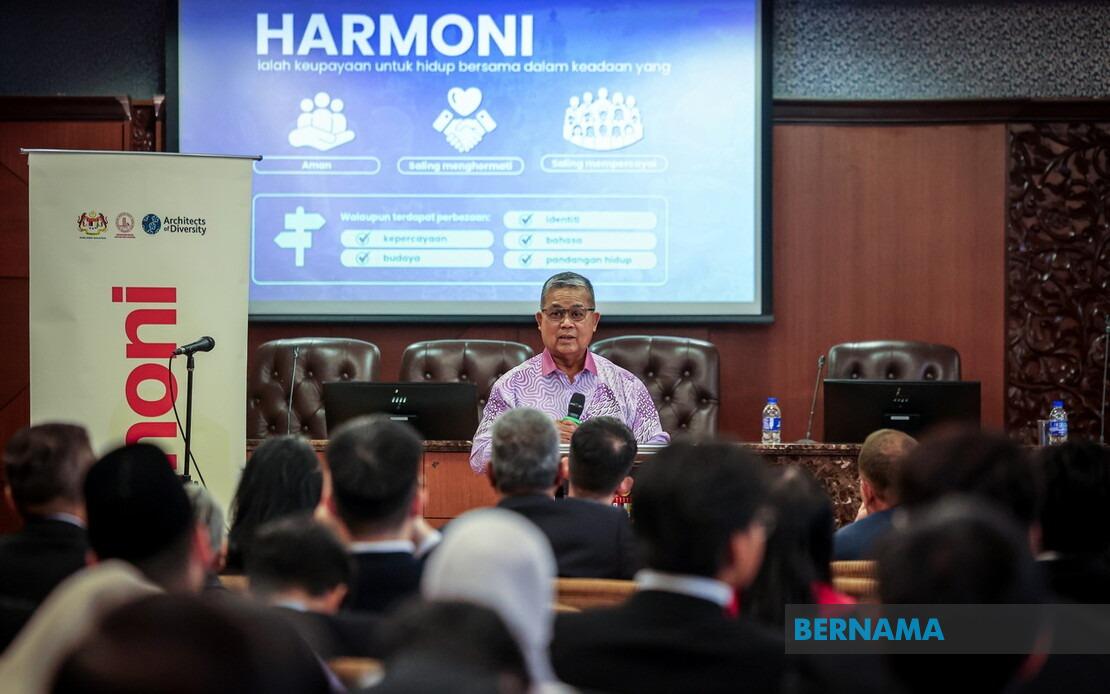
The Department of National Unity and National Integration (JPNIN) has commenced work on a Community Tension Index designed to evaluate the state of social cohesion across Malaysia and systematically track matters relating to racial and religious sensitivities. Speaking at the 2026 Harmony Symposium held at Parliament Building in Kuala Lumpur on June 26, Minister of National Unity Datuk Aaron Ago Dagang outlined how the index would function as a critical analytical tool for government policymakers seeking to craft proactive interventions before tensions escalate into broader social fractures.
The timing of this initiative reflects growing alarm within official circles about the nature and scale of divisive content now circulating through digital channels. Between the beginning of January 2025 and the final day of January 2026, the Malaysian Communications and Multimedia Commission (MCMC) took enforcement action to remove 1,493 items of online material that touched on religion, royalty and race—collectively termed 3R issues. This volume of flagged content underscores the persistent challenge posed by inflammatory discourse taking root in spaces where algorithmic systems amplify outrage and reward engagement with divisive messaging.
Aaron highlighted a particular concern increasingly recognized by researchers and policymakers across the democratic world: the way social media platforms enable what scholars describe as filter bubbles and echo chambers. These mechanisms function by preferentially showing users content aligned with their existing views, progressively narrowing the information diet available to each person. The consequence, as the minister articulated, extends beyond mere fragmentation of awareness; it actively corrodes the foundation upon which multiethnic democracies depend—namely, the capacity of citizens from different communities to inhabit a shared factual and moral universe and engage in constructive disagreement grounded in mutual understanding.
The structure of these digital ecosystems has particular resonance for Malaysia, a nation whose stability and prosperity depend fundamentally on peaceful coexistence among Malay-Muslim, Chinese, Indian, and other communities. When algorithmic systems mechanically sort citizens into information silos based on their online behavior, the naturally occurring friction points between different cultural and religious perspectives can metastasize into irreconcilable polarization. The removal of nearly 1,500 pieces of 3R-related content in a single year suggests that the problem extends beyond isolated bad actors to encompass a systemic pressure toward divisive expression inherent in how contemporary social media functions.
Beyond measurement, JPNIN has been conducting broader consultative work aimed at establishing an institutional response to these challenges. The department has engaged various stakeholders—civil society organizations, religious leaders, academics, business figures, and community representatives—to gather feedback on a proposal to create a National Harmony Commission, or SKN in its Malaysian acronym. This prospective body would operate along several complementary dimensions: early detection of emerging tensions, mediation between parties in conflict, structured dialogue facilitation, and investigative capacity to examine events that might threaten national cohesion.
The proposed commission represents an institutional acknowledgment that managing communal relations in an increasingly digitally mediated society requires more than ad hoc crisis response. Instead, sustained, dedicated capacity devoted exclusively to monitoring, mediating and preventing harmony-threatening incidents could establish preventive architecture. Such mechanisms exist in various forms across other plural democracies, though their effectiveness depends heavily on credibility, resourcing, and genuine commitment to equitable treatment of all communities.
The Community Tension Index itself would serve as the empirical backbone supporting such institutional interventions. By quantifying and tracking indicators of social cohesion—perhaps measuring sentiment in online discourse, documenting communal incidents, surveying cross-community trust levels, and analyzing media coverage patterns—policymakers would gain evidence-based guidance about where tensions are building and which communities or regions require targeted attention. This data-driven approach contrasts with reactive policymaking driven by acute crises, permitting the government to allocate prevention resources where they are most needed.
For Malaysia's diverse population and its regional neighbors facing similar pluralism challenges, this initiative carries broader implications. The rise of disinformation and polarizing content in digital spaces represents a transnational phenomenon affecting democracies from Indonesia to Singapore to Thailand. The Malaysian model of systematically measuring social tension and establishing dedicated institutional mechanisms for early intervention could offer lessons applicable across Southeast Asia, where governments grapple with balancing free expression with social stability amid rapid technological change.
The practical implementation of such tools and institutions will ultimately determine their worth. Creating metrics for something as complex and culturally embedded as social cohesion presents methodological challenges; different communities may interpret identical events through divergent lenses. Moreover, ensuring that a National Harmony Commission operates with genuine impartiality across Malaysia's diverse landscape—treating complaints and tensions involving each community with equal seriousness—remains essential to its legitimacy and effectiveness.
Aaron's presentation at the parliamentary symposium, organized by the Secretariat of the Malaysian Parliamentary Cross-Party Group on Racial and Religious Harmony, itself reflects growing bipartisan recognition that national unity cannot be assumed but must be actively cultivated and defended. The involvement of parliamentarians from across the political spectrum suggests that concern about social cohesion transcends partisan boundaries, even as different groups may disagree about specific policies or causes of division.
Looking forward, the success of JPNIN's Community Tension Index will depend on how comprehensively and transparently it operates. If it functions as a genuine analytical tool informing evidence-based policy, it could represent meaningful progress in Malaysia's long-standing project of maintaining harmony within diversity. Conversely, if it becomes a vehicle for controlling narrative or selectively targeting certain communities, it could deepen the very divisions it aims to prevent. The coming months will reveal whether this initiative advances genuine national cohesion or becomes another contested terrain in Malaysia's ongoing conversation about pluralism, belonging and unity.

