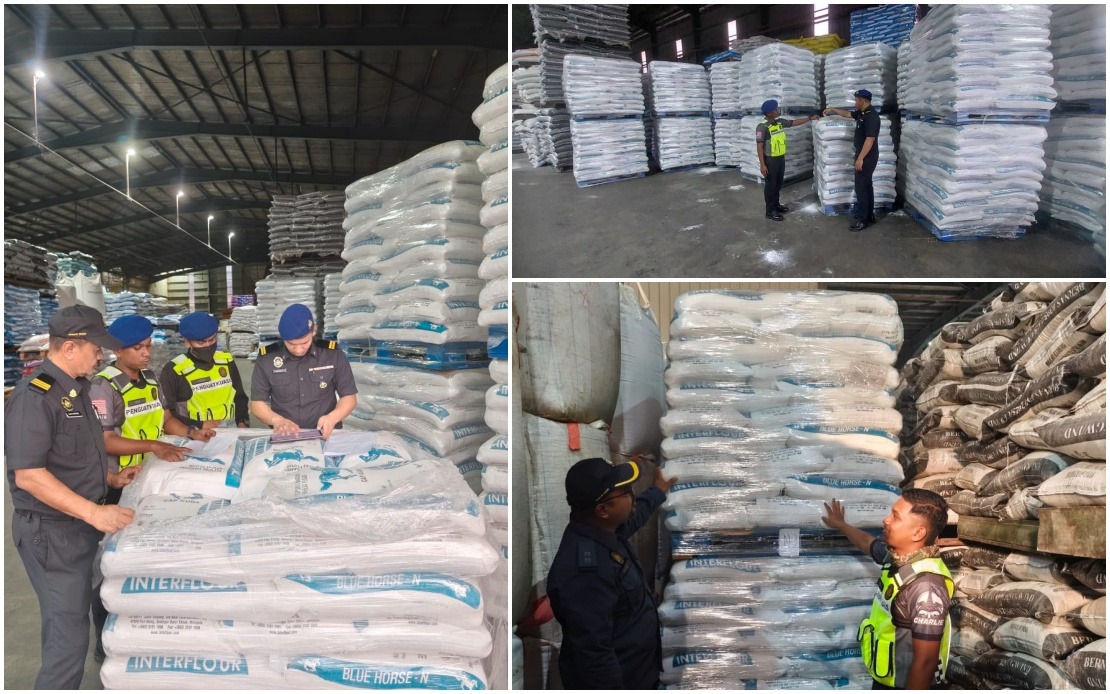
Enforcement officers from the Ministry of Domestic Trade and Cost of Living (KPDN) Kedah branch have seized a substantial stockpile of wheat flour from an animal feed processing facility in the Kuala Ketil Industrial Area following a surprise inspection that revealed serious breaches of supply control regulations. The raid, conducted on the afternoon of June 15 by four enforcement personnel from the Baling branch at approximately 4.30 pm, uncovered evidence that the factory had been storing the flour without the mandatory authorisation required under national subsidy management frameworks.
According to Kedah KPDN director Muhammad Nizam Jamaludin, the operation revealed wheat flour that the company had incorporated into its animal feed manufacturing operations without following proper regulatory channels. The total quantity of flour seized amounted to 53,325 kilogrammes, representing significant stock that investigators assessed as being worth approximately RM100,251 at prevailing market rates. This substantial confiscation underscores the scale of the compliance breach and the potential financial impact on the company involved.
The 25-year-old factory manager, identified as the facility's operator, was unable to present any valid permit or approval documentation from the Supply Controller authorising the storage of wheat flour on the premises. This absence of required documentation forms the crux of the enforcement action, as regulatory oversight of grain products like wheat flour remains a critical mechanism for protecting Malaysia's subsidy programme and ensuring that government-controlled commodity pricing benefits legitimate domestic users rather than unauthorised commercial stockpiling. The manager's failure to produce such permits indicates either negligence in administrative procedures or deliberate circumvention of regulatory requirements.
The investigation has been filed under Section 21 of the Control of Supplies Act 1961 (Act 122), legislation that grants the government broad powers to regulate the storage, movement, and distribution of essential commodities deemed critical for national economic stability. This particular provision addresses unlawful possession and unauthorised holding of controlled items, with penalties designed to deter businesses from operating outside the formal subsidy and supply management system. The application of this statute signals that authorities view the breach as sufficiently serious to warrant prosecution rather than mere administrative correction.
The seizure reflects ongoing tensions between Malaysia's commitment to maintaining food price stability through commodity subsidies and the parallel challenge of preventing leakage into unregulated channels. Animal feed manufacturing represents a legitimate industrial user of grain products, yet the regulatory framework requires even authorised food processors to obtain specific approvals when storing controlled items in quantities exceeding permitted thresholds. This distinction acknowledges that while certain industries genuinely require substantial inventories, unmonitored stockpiling can distort market dynamics and undermine subsidy effectiveness.
Malaysia's subsidy management system has grown increasingly complex as authorities attempt to balance multiple competing objectives: maintaining affordability for consumers, supporting domestic producers, controlling fiscal expenditure, and preventing smuggling or unauthorised diversion to neighbouring countries. The Control of Supplies Act represents one of the older regulatory instruments in this architecture, yet it remains foundational for enforcement operations. Recent years have witnessed heightened scrutiny of supply chains for essential commodities, particularly as regional price volatility has increased pressure on Malaysia's subsidy budget.
The KPDN has signalled that enforcement against subsidy circumvention will intensify, with Muhammad Nizam explicitly warning that firm action would be taken against any party found misusing or diverting subsidised goods. This statement carries particular weight given Malaysia's experience with cross-border smuggling operations that exploit price differentials between the domestic market and neighbouring countries. Animal feed products, being lower-value compared to human consumption items, might seem less attractive targets for smuggling, yet their inclusion in subsidy controls reflects awareness that even marginal price advantages can incentivise large-scale diversion when measured in tonnage.
The Kuala Ketil Industrial Area, where this facility operates, forms part of Kedah's broader manufacturing infrastructure focused on food processing and agricultural inputs. The region has experienced steady industrial development, attracting investment in animal husbandry-related businesses that service Malaysia's poultry and livestock sectors. This geographic context makes supply control enforcement particularly significant, as concentration of food-related manufacturing in industrial corridors enables more efficient regulatory oversight but also creates vulnerability to organised circumvention schemes.
For businesses operating in the animal feed sector, the raid serves as a reminder that compliance with supply control permits is non-negotiable regardless of operational legitimacy or industry category. Companies must obtain advance approval from relevant authorities before acquiring substantial quantities of controlled commodities, even when intended for lawful manufacturing purposes. The distinction between legal industrial use and unlicensed storage hinges entirely on documentation and prior authorisation, not on the putative end-use of the flour.
Industry stakeholders across Malaysia's food and agriculture sectors will be monitoring the outcome of this investigation closely, particularly regarding potential penalties and any charges filed against the facility's management. The case may establish important precedent regarding enforcement intensity and the standards to which companies can expect to be held. Feed manufacturers and processors will likely review their permit compliance status in response, recognising that unannounced inspections appear to form a regular part of KPDN's operational methodology in Kedah and potentially across other states.
The broader implications extend to questions about whether Malaysia's subsidy oversight mechanisms possess sufficient resources and sophistication to effectively police commodity flows across complex supply chains. While this particular raid demonstrates enforcement capacity, it also raises questions about how many similar violations escape detection, particularly in less frequently monitored facilities or more remote industrial zones. Future subsidy policy discussions may need to address whether current regulatory frameworks adequately balance the administrative burden on compliant businesses against the effectiveness of prevention efforts.