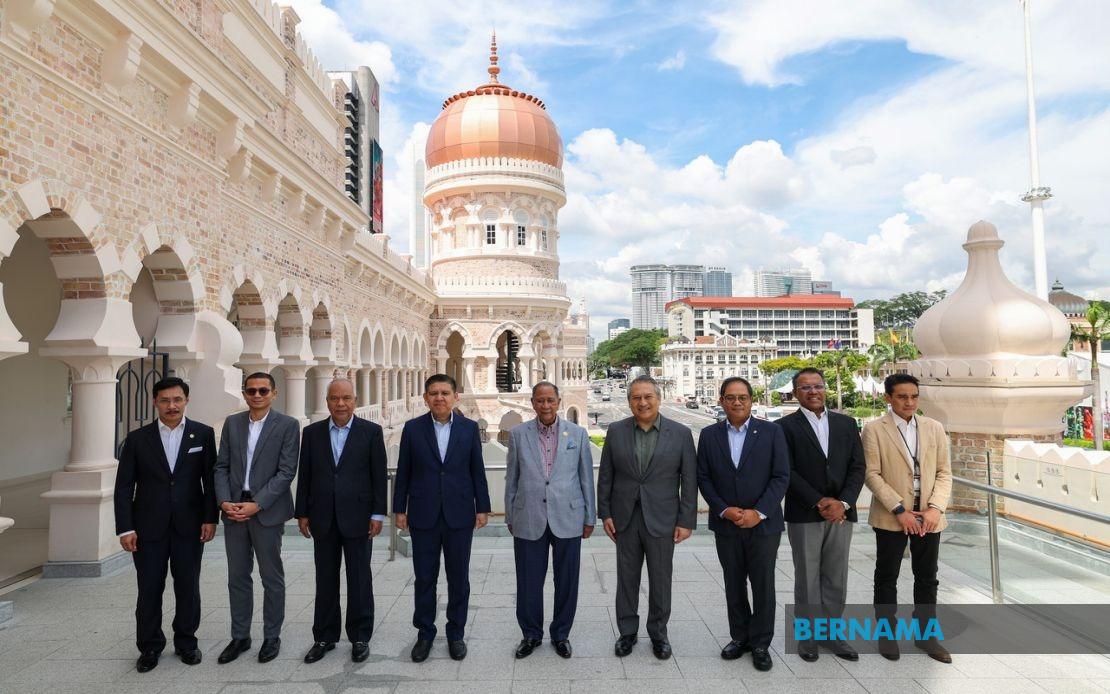
The Sultan of Kedah, Al Aminul Karim Sultan Sallehuddin Sultan Badlishah, made a ceremonial visit to the Sultan Abdul Samad Building in Kuala Lumpur on June 24, underscoring the significance the Malaysian royal institution places on preserving the nation's architectural and historical heritage. Arriving at approximately 10.30 am, His Royal Highness was welcomed by Khazanah Nasional managing director Datuk Amirul Feisal Wan Zahir, whose state-owned investment holding company has championed the multi-million ringgit restoration of this nationally treasured landmark.
The Sultan Abdul Samad Building stands as one of Malaysia's most evocative symbols of nationhood, serving as the ceremonial backdrop for key moments in the country's independence struggle. Originally constructed as the Secretariat Building during British colonial administration, it witnessed the pivotal moment in August 1957 when the Union Jack was lowered and the Federation of Malaya flag raised for the first time, marking the dawn of a sovereign nation. The building's architecture, a blend of Moorish and neo-Renaissance styles, reflects the aesthetic sensibilities of late 19th-century imperial design, yet it has become inseparable from Malaysia's post-colonial identity.
During his three-hour visit, the Sultan engaged comprehensively with the building's newly curated public spaces, beginning with the Confluence Hall, which presents a chronological narrative of Kuala Lumpur's origins and transformation. Think City senior manager Mariana Isa provided detailed briefings on the gallery's exhibits, allowing the Sultan to appreciate how the displays contextualize the capital's evolution from a tin-mining settlement to a modern metropolis. The educational framing of these exhibits reflects a deliberate curatorial strategy to connect Kuala Lumpur's physical and demographic growth with Malaysia's broader nation-building project.
The royal itinerary progressed to the Visionary Hall, where the Sultan encountered architectural models and interactive multimedia presentations depicting the capital's planned development trajectory. These forward-looking displays sit in deliberate contrast to the historical orientation of the Confluence Hall, creating a narrative arc that moves from past accomplishments to future aspirations. The Sultan subsequently accessed the balcony above the Porte Cochere, the building's distinctive columned entrance, from which he could observe the vistas of Merdeka Square and the surrounding civic precinct that form the symbolic heart of Malaysia's governmental landscape.
A notable inclusion in the day's programme was a visit to the School of Hard Knocks, an enterprise operated by Royal Selangor, a prominent Malaysian pewter manufacturer. This facility operates within the building's precinct, representing an attempt to animate the heritage space with contemporary commercial and cultural activity. The inclusion of such operational businesses within heritage buildings remains a contentious issue in conservation circles globally, balancing revenue generation and sustained public engagement against concerns about authenticity and architectural integrity.
The restoration initiative represented a substantial institutional commitment. Earlier in 2024, on January 31, Yang di-Pertuan Agong Sultan Ibrahim formally inaugurated the completion of Phase One restoration works, which had consumed eleven months of intensive conservation activity. The project operated under the Khazanah Heritage Fund programme, Khazanah Nasional's dedicated mechanism for preserving Malaysia's cultural patrimony. The scale and ambition of this undertaking signal a shift in how Malaysia's state apparatus approaches heritage management, moving beyond passive preservation toward active stewardship that transforms historical sites into dynamic public spaces.
Since its opening to the general public on February 2, the Sultan Abdul Samad Building has attracted approximately 200,000 visitors, a figure suggesting considerable public appetite for accessing Malaysia's heritage sites. For comparative context, this visitation rate indicates the building has achieved meaningful penetration within Kuala Lumpur's tourism and cultural circuits. The rapidity with which the venue has accumulated visitors implies that heritage tourism remains economically and socially significant to Malaysia's cultural economy, particularly as urban populations increasingly seek connections to national narratives and architectural landmarks.
Datuk Amirul Feisal's public remarks following the visit framed the Sultan's presence as validation of Khazanah Nasional's conservation philosophy. He emphasized that the organization's mandate extends beyond structural restoration to encompass the interpretation and communication of Malaysian history, particularly the interconnected stories of Kuala Lumpur, Selangor, and the federation's development. This articulation suggests a curatorial vision that understands heritage preservation as fundamentally about meaning-making—helping contemporary and future Malaysians understand how their nation emerged and how institutions shaped that emergence.
The royal visit carries particular symbolic weight because it represents the Malaysian sultanate's institutional endorsement of state-led heritage initiatives. Malaysia's constitutional monarchy positions the rulers as custodians of national identity and Islamic faith, making their participation in cultural preservation activities a form of legitimate authority. When a Sultan personally tours a heritage site, he implicitly validates its historical importance and signals to the broader public that engagement with the nation's past constitutes an appropriate and valued activity.
For Southeast Asian observers, the Sultan Abdul Samad Building's restoration reflects broader regional patterns in how post-colonial nations approach their architectural inheritances. Across the region, former colonial administrative centers have become focal points for heritage conservation efforts, as governments grapple with the complex task of acknowledging imperial legacies while asserting post-independence identities. Malaysia's approach, emphasizing public accessibility and educational programming, represents one interpretation of how to balance these competing imperatives.
Looking forward, the building's successful public reopening and royal endorsement may influence how Khazanah Nasional and other Malaysian heritage organizations approach similar projects. The attendance figures and positive official reception suggest that there exists both institutional support and public interest for transforming Malaysia's architectural heritage into experiential learning environments. Future initiatives may increasingly integrate these spaces with educational curricula, tourism strategies, and urban renewal programs.
The Sultan's visit also occurred within a broader context of Malaysian cultural policy that increasingly recognizes heritage preservation as integral to national cohesion and identity formation. As Malaysia navigates contemporary political and social complexities, anchoring national consciousness to shared historical narratives and iconic locations serves multiple functions—tourism promotion, educational enrichment, and the reinforcement of collective identity. The Sultan Abdul Samad Building, with its direct connection to independence and its prominent position within Kuala Lumpur's civic geography, represents an ideal focal point for such national meaning-making activities.

