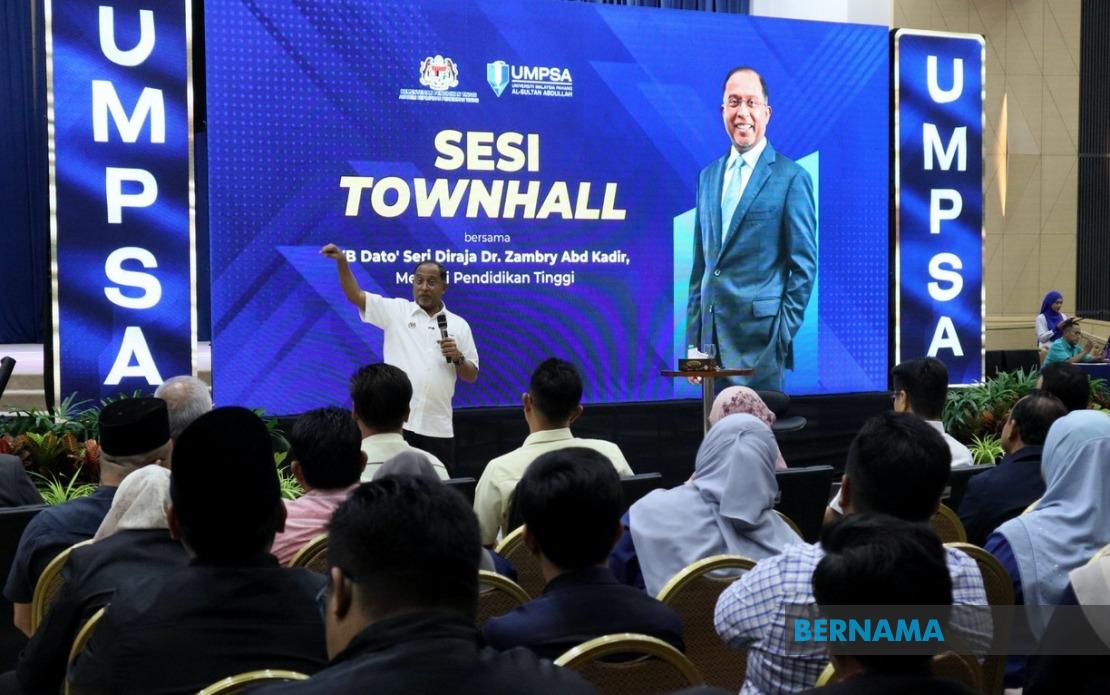
Malaysia's higher education sector is entering a significant transition following the government's commitment to overhaul how universities handle student discipline. The Ministry of Higher Education (KPT) has begun implementing Prime Minister Datuk Seri Anwar Ibrahim's directive to recalibrate the approach to disciplinary action against students, particularly those facing sanctions for criticising the administration. Education Minister Datuk Seri Dr. Zambry Abd Kadir outlined the ministry's strategy during an appearance at Universiti Malaysia Pahang Al-Sultan Abdullah's convocation ceremony, signalling that institutional mechanisms are already in motion to translate the Prime Minister's policy guidance into concrete operational change.
The reform initiative represents a deliberate alignment with Malaysia's broader democratic renewal agenda. Anwar recently announced plans to repeal the Universities and University Colleges Act (AUKU) 1971, a statute long viewed as restrictive to student activism and political expression on campus. However, recognising that legislative amendment requires extended parliamentary processes, the government is pursuing immediate relief through executive action. Students previously disciplined for voicing criticism of the government or political leadership will have their cases reviewed, with the expectation that relevant offences will be expunged from their records where university regulations—rather than criminal statutes—governed the original disciplinary proceedings.
Zambry clarified that the ministry's initiative operates within carefully delineated boundaries. The amnesty for previously disciplined students explicitly excludes matters investigated or prosecuted under the Royal Malaysia Police's criminal law enforcement authority. This distinction is crucial, as it preserves government authority to address conduct that crosses into criminal territory—such as violence, threats, or behaviour violating general penal statutes—whilst creating space for legitimate campus dissent and political expression that falls within university administrative jurisdiction. The minister emphasised that several legislative and regulatory considerations informed the policy framework, reflecting efforts to balance student freedom with institutional governance requirements.
The practical implementation phase commenced immediately, with the director-general of higher education convening all university vice-chancellors to discuss operational protocols. This coordinated approach signals the government's determination to ensure consistency across Malaysia's public university system. A formal statement outlining specific procedures and timelines was anticipated following these consultations, providing clarity to university administrators managing the transition. Such horizontal coordination is essential given that each institution operates within distinct governance structures and may have accumulated different backlog volumes of disciplinary cases requiring review.
The scope of the reform extends beyond public universities, though implementation pathways differ substantially. Private higher educational institutions operate under separate legislation—the Private Higher Educational Institutions Act 1996 (Act 555)—which provides them with distinct regulatory autonomy. Zambry indicated that while the ministry cannot impose the same requirements on private providers, it hopes state-owned or state-affiliated institutions within the private sector will voluntarily align their practices with public university standards. This approach balances respect for institutional autonomy with pragmatic encouragement toward systemic consistency, recognising that Malaysia's higher education landscape comprises diverse institutional types with varying legal obligations.
The policy reversal carries profound implications for Malaysian campus culture and the university's role in civil society. Throughout the AUKU era, Malaysian universities operated under unusually restrictive provisions compared to regional and international peers, with students historically subject to prohibitions on political activity and off-campus participation in demonstrations. The proposed reforms acknowledge shifting governance philosophy: that universities function more effectively when they provide sheltered spaces for vigorous intellectual debate and allow students to develop civic capacities through engagement with contested issues. This reflects evolution in thinking about how democratic societies sustain themselves through educational institutions that nurture rather than suppress critical thinking.
For Southeast Asian observers, Malaysia's trajectory offers instructive lessons about trajectories in tertiary education governance. Regional democracies have increasingly recognised that university autonomy and student freedom correlate with institutional quality and graduate employability. Thailand and Indonesia have wrestled with similar tensions between security concerns and academic freedom, whilst Singapore and Vietnam maintain tighter frameworks. Malaysia's move toward deregulation, even if incremental, suggests confidence that campus dissent can be accommodated within broader institutional health frameworks. Whether this confidence proves justified will depend substantially on implementation fidelity and the emergence of new campus norms as restrictions ease.
The immediate practical challenge confronting the KPT involves managing a potentially substantial caseload of historical disciplinary records. Universities must identify students previously sanctioned under provisions now viewed as overly restrictive, assess whether their conduct genuinely constituted legitimate political expression versus genuine misconduct, and execute appropriate remedial actions. This administrative work requires institutional capacity, clear guidance documentation, and sensitivity to affected individuals who may have borne reputational costs or foregone opportunities due to disciplinary records. Moreover, universities must communicate clearly to their current student bodies about the reformed disciplinary framework, establishing new cultural norms that distinguish between protected expression and prohibited misconduct.
The minister's reference to considerations decided at the legislative level reflects ongoing parliamentary work to harmonise Malaysia's statutory framework with democratic principles. The AUKU repeal process involves substantive debate about what regulatory architecture universities genuinely require versus what restrictions simply perpetuate dated assumptions about student management. Legislators must balance institutional autonomy with accountability, student freedom with behavioural standards, and democratic values with legitimate concerns about disruption to teaching and research missions. The KPT's interim administrative actions effectively buy time for these legislative conversations to mature, whilst signalling government commitment to reform.
Institutional adaptation to reformed disciplinary frameworks typically generates complex cascading effects. University administrations must reorient training programmes for student affairs personnel, revise disciplinary procedures documentation, establish appeals processes for historical cases, and cultivate campus cultural expectations around permissible expression. Faculty members may require guidance about navigating classrooms where students now feel emboldened to voice dissenting viewpoints. Student affairs professionals accustomed to maintaining strict control must recalibrate toward developmental approaches emphasising education and consequence rather than punishment. These cultural transitions require time, thoughtful leadership, and transparency about why the changes are occurring.
The timing of this initiative, occurring during Anwar's tenure as Prime Minister and coinciding with the Malaysia Madani framework emphasising inclusive governance, suggests consolidation of a broader executive commitment to democratic renewal. The Kembara KARISMA programme gathering 500 young university administrators and lecturers provided an apt forum for signalling ministerial direction to institutional leaders who will operationalise these changes. By anchoring the policy initiative in direct Prime Ministerial instruction and involving senior administrators in collaborative implementation planning, the government has created multiple reinforcing pressures toward compliance and consistency. This multi-level engagement approach typically yields stronger institutional adoption than isolated bureaucratic directives.
Looking forward, the success of Malaysia's student disciplinary reforms will ultimately depend on institutional cultures embracing the underlying philosophy of greater academic freedom alongside maintained standards. The reforms represent not capitulation to unruly students but rather a recalibration recognising that universities advance societal development through fostering informed, engaged citizens capable of rigorous debate. Whether Malaysian universities successfully navigate this transition, transforming from institutions perceived as extensions of state control to genuine intellectual commons, will substantially influence the nation's human capital development and its regional competitive positioning in knowledge economies increasingly dependent on creative capacity and critical thinking. The follow-up steps initiated by the KPT represent essential but preliminary moves in what will prove a longer institutional and cultural transition.

