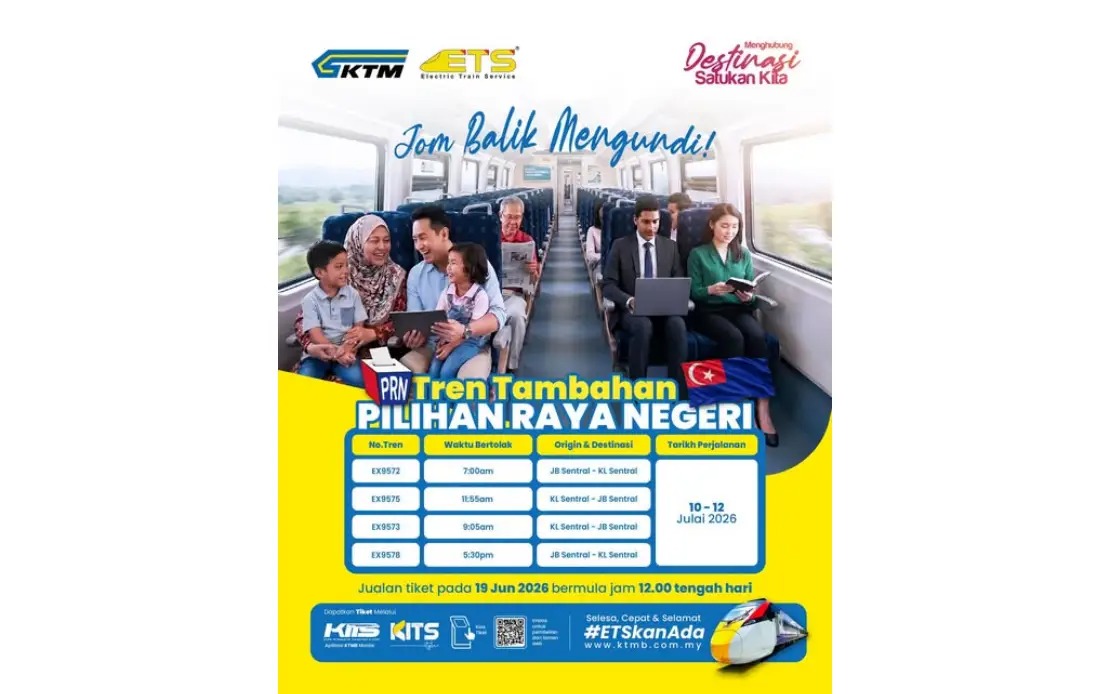
Keretapi Tanah Melayu Berhad (KTMB) has rolled out supplementary ETS express train services to accommodate the anticipated surge in passenger numbers as voters travel to Johor Bahru for the state election scheduled for July 11. The railway company's decision to boost capacity reflects the logistical challenges that accompany major electoral events across Malaysia, when large segments of the working population need to return to their home constituencies to cast their ballots.
Ticketing for these additional services opened at noon on June 19, with KTMB offering multiple booking channels to suit different passenger preferences. Commuters can purchase tickets through the KTMB Mobile application, via the KITS Style platform, on the company's official website at online.ktmb.com.my, or by visiting physical ticket kiosks at stations. This multi-channel approach aims to prevent bottlenecks at any single sales point and distribute demand across the transport ecosystem.
The window for these enhanced services spans July 10 through July 12, strategically bracketing polling day to allow voters arriving from elsewhere in Malaysia to settle before voting and departing afterward. The three-day operational window acknowledges the reality that not all eligible voters can take time off work simultaneously, with some arriving the day before the election and others departing the day after their civic duty concludes.
The Johor state election follows the dissolution of the State Legislative Assembly on June 1, a political development that triggered the electoral process. The Election Commission's decision to schedule polling for July 11 gave political parties and election logistics coordinators roughly six weeks to prepare, a timeline that permits railway operators like KTMB to organise additional rolling stock and crew scheduling without catastrophic service disruptions elsewhere on their network.
This mobilisation of transportation infrastructure underscores a recurring challenge in Malaysian electoral management. The country's extensive internal migration patterns mean that millions of registered voters live and work in locations far from their constituencies of registration. During federal and state elections, the transport sector faces compounded pressure as citizens attempt to travel simultaneously, creating congestion on highways, at airports, and across rail networks.
For KTMB specifically, operating additional ETS services represents both an operational opportunity and a logistical strain. The Electric Train Service operates on defined corridor routes with fixed infrastructure constraints; adding trains requires careful coordination with maintenance schedules, staff availability, and track access windows. The decision to supplement services during election periods has become routine, yet it demands sophisticated planning to avoid compromising regular commercial operations that depend on reliable timetables.
The availability of digital booking platforms reflects Malaysia's increasing embrace of mobile-first service delivery. The KTMB Mobile app and KITS Style application allow voters to reserve seats from their offices or homes, reducing the need to visit physical locations and accelerating the booking process. This technological layer has proven especially valuable in managing demand spikes, as system capacity can often accommodate more transactions than traditional ticket windows.
For Johor specifically, the election holds substantial political weight as one of Malaysia's most developed and populous states. The state's role as an economic powerhouse and its strategic proximity to Singapore makes internal political dynamics consequential for broader regional stability. High voter participation in Johor elections therefore becomes a matter of interest not merely to local political parties but to observers of Malaysian governance and Southeast Asian political trends.
The KTMB initiative also reflects broader government priorities around electoral participation and voter accessibility. By facilitating transport, authorities aim to reduce barriers that might otherwise prevent citizens from exercising their franchise. In a country where franchise rights remain constitutionally protected but can be practically constrained by geographical and economic realities, transport accessibility becomes a genuine policy concern.
The railway sector's capacity to respond to election-driven demand variations depends significantly on advance notice and political coordination. KTMB's announcement on June 19 for a July 11 election suggests routine contingency planning rather than last-minute improvisation, indicating that election dates trigger standard protocols within the transport sector designed to accommodate predictable surges in demand during electoral periods.
Passengers planning to travel to Johor should note that ticket availability for popular time slots may diminish rapidly given the concentrated nature of election travel. Early booking through the mobile application or website remains advisable to secure preferred departure times, particularly for journeys on July 10 or the eve of election day when demand will likely peak as voters attempt to reach their constituencies.

