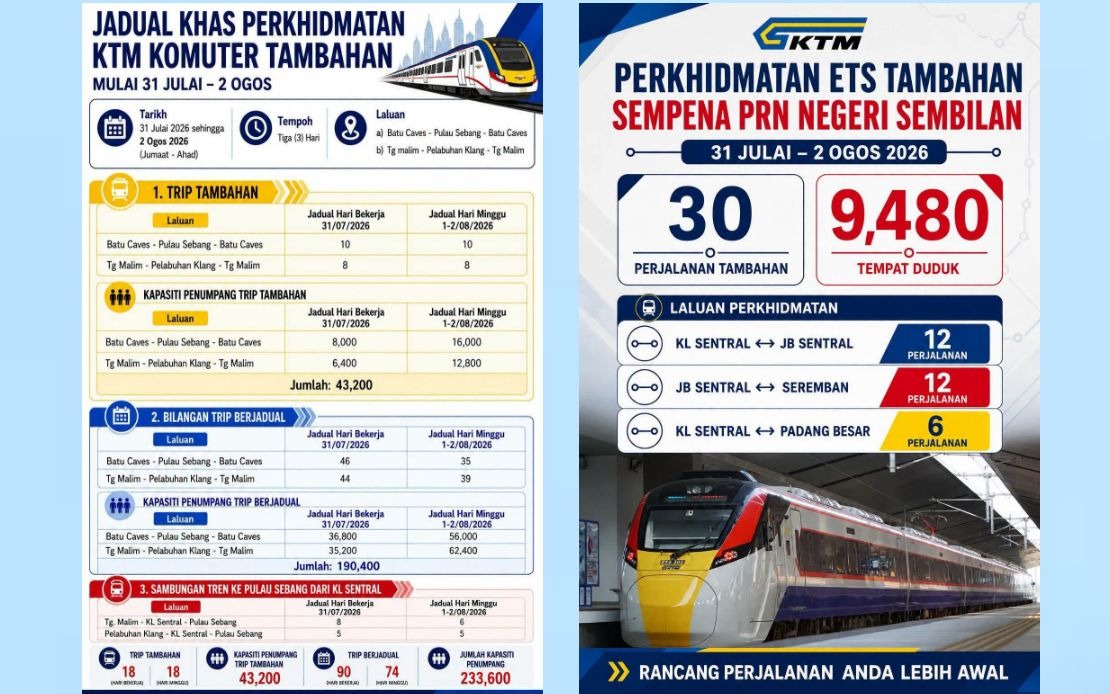
Malaysia's national rail operator, Keretapi Tanah Melayu Berhad (KTMB), is mobilising additional train capacity to facilitate voter movement ahead of the Negeri Sembilan state election scheduled for August 1, 2026. The railway company announced an expanded service schedule spanning July 31 through August 2, designed to manage anticipated passenger surges as registered voters from across the country travel home to cast their ballots. This logistical response reflects the practical challenges posed by electoral cycles in a geographically dispersed nation where many citizens work and study far from their constituencies of residence.
The enhanced Komuter network will see 18 supplementary trips introduced on both the opening day and the weekend period immediately following the poll. These services maintain a weekday operational pattern on Friday, July 31, while weekend schedules govern the Saturday and Sunday frequencies from August 1 to 2. The allocation reflects KTMB's assessment of demand patterns, with ten trips dedicated to the Batu Caves–Pulau Sebang–Batu Caves corridor and eight traversing the Tanjung Malim–Port Klang–Tanjung Malim route. Collectively, the three-day window will accommodate approximately 233,600 passengers, with existing scheduled services providing 190,400 seats and the new additions supplying a further 43,200 capacity.
The Electric Train Services (ETS) expansion proves even more substantial, with KTMB arranging 30 additional trips across three primary corridors. The expansion encompasses twelve trains on the KL Sentral-JB Sentral-KL Sentral route, another twelve connecting JB Sentral-Seremban-JB Sentral, and six services covering the KL Sentral-Padang Besar-KL Sentral link. In aggregate, these supplementary ETS trips provide 9,480 additional seats, predominantly serving the southern and central regions where commuter populations are densest. The Seremban connection proves particularly critical, as Negeri Sembilan's capital remains a focal point for voters travelling from Johor and the greater Kuala Lumpur metropolitan zone.
Specific scheduling details underscore KTMB's operational precision in managing the surge. On the Johor Bahru-Seremban corridor, train EP9636 departs Johor Bahru Sentral at 2.10 pm, arriving in Seremban by 5.15 pm, with the return journey via EP9637 leaving Seremban at 5.45 pm and reaching Johor Bahru by 8.50 pm. Morning options include EP9630 departing Johor Bahru at 6.15 am with a Seremban arrival at 9.20 am, complemented by the EP9633 service departing Seremban at 9.50 am for a midday arrival in Johor Bahru. These carefully staggered departure times allow voters to choose schedules matching their work patterns and personal circumstances, reducing the likelihood of missed trains or overcrowding during peak hours.
The KL Sentral-Johor Bahru routes feature similarly calibrated timing. The morning EX9572 service departs Kuala Lumpur at 7.00 am, reaching Johor Bahru by 11.10 am, whilst the evening EX9578 leaves at 5.30 pm for a 9.40 pm arrival. The return leg offers a mid-morning departure at 11.55 am via EX9575 and an early morning 9.05 am slot on EX9573. For northern travellers, the Padang Besar connection via EP9273 operates at 11.05 am departures with 4.30 pm arrivals in Kuala Lumpur, and the evening return train EP9276 departs the capital at 5.00 pm, reaching Padang Besar by 10.20 pm. This comprehensive schedule architecture ensures that voters from Johor, Kuala Lumpur, Selangor, and Perlis can access Negeri Sembilan within reasonable travel windows.
Infrastructure considerations have shaped the operational planning, with KTMB temporarily suspending maintenance work under the Klang Valley Electric Double Track Infrastructure Facilities Upgrading Project Phase 2 (KVDT2) throughout the three-day election period. This decision prioritises service reliability and safety over scheduled infrastructure improvements, reflecting the operator's assessment that uninterrupted passenger movement takes precedence during significant national events. The temporary halt, whilst incurring project delays, enables smoother train operations by eliminating track works that might otherwise force diversions or speed restrictions.
For Komuter passengers utilising the Tanjung Malim–Port Klang route, KTMB has arranged a simple transfer protocol requiring users to change trains at KL Sentral Station to continue journeys toward Seremban or Pulau Sebang stations. This arrangement, whilst adding complexity to single-line journeys, remains operationally feasible given the multiple daily frequencies at the central interchange hub. Commuters should anticipate modest delays from the additional station stop, though this inconvenience remains preferable to cancelled services.
From a broader perspective, KTMB's election-readiness measures demonstrate how Malaysia's transport infrastructure adapts to civic participation patterns. The rail network's ability to absorb temporary demand spikes relies on advance planning, flexible scheduling, and willingness to defer non-critical maintenance. However, the necessity for such exceptional arrangements annually hints at systemic capacity constraints that may warrant longer-term infrastructure investment. As Malaysia's workforce increasingly disperses across state lines while maintaining electoral ties to hometowns, transport systems face recurring pressure to accommodate migration-driven commuting patterns.
The operation also reflects the practical intersection of electoral democracy and modern mobility. Malaysia's distributed electorate means that genuine participation requires substantial travel time and cost for many voters. KTMB's intervention directly reduces these friction costs, acknowledging that transport accessibility influences voter turnout and democratic engagement. By absorbing surge demand, the railway operator effectively subsidises democratic participation, though passengers must still purchase tickets at standard rates.
Passengers are strongly advised to consult KTMB's official channels for finalised timetables and service confirmations, as operational details remain subject to adjustment based on preliminary booking patterns and any unforeseen circumstances. Early journey planning, particularly for long-distance routes from Johor or Perlis, maximises the likelihood of securing preferred departure slots. The operator's advance notice allows voters ample time to coordinate leave from employment and arrange complementary ground transport in Negeri Sembilan, though some commuters will inevitably face compressed schedules.
The Negeri Sembilan election thus becomes more than a political event—it temporarily reshapes Malaysia's transport landscape, demonstrating both the capacity and the limitations of existing infrastructure when confronted with concentrated demand. Successful implementation of these additional services will validate KTMB's planning assumptions and potentially inform future election-period arrangements, whilst any operational shortcomings may prompt calls for permanent capacity expansions on high-demand corridors serving significant electoral populations.

