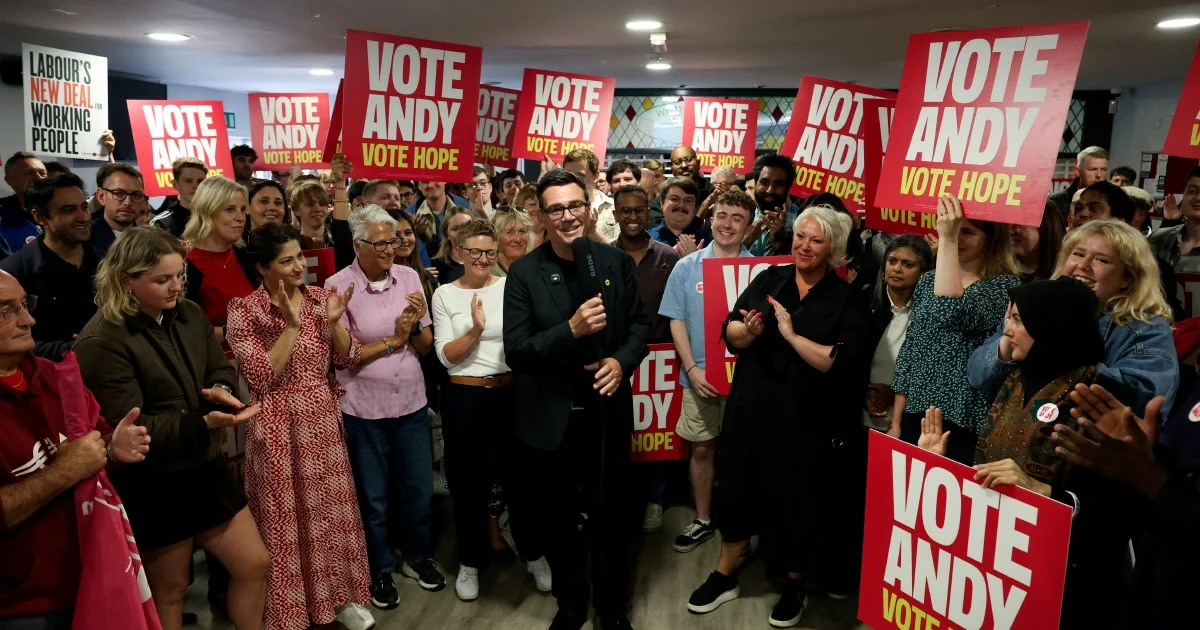
Andy Burnham's campaign to challenge British Prime Minister Keir Starmer for the country's top job has received an unexpected boost from a fractured right-wing political landscape. Should Burnham retain his seat in Thursday's Makerfield election, he will be positioned to mount a serious leadership challenge against Starmer, though victory may owe more to division among centre-right and populist opponents than to his own political standing. The split between the Conservative Party and the insurgent Reform UK movement is proving consequential enough to reshape parliamentary dynamics in ways that favour the Labour frontrunner.
The Makerfield seat represents a crucial stepping stone for Burnham, whose regional prominence and executive experience make him a credible alternative to Starmer among Labour ranks. Success in this traditional working-class constituency would provide the political platform necessary for him to contest against the current prime minister, should an opportunity arise within Labour's hierarchy or through electoral shifts. However, the mechanics of his potential victory reveal deeper fractures within Britain's opposition forces that merit closer scrutiny for anyone tracking the country's political trajectory.
Conservatives and Reform UK, despite their ideological proximity on questions of immigration, sovereignty, and economic nationalism, have emerged as serious competitors for the same voter base. This rivalry has created space for Labour candidates to accumulate majorities without necessarily commanding overwhelming local support. In Makerfield and similar constituencies, the right-wing vote fragmentation means that a relatively unified Labour vote, even if modest in its breadth, can prove sufficient to prevail. This phenomenon has become increasingly pronounced as Reform UK, under leadership that appeals to populist frustrations with traditional conservatism, consolidates its own organisational presence and candidate recruitment efforts.
For Malaysian observers of British politics, this development carries parallels worth noting. Coalition fragmentation among opposition movements, whether in Westminster or elsewhere, frequently determines electoral outcomes in ways disconnected from any single party's genuine popularity. The mechanics of first-past-the-post electoral systems amplify these dynamics, rewarding parties that maintain organisational coherence while punishing those split across multiple organisations competing for overlapping constituencies. In Britain's case, the Conservatives' failure to prevent Reform UK's emergence as a credible alternative has created unintended consequences for their electoral prospects.
Burnham himself represents a particular strand within contemporary Labour politics—rooted in regional governance, commercially pragmatic, and positioned as a compromise figure between the party's ideological wings. His tenure managing major English metropolitan areas has provided him with executive credentials that appeal to Labour members seeking credible alternatives to Starmer, particularly if the prime minister's polling numbers deteriorate. Yet his advancement depends substantially upon structural advantages rather than personal mandate, a reality that shapes how effectively he could govern should his leadership ambitions materialise.
The Conservative-Reform split raises strategic questions for both parties that extend well beyond individual constituencies. The Conservative Party under its current leadership faces pressure to either accommodate Reform UK's policy priorities through cooperation or accept sustained electoral losses to rival vote-splitting. Reform UK, meanwhile, must transform from protest movement to governing alternative—a transition that requires substantive policy development and institutional depth that populist movements frequently lack. Both face incentives to pursue some form of alignment, yet neither can easily accommodate the other without sacrificing core supporters or policy commitments.
For Southeast Asian analysts tracking British political evolution, the right-wing fragmentation occurring in the United Kingdom presents instructive lessons about opposition consolidation and populist movement sustainability. The degree to which traditional conservative parties can absorb or accommodate populist challengers without losing institutional identity remains contested territory across democracies. Britain's experience will likely influence comparable dynamics in other parliamentary systems where right-wing movements challenge established centre-right parties for dominance.
Burnham's pathway to greater prominence thus depends partly upon developments he cannot entirely control—specifically, whether Conservative-Reform divisions persist or narrow before subsequent electoral contests. If the schism proves temporary, with one movement absorbing the other's supporters or negotiating electoral cooperation, then Labour's structural advantages in constituencies like Makerfield may diminish significantly. Conversely, if right-wing fragmentation hardens into permanent party competition, then Labour's relative coherence becomes an increasingly valuable asset in plurality voting systems.
The implications for Starmer's government are ambiguous. While Burnham's success in Makerfield and potential leadership challenge might appear problematic for the prime minister, the underlying causes—right-wing division—actually strengthen Labour's overall parliamentary position. A fractured opposition reduces the likelihood that either Conservative or Reform UK could mount effective unified challenges to Labour's legislative agenda. This dynamic creates space for Labour to govern more independently, even as internal succession anxieties may complicate the prime minister's authority within his own party.
British voters surveying their political options find themselves in a landscape where electoral outcomes increasingly reflect opposition fragmentation rather than clear affirmative mandates for governing parties. Burnham's prospective advancement exemplifies how structural parliamentary mechanics can elevate figures whose personal support bases remain narrower than their political influence. Whether such figure can translate parliamentary success into effective leadership remains a question distinct from their electoral viability—a distinction that British politics, like many democracies, increasingly treats as secondary to the mechanics of victory.