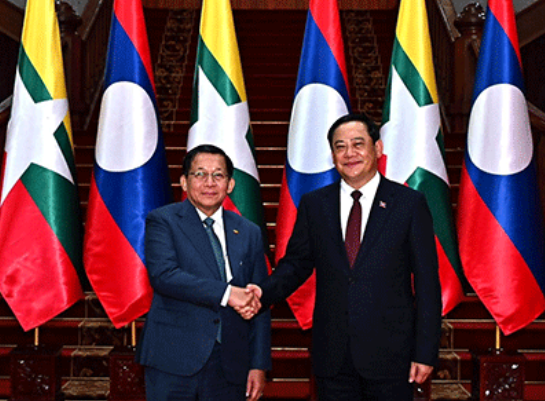
Myanmar President Min Aung Hlaing's three-day state visit to Laos from July 3-5 represents a significant moment for bilateral relations between the two Southeast Asian neighbours, with leaders committing to broaden collaboration across political, security and economic domains. The visit, timed to commemorate the 70th anniversary of formal diplomatic ties, underscores the persistent strategic importance both nations place on their relationship despite the challenges facing Myanmar's regional standing.
President Thongloun Sisoulith extended a formal state welcome at the Presidential Palace, with ceremonies observing full diplomatic honours. The reception signalled Laos's intent to position itself as a steadfast ally to Myanmar's military leadership at a moment when international scrutiny of Myanmar has intensified. For Myanmar's junta-led administration, this visit offered an opportunity to demonstrate that it retains meaningful support within the regional community, particularly among neighbouring states that prioritise non-interference in internal affairs.
The official talks between the two presidents ranged across multiple fronts, with both sides reaffirming their commitment to strengthening what they characterised as "traditional friendship" rooted in shared history and geographic proximity. The dialogue extended beyond ceremonial pleasantries, encompassing substantive discussions on regional security developments and international affairs. Notably, President Thongloun offered congratulations on Myanmar's recent general election and the formation of a new government, effectively endorsing Myanmar's democratic narrative despite international concerns about the legitimacy of electoral processes and governance structures in the country.
Defence and security cooperation emerged as a cornerstone of the bilateral agenda, with both nations agreeing to enhance border security arrangements and intelligence sharing mechanisms. For Laos, which shares an extensive frontier with Myanmar, such arrangements carry practical implications for managing cross-border migration, drug trafficking, and unauthorised movement of persons. The emphasis on border management reflects broader regional concerns about transnational criminal networks and the need for coordinated responses across state boundaries in mainland Southeast Asia.
Economic collaboration featured prominently in discussions, with both leaders endorsing expanded trade and investment frameworks. The signing of a Memorandum of Understanding on tourism cooperation between Laos's Ministry of Culture and Tourism and Myanmar's Ministry of Hotels, Tourism and Culture signals intent to capitalise on growing regional travel demand. Additionally, the establishment of "friendship city" relations between Vientiane and Naypyidaw provides a formal mechanism for deepening urban-level exchanges and people-to-people contacts. These initiatives reflect recognition that tourism and cultural exchange can serve as both economic drivers and confidence-building measures.
Energy cooperation constitutes another significant dimension of the partnership, with both nations exploring opportunities within the Mekong region's developing energy infrastructure. Myanmar's hydroelectric potential and Laos's downstream position on the Mekong create natural complementarities in power generation and distribution. The convergence of interests in energy development aligns with broader regional frameworks like the Greater Mekong Subregion and the Lancang-Mekong Cooperation mechanism, both of which seek to facilitate cross-border infrastructure projects that can enhance connectivity and economic integration.
Parliamentary cooperation received particular attention during talks between President Min Aung Hlaing and National Assembly President Xaysomphone Phomvihane. The emphasis on legislative engagement carries significance for translating high-level political commitments into implemented agreements and monitoring mechanisms. Xaysomphone's reaffirmation that the National Assembly would provide oversight of bilateral memorandums and ensure practical benefits for both populations underscores the importance of institutional frameworks in sustaining long-term cooperation beyond individual leadership tenures.
The visit carried symbolic weight beyond the immediate bilateral context. As the Myanmar leader's first official foreign visit since taking office, the choice of Laos as the inaugural destination reflected strategic calculation about which nations would provide legitimacy and support. Laos, as the first ASEAN member state to receive this visit, thereby signalled regional acceptance of Myanmar's current political arrangement, a position consistent with ASEAN's traditional emphasis on non-interference and consensus-building rather than condemnation.
The humanitarian dimension also formed part of the visit's agenda, evidenced by the handover of snake antivenom serum to Laos's Ministry of Health. While seemingly modest, such medical cooperation addresses practical public health challenges in both countries and demonstrates willingness to engage in functional cooperation that directly benefits civilian populations. Cross-border air pollution emerged as a recognised challenge requiring coordinated action, reflecting growing awareness in Southeast Asia of environmental issues that transcend national boundaries.
The Laos-Myanmar Joint Committee on Bilateral Cooperation was designated as the primary institutional mechanism for sustaining momentum on agreed initiatives. This formalised structure provides continuity between high-level visits and ensures that diplomatic pledges translate into coordinated action by relevant ministries and agencies. Regular meetings of such committees typically involve technical working groups addressing specific sectors, thereby embedding cooperation in bureaucratic practice and institutional memory.
For Malaysia and other ASEAN members, this strengthened Laos-Myanmar partnership carries implications for regional dynamics. The consolidation of ties between two smaller Southeast Asian nations reflects the reality that bilateral relationships continue to matter profoundly in a region where great power competition and varying international alignments create complex geopolitical terrain. Myanmar's cultivation of support among its immediate neighbours provides ballast against international isolation, while Laos benefits from enhanced security cooperation and economic opportunities.
The state visit also illustrated how ASEAN members navigate the challenge of maintaining solidarity with Myanmar while managing international pressure regarding governance and human rights concerns. Laos's approach—emphasising traditional friendship and regional cooperation frameworks while avoiding direct engagement with governance questions—represents a pragmatic balancing act common among ASEAN nations committed to the principle of non-interference yet aware of regional security interdependencies.
Moving forward, the success of bilateral cooperation will depend on effective implementation of signed agreements and sustained political commitment from both leaderships. The scheduled visits to Luang Prabang and cultural landmarks provided opportunities for softer forms of engagement that complement formal political and security dialogues, fostering the people-to-people connections that underpin stable interstate relations in mainland Southeast Asia.

