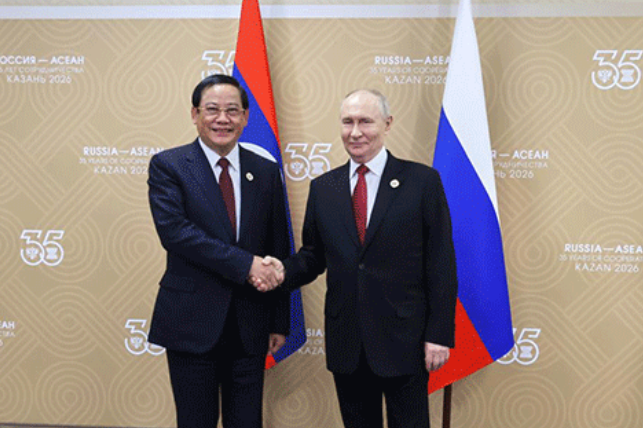
Prime Minister Sonexay Siphandone and Russian President Vladimir Putin have reaffirmed their nations' enduring commitment to strengthening bilateral relations during talks held at the Russia-Association of Southeast Asian Nations Summit in Kazan. The meeting represents a significant moment for Laos-Russia ties, coming as the Lao premier concluded his inaugural official visit to Russia following his appointment to office. Taking place from June 14-17 at the invitation of Russian Prime Minister Mikhail Mishustin, the visit sought to deepen a partnership that has historically centred on principles of friendship and mutual respect.
The centerpiece of the diplomatic engagement was the signing of an intergovernmental agreement on cooperation in the peaceful use of nuclear energy—a landmark development that signals Moscow's confidence in Vientiane's commitment to contemporary energy solutions. President Putin characterised this accord as a significant achievement, underlining that it establishes the foundational legal framework necessary for constructing a small nuclear power plant utilising Russian technology within Laos. For Southeast Asia, where energy demands continue to rise alongside economic development, such cooperation reflects broader regional trends toward diversifying power generation sources beyond hydroelectricity and coal.
During their bilateral conversation, President Putin stressed Russia's high valuation of its relationship with Laos, emphasising the bedrock principles of friendship, mutual respect, and balanced consideration of each nation's strategic interests. The Russian president also acknowledged Laos's instrumental role in facilitating expanded cooperation between Moscow and the ten-member ASEAN bloc, noting that 2026 will mark the 35th anniversary of formal relations between Russia and the regional grouping. This framing positions Laos as a crucial diplomatic intermediary for Russia within Southeast Asia—a role that carries particular weight given shifting geopolitical alignments in the region.
Moscow demonstrated appreciation for Laos's symbolic gestures of solidarity, including President Thongloun Sisoulith's attendance at Russia's Victory Day celebrations in May and Laos's deployment of military personnel to participate in Moscow's 80th anniversary parade commemorating Soviet victory in World War II. These acts transcend ceremonial protocol; they represent meaningful alignment on historical narratives and geopolitical positioning. For Malaysian observers, such military-cultural exchanges underscore how Southeast Asian nations are navigating great power competition through carefully calibrated diplomatic gestures that acknowledge historical relationships without foreclosing other partnerships.
The bilateral agenda encompasses a comprehensive range of cooperation domains extending well beyond defence and security. Both nations committed to expanding collaboration in energy, industrial development, agriculture, mining operations, digital economy initiatives, banking services, transportation infrastructure, tourism promotion, and educational exchange. This sectoral breadth reflects a matured partnership that transcends Cold War-era paradigms focused primarily on military cooperation. The emphasis on technological and educational dimensions signals Laos's effort to modernise its economy through Russian expertise and capital, particularly in sectors where Russia possesses competitive advantages.
Prime Minister Sonexay's separate engagement with Russian Premier Mikhail Mishustin reinforced the multilayered nature of the bilateral relationship. Both officials highlighted their mutual appreciation for expanding cooperation rooted in trust and reciprocal support. Notably, the Lao premier extended gratitude to the Russian government for sustained assistance in human resource development, with particular emphasis on the consistent provision of annual scholarships and professional training opportunities for Lao nationals, including government officials. This educational dimension often receives less media attention than military or energy partnerships, yet it represents perhaps the most consequential long-term investment in bilateral relations, as it shapes the institutional capacity and policy orientations of future Lao leadership cadres.
The construction of the Laos-Russia Friendship School in Vientiane, which both governments reported nearing completion, exemplifies this commitment to deepening societal-level connections. Educational infrastructure projects create sustained interaction channels between populations and institutional networks that can outlast shifts in individual leadership or geopolitical circumstances. For Malaysia and other ASEAN members observing these developments, such educational investments signal Russia's intent to maintain meaningful engagement with Southeast Asia despite international sanctions and strategic competition with Western powers.
Prime Minister Sonexay's address to a Laos-Russia business forum during his Kazan visit underscores an additional pillar of bilateral engagement: commercial cooperation. By hosting a dedicated forum to facilitate trade and investment partnerships, both governments sought to translate political goodwill into tangible economic transactions. For Lao entrepreneurs and Russian investors, such forums provide structured opportunities to identify mutually beneficial commercial ventures across manufacturing, resource extraction, and service sectors. The success of these business-level engagements will largely determine whether the political partnership translates into sustainable prosperity for Lao citizens.
An apparently minor yet symbolically resonant element of the visit involved Prime Minister Sonexay's presiding over the transfer of two elephants to the Kazan Zoo. These creatures, gifted by President Thongloun and the Lao people to commemorate the 65th anniversary of diplomatic relations and Russia Day, represent a distinctly Southeast Asian gesture of friendship that leverages Laos's renowned wildlife heritage. Such cultural diplomacy humanises bilateral relationships and creates positive public sentiment in Russia toward Laos, potentially generating broader support within Russian society for sustained engagement with the Southeast Asian nation.
The timing and location of these discussions—during a major Russia-ASEAN summit—carries implications extending beyond bilateral Laos-Russia dimensions. By prominently featuring Laos-Russia engagement within this multilateral framework, both governments signalled that their partnership strengthens rather than contradicts ASEAN unity. For Malaysia and other members, this positioning matters significantly for regional cohesion, as it suggests that bilateral great power partnerships need not undermine the consensus-driven ASEAN process. The 35-year trajectory of Russia-ASEAN relations, which both officials referenced, indicates that Moscow has established itself as a persistent regional player unlikely to diminish engagement despite Western pressure.
The nuclear energy agreement warrants particular scrutiny from a Southeast Asian perspective. As nations in the region contemplate long-term energy security amid climate concerns and rising electricity demand, the Laos-Russia nuclear accord may catalyse broader regional interest in Russian nuclear technology. However, proliferation concerns, safety standards compliance, and the political dimensions of relying on Russian expertise for critical infrastructure remain considerations that Malaysia and other capitals must evaluate carefully as they assess their own energy portfolios.
Moving forward, the substantive expansion of cooperation across energy, education, commerce, and technological domains suggests that Laos-Russia relations will deepen incrementally rather than dramatically. The visit culminated a sequence of diplomatic engagements that have steadily reinforced Moscow's position in Laos and, by extension, within Southeast Asia more broadly. For regional observers, the trajectory indicates that Russia intends to maintain strategic presence in the region through diversified partnership mechanisms that appeal to Southeast Asian governments' desire for non-aligned positioning and economic diversification in a multipolar international system.

